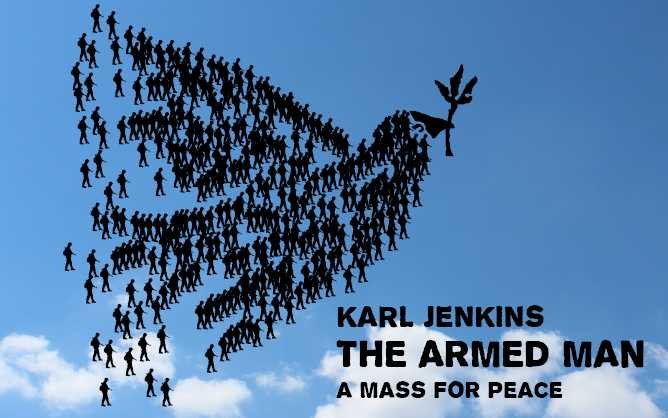
“A Mass for Peace” in Memory of the Victims of the War in Kosovo —
Eda Zari reflects on Karl Jenkins’s The Armed Man: A Mass for Peace, its dedication to victims of the Kosovo war, its multicultural musical language and its message against war.
When a foreigner helps heal our wound through sound.
“A Mass for Peace” in memory of the victims of the war in Kosovo.
During the catastrophe, terror and tragic events of the war in Kosovo, Welsh composer Karl Jenkins wrote The Armed Man: A Mass for Peace.
The work was premiered in 2000 as a tribute to the victims of the Kosovo war.
Across the centuries, war has preoccupied generations of composers and artists.
Of course we too have songs and works dedicated to war heroes.
But do we have a mass — a monumental work of this multicultural scale — reflecting on the devastating consequences war brings to human beings, animals, water and land?
Do we have an act of large-scale healing emerging from our own artistic imagination?
Our Kosovar sisters and brothers still carry the human catastrophe, shock and terror of that war close to the surface.
War is the recurring shadow hanging over our world, whether we think of Vietnam, Hiroshima, Iraq or the more recent civil war in Syria.
We remember in order not to forget, but also to protect a pain that Kosovo is too often expected to forget.
During my tour that summer I had the opportunity to meet a colleague from the Sarajevo Philharmonic.
In that beautiful routine and privilege that follows a successful concert, we immersed ourselves in our musical preferences and in the many composers who nourish us and keep alive our desire to create meaningful work.
After he mentioned my album Entropy, our conversation remained in the territory of requiems. I then told him that I had once sung as a soloist in Leonard Bernstein’s Mass.
In that context, using his phone, he reminded me of Karl Jenkins’s mass, so intensely charged with musical cultures and subcultures.
Like Benjamin Britten’s War Requiem, this work places an anti-war statement within the framework of the Catholic Mass.
Alongside the familiar elements Kyrie, Sanctus, Agnus Dei and Benedictus, Jenkins uses texts by several authors, including Swift, Kipling, Tōge Sankichi and Dryden.
The work becomes a reflection on the way war begins and gradually carves out its own bed.
A distinctive feature is the diversity of cultural influences shaping the whole.
The second movement contains the call to prayer of a muezzin, while the movement “Torches” draws textual material from the Indian Mahabharata.
The work is a story filled with hope and despair.
It bears witness to war and peace, and experiences both conflict and the reluctant human accommodation to destruction when that destruction comes unbearably close.
At the beginning, footsteps are heard, faintly approaching from the distance.
For a moment I thought I was hearing the crackle of an old gramophone record damaged by scratches.
A solitary drum can be heard from a distance one cannot quite name.
More than sixty singers move through the church.
You are seized by the sense that the armed man is someone to fear; everything warns you.
At first the warning is quiet, but the fear is later intensified by a disturbing fugato conveying a sense of immediate danger.
The instruments — flutes, drums and brass — begin to embody the unstoppable catastrophe approaching.
The muezzin’s call to prayer carries me for several minutes into an Eastern distance.
Then comes the Kyrie, where the soprano and finally the full choir ask God for mercy.
The tragic beauty hurts down to the bone because nothing seems capable of stopping the disaster.
The desperate plea of a solitary man — “Save me from bloody men” — is interrupted by an explosion.
Perhaps the first bomb.
Karl Jenkins builds the finale around a concluding pastoral chorale, full of humility, guilt and spiritual fracture.
Simple, yet extraordinarily effective, is the faith and hope that peace alone stands above violence:
“God shall wipe away all tears.”
Praise the Lord.
Better peace than war.
How much I would have wished — and how rightly proud I would feel — if a work of this scale had come from one of our own composers of “serious” music.
All rights reserved. Eda Zari Kotor, 14 July 2021
CONTINUE READING →