Kosovo Outside Eurovision: Geneva’s “Customs Gates”.
A cultural-diplomacy essay on Kosovo’s exclusion from the Eurovision Song Contest, examining EBU membership rules, soft power, nation branding, institutional double standards and the gap between cultural belonging and bureaucratic recognition.
The Technical Paradox, Aesthetic Colonialism and Geopolitics in the EBU
Field: Cultural Diplomacy / International Relations
“Kultur ist nur das, was es nie hinnimmt, beiseite zu bleiben, wo man es nicht einlässt.”
“Culture is precisely that which never accepts remaining on the sidelines where it is not allowed to enter.” — Theodor W. Adorno (1)
Abstract
This article examines the sharp asymmetry between Europe’s cultural spirit and the institutional machinery of the European order, taking as a case study Kosovo’s persistent efforts to participate in the Eurovision Song Contest (ESC). Through a deconstruction of recent cases, such as the possibility of Kazakhstan being invited (2), the essay considers how membership standards reflect power dynamics and geopolitical entanglements in the Western Balkans.
The article argues that while Albanian artists have achieved a de facto integration into the bloodstream of global culture, institutions remain hostage to a frozen bureaucracy. It proposes that Eurovision has never been merely a song festival, but a major platform of “soft power” (Nye, 2004) (3), where states perform their European identity. For countries in the region, appearing on this stage is an act of “nation branding” (Anholt, 2007) (4). Yet for Kosovo that stage remains a horizon kept out of reach, creating an ontological paradox: a country that exports some of the world’s biggest pop stars is barred from the screen of the European Broadcasting Union (EBU).
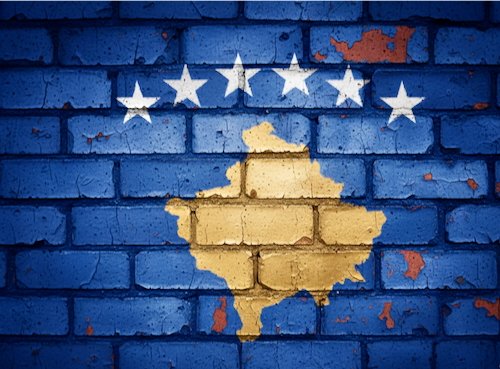
Kosovo’s flag as a “graphic error”?
What law of political physics permits the voices of Dua Lipa or Rita Ora to fill the speakers of Berlin, Paris, London, Rio, São Paulo, Singapore, Jakarta, Tokyo, Kuala Lumpur, Seoul and elsewhere, while the flag of their country is treated as a “graphic error” that cannot appear on screen?
Here we encounter what we might call the politics of culture through art. Art, at its core, is the act of making visible. If a nation produces art that Europe consumes, yet is not permitted to represent itself in Europe’s cultural institutions, are we not witnessing a modern form of aesthetic colonialism?
For me as an artist, the essential question is never whether I am “right” or “wrong” in my judgment of the continent in which I live and create. My utopian desire has always been to belong to that space in which thought flows freely and to that spiritual process that makes one part of a whole. George Steiner called this an “invitation to meaning” (5).
For me, this continent is neither an old museum nor an Excel spreadsheet of dates and figures, but an ontological home. The mark I carry begins with my refusal to see Europe as a frozen administrative map. I see it as a nervous system and a spiritual topography in which music is organically intertwined, without requiring stamps from counters or bureaucratic travel permits.
In 1956, Marcel Bezençon (6) was not thinking about broadcasting contracts or resonance zones. In a Europe whose walls were still blackened by war, he imagined the festival as an antidote to nationalism — a utopia in which radio waves might pierce what diplomacy had tangled. It was the mission of a family that did not ask for passports.
Today, however, his successors in the EBU behave like stern custodians of a museum, more concerned with the dust on regulations than with the value of the paintings. When Australia can be invited as an honoured guest while Kosovo is asked for a “birth certificate” from the ITU, one realizes that Bezençon’s vision has been reduced to the mentality of a warehouse inventory.
Why, then, does this “house” of cultures have thresholds that cannot be crossed?
Article 3.3 (7) of the EBU Statutes has become a fault line where art yields to geopolitics. By making membership contingent on the ITU — a UN agency in which the Russian veto can weigh more than talent — the EBU has constructed an architecture of exclusion that betrays its original mission.
This is the frozen paradox: an association that presents itself as “apolitical” has tied its fate to some of the most rigid mechanisms of global governance.
The interpretation of this article remains selective. If, in 1950, the EBU found flexibility for broadcasters in Morocco or Tunisia before those countries had achieved full independence, today the law is read for Kosovo only in its punitive form. This technical fortification becomes a bureaucratic alibi for avoiding visionary courage, turning a regulation about radio waves into an ideological obstacle.
In music, dissonance is a tension that demands resolution. At the EBU, however, it remains a cacophony — one I saw manifest itself in full force behind the scenes of the great stage.
As a representative of the Albanian delegation at Eurovision in 2011, in Düsseldorf, where I live, I saw how music completes de facto integration long before diplomacy does. But I also saw the essence of this absurdity: heads of delegations, trapped by the dictates of institutions on paper, turned the festival’s points into geopolitical tokens. In their hands, the vote did not evaluate the song; it ratified the next alliance.
This institutional dictate undermines the festival’s mission of peace and turns voting into an ordinary act of political reciprocity.
In this theatre, Kosovo’s case demonstrates that a “Berlin Wall” in art has still not fallen.
Can the EBU truly claim neutrality while playing hide-and-seek with its own rules? When Kazakhstan or Australia is concerned, the “letter of the law” becomes flexible enough for special invitations; for Kosovo — at the heart of Europe — it remains frozen in place.
At that point, the issue is no longer technical but principled.
What weighs more: an administrative right to manage frequencies, or the universal right to communicate through art?
Kosovo — Board of Peace, 22 January 2026
President Osmani’s readiness for Kosovo to become part of the “Board of Peace” (8) proposed by Donald Trump — a structure that seeks to address global conflicts outside traditional frameworks — signals a willingness to be a co-author at the tables where the world order is being rewritten.
This, for me, is the supreme irony: Kosovo demonstrates maturity to become part of a board that challenges the global security architecture, yet remains excluded from a song contest because of a regulation tied to a frozen system that the major powers themselves are already bypassing.
Since 2023, RTK has entered an ambitious “training” phase by organizing a festival intended to become Kosovo’s gateway to Eurovision. Although the first edition, with La Fazani, demonstrated production maturity, Geneva, in the author’s view, remained deaf; even the 2024 budget of €350,000 was not enough to break through the fence of Basel 2025.
Here the paradox reveals itself again. RTK is building its muscles for a competition in which it is still not allowed onto the track.
As Florent Boshnjaku has also observed, the problem is not the microphone but diplomacy. The festival remains a rehearsal suspended in mid-air, where artistic success collides with the “political position” — a battle against windmills in which state lobbying weighs more heavily than the song itself.
Yet the criteria in Article 3.3 (9) do not end with ITU frequencies; they require the broadcaster to demonstrate an almost total “national character”, covering 98% of households. RTK, equipped with Japanese technology through JICA and digitized newsrooms, has fulfilled this technical quota, yet remains, in the author’s account, hostage to editorial scepticism.
Geneva, as this essay argues, uses the financial-stability crises of 2024–2025 as a reason not to recognize technological progress. And here another paradox appears from the beginning: RTK is expected to function like a Swiss institution in the middle of a Balkan transition, transforming a technical standard into an instrument of political pressure.
This dissonance between technological readiness and bureaucratic refusal reaches its most absurd — almost Kafkaesque — form in official correspondence.
The letter RTK (10) sent to Martin Österdahl on 6 June 2024, signed by director Shkumbin Ahmetxhekaj, asks for nothing more than the application of a simple logic: an invitation based on the precedent established with Australia.
At precisely this point, RTK behaves like an excellent student reminding an ageing teacher of the rules that the teacher himself invented for “inclusion”.
In this game of hide-and-seek with standards, the absurd becomes geographical. While Australia is allowed to cross oceans for one song on the stage, Kosovo is required to cross chasms of bureaucracy to reach its neighbour.
Ultimately, we are knocking on a door that does not remain closed because we lack the key, but because the caretaker inside seems to have forgotten his original function.
This is not a technical deadlock but a drama of exclusion, in the author’s formulation — a stage on which stars such as Lipa and Ora are allowed to entertain Europe, while their country of origin is forbidden from sitting at the table of this “family”.
The paradox is now complete: our artists are already “inside”, while their flag remains hostage to a bureaucracy that, in this reading, has lost touch with the necessary Zeitgeist.
As pianist Elena Bashkirova has said: “Such restrictions on artistic freedom are customary only in dictatorships.” (11)
If we listen carefully to Bashkirova, we hear not merely an artistic protest, but a diagnosis of what I would call the “institutionalized cowardice” of our modern Europe.
The question Bashkirova poses — and which burns all of us — is this: Does art have a political mandate?
The answer is an emphatic “No”, but with a great “And yet” after it.
The problem with institutions such as the EBU in Kosovo’s case is that they are turning artistic freedom from an active value into a protective clause for themselves. When fear of geopolitics becomes the compass of a song festival, we are not protecting regulations; we are destroying what I call the ecology of Europe’s cultural spirit.
But does our time require courage?
Of course it does. We need only turn our heads toward the Christmas celebrations of 1989 in Berlin.
Leonard Bernstein, in an act that transcended strict convention, altered the text of Beethoven’s Ninth Symphony: he transformed the “Ode to Joy” (Ode an die Freude) into an “Ode to Freedom” (Ode an die Freiheit) (12). He solemnly declared: “I am sure Beethoven would have given us his blessing.”
If Bernstein could make a symphony speak against walls, the EBU is preserving them with a regulation.
The point is that when one reads Article 13 of the EU Charter carefully (13), one understands that artistic freedom is not a gift handed out by institutions with a ration coupon; it is a right that belongs to us — written there in black and white.
And here the paradox raises its head once more: while the law says that art is free, EBU bureaucrats slide the bolt across the door and hide behind technical ITU regulations that resemble warehouse inventories more than European values.
Artists, however, no longer intend to wait for an invitation at the threshold. The time has come to take these laws out of our pockets and place them on the table.
Article 10 of the Convention (14) states that expression knows no frontiers, full stop.
Jurist Christoph Möllers (15) reminds us when he writes: “The state may control the purse, but it cannot control the microphone.”
When institutions hide behind “political fear” to keep Kosovo outside, they are not defending the law; they are defending, in this reading, their own fear of freedom.
As if the arguments above were not enough, a further confirmation comes from German academia.
At the end of 2019, the University of Konstanz, through the major SFB 484 project, concluded a thirteen-year research chapter on what it called the “Cultural Foundations of Integration” (16). Nearly five hundred scholars reached the conclusion that integration is not a file closed with a signature in Geneva or at the ITU, but a living process of exchange that requires freedom, not frozen regulation.
Here, for the author, the institutions’ final alibi collapses.
While the Europe of thinkers — the Europe of Konstanz and the DFG, the German Research Foundation — invests millions to say that culture is what holds us together, the Europe of screens is doing the opposite: using technology to divide us.
As an artist who believes in the “productive exchange” described by the Konstanz report, I see our mission not as a plea for admission, but as a continuation of that tradition.
We carry out de facto integration every day, in every concert, every square, every club and every café, leaving institutions to busy themselves with their rusting locks.
In every attempt to analyse the integration of the Balkans, we must accept that we are operating in a territory where truths are never absolute. And that is the beauty of the process...
Ultimately, music and art are not waiting to enter Europe — they are the “house” in which Europe lives, even when officials forget to pay the electricity bill.
In 1982, when Nicole stepped onto the Eurovision stage with a guitar that seemed larger than she was, I was only ten years old.
For a little girl in Albania in those years, her voice was not merely a musical medium; it was a vessel carrying the spirit toward the great stages of the world, which existed only in the imagination.
With “Ein bisschen Frieden” — “A Little Peace” (17) — Nicole was not presenting a legal document for peace. She was launching a spiritual hypothesis into the midst of a divided continent. It was an act that lacked the precision of an equation but possessed the power of an idea daring to be fragile.
But for that image to reach our living room, a real operation of improvisation and tricks was required — an act of love that today resembles the absurd, poetic scenes of Emir Kusturica’s films, where people fly after their dreams over the roofs of grey apartment blocks.
We watched the ESC festivals on Rai Uno in complete secrecy.
I remember my brother Agim, four floors above me on the roof of our building at the 21 Dhjetori intersection in Tirana, hanging his head down and asking me for a signal: was the picture coming in?
From the first-floor window I signalled with my hands: “Yes — now I’ve got it!”
He turned the antenna as if searching for the frequencies of freedom. And in that instant, when the noisy strip across the television screen disappeared and Rai Uno or the Zagreb station appeared, with those sparkling Eurovision stars, we were not simply watching a song contest.
We were holding a dream by the hand.
It was not merely a technical operation; it was an almost biological attempt to breathe outside the cage.
For us Albanians, turning the antenna — “catching the signal” — became a refusal of isolation. It was proof of a spirit that always finds a way to strike at the impossible.
Music is the language that needs no imperial decree to cross a border, even when that border was armoured with wire, bunkers and checkpoints — there where my brother lost his life.
Eurovision as ritual and “necessary evil”
To avoid falling into the trap of subjective interpretation, it is worth hearing how Dr Irving Benoît Wolther (18) defines the true nature of this organism.
He does not hesitate to call the festival a “necessary evil”, a format that EBU leaders themselves in the 1990s wanted to get rid of but could not, because its name had become inseparable from their own institutional existence.
For Wolther, the ESC is not simply a television programme, but a “lived tradition, rather like Easter”.
He explains that its success does not come from market rules, but from:
“...childhood memories of family evenings in front of the television, from a cultural proximity that has grown over centuries, but also from the antagonisms between participating countries... all of this cannot be reduced to a format.”
It is precisely this organic and historical nature that, according to him, makes the project impossible for Americans or Asians simply to copy. Attempts such as the “American Song Contest” fail because they lack what Wolther calls the “European spirit” — a painful and beautiful mixture of history, geopolitical paradoxes and collective memory.
What each of us should think when confronted with a definition that oscillates between “necessary evil” and “a ritual like Easter” is for each person to judge.
But for us Albanians, who have always watched this festival through the sincere eyes of a child searching for light beyond isolation, the question remains:
Can an institution be a “European Easter” while keeping the door closed to a member of the family?
If this festival truly has a spirit that cannot be copied, then we choose to stand on the side of that spirit — where Bezençon believed music could break through every technocratic bunker.
This article is not merely asking for a vote or for participation. It is asking Europe not to forget its original mission: to be the signal itself that connects people, regardless of how high or low they stand on the political rooftop.
We have done our part — we have kept the antenna pointed in the right direction for decades.
It is Europe’s turn to see whether the signal of its values is still being transmitted, or whether what remains is merely a coloured test card designed to deceive those viewers left outside.
“Whoever thinks does not carry resentment”
We must, of course, take the question out of critical podcasts — out of our own rooms — and set it against the glass façades of Brussels:
Why does Europe’s “code” fail so miserably the moment it reaches Kosovo’s borders?
As Hannah Arendt observed, “Wer denkt, ist nicht wütend” (19) — whoever thinks is not angry.
Thinking is, above all, an act of clarification: it strips anger of affect and turns it into awareness.
If we want this reflection not to remain a purely discursive exercise, we need to understand that our “antenna” no longer receives the signal.
We think without resentment, but with a long list of unfinished work waiting on both sides of the curtain.
Europe must understand that technical criteria, by themselves, are not European values.
An intermediate status should be created for states that are de facto part of European cultural life.
Kosovo’s institutions, meanwhile, must stop communicating as victims of bureaucracy and begin behaving as custodians of a culture that Europe already consumes — one need only look at the success of our artists around the world.
A legal and technical infrastructure should be built around RTK that does not beg for admission, but makes exclusion look like a logical absurdity.
Investment must be made in cultural diplomacy, not as political lobbying, but as an aesthetic intervention.
The EU should see Kosovo at Eurovision as a success story of its peace project.
Every year Kosovo remains outside is another year in which Europe demonstrates that its house still has windows boarded shut.
Integration is not an official act stamped in a fluorescent-lit office; it is a process of recovering political and cultural sensibility.
Until Eurovision dares to become whole, it will never be a mirror of Europe, but only a broken mirror reflecting what we say we want to be, yet do not dare become.
We will continue to keep the antenna pointed in the right direction — not because we cannot “catch” their signal, but because their deafness, as we experience it, wounds us.
© 2026 Eda Zari. All rights reserved.
Note: This paper forms part of the KULT 360 Foundation’s study programme on Cultural Diplomacy. Our purpose remains the deconstruction of institutional walls through the power of research and art, transforming Kosovo’s blockade into a debate about European cultural rights.
References
Adorno, T. W. (1970). Ästhetische Theorie. Frankfurt am Main: Suhrkamp. (The quotation underlines culture’s ontological resistance to institutional exclusion.)
Rick (2025, 14 July). Debüt zum 70-jährigen Jubiläum? Kasachstan könnte zum ESC 2026 eingeladen werden. ESC-Kompakt.
Metz, M. & Seeßlen, G. (2022, 11 September). “Soft Power” — Weiche Macht: Die Krise des Konzepts. Deutschlandfunk.
Dinnie, K. (2008). Nation Branding: Concepts, Issues, Practice. Butterworth-Heinemann.
Steiner, G. (2004). The Idea of Europe. Amsterdam: Nexus Institute. (For an exploration of George Steiner’s concept of “invitation” and intellectual hospitality.)
Die Entstehung und Entwicklung des ESC. [The Origin and Development of the ESC]. Europa-Blog, Universität Bremen.
European Broadcasting Union (EBU). Statutes of the European Broadcasting Union. Updated edition. Article 3.3, pp. 6–7.
Kelmendi, G. (2026, 23 January). Osmani: “Besoj në udhëheqjen e presidentit Trump për të sjellë paqe”. RTKlive.
European Broadcasting Union. (2023). EBU Statutory Documents: Statutes of the EBU. Article 3.3 specifies the requirements for active membership and the connection with the International Telecommunication Union (ITU). Official document.
Telegrafi.com (2024). RTK aplikon që Kosova të marrë pjesë në Eurovision 2025.
Landfried, C. (2024). Kunst und Politik [Art and Politics]. Verfassungsblog.
Hochschule für Musik Franz Liszt Weimar. Beethoven-Rezeption: “Ode an die Freiheit” [Beethoven Reception: “Ode to Freedom”].
EUR-Lex. Charter of Fundamental Rights of the European Union. Article 13: Freedom of the Arts and Sciences. Official Journal of the European Union (2012/C 326/02).
Council of Europe. European Convention on Human Rights, Article 10: Freedom of Expression.
Möllers, C. (2014). Das Grundrecht der Kunstfreiheit. Frankfurt am Main: Suhrkamp. See also his analysis of the autonomy of art in relation to the state and public institutions.
Universität Konstanz / DFG. Sonderforschungsbereich 484: Kulturtheoretische Grundlagen der Integration.
Nicole. Ein bisschen Frieden. Winner of the Eurovision Song Contest 1982.
Wolther, I. B. (2004). “Ein bisschen Frieden”: Der Eurovision Song Contest als europäisches Ritual. Heinrich-Böll-Stiftung.
Arendt, H. Denktagebuch (1950–1973). This reflection on the relationship between thinking and anger is widely discussed in scholarship on the “Arendt year” and the process of political judgment.
CONTINUE READING →