Our Collective Memory — No More Qofte by the Train.
A personal essay on the demolished Tirana railway station, childhood train journeys, forced labour, urban memory and the responsibility to preserve material evidence of Albania’s difficult twentieth-century history.
To put it bluntly:
there is no longer a railway station in our Tirana.
What is this?
A delirious urge to lay pseudo-traces over the traces that are already there?
What resentment do decision-makers have toward places in which so many of us still carry one, two, perhaps many stories carried in the soul — personal episodes that continue to wander along a platform, between columns and rails, like a wise old spirit?
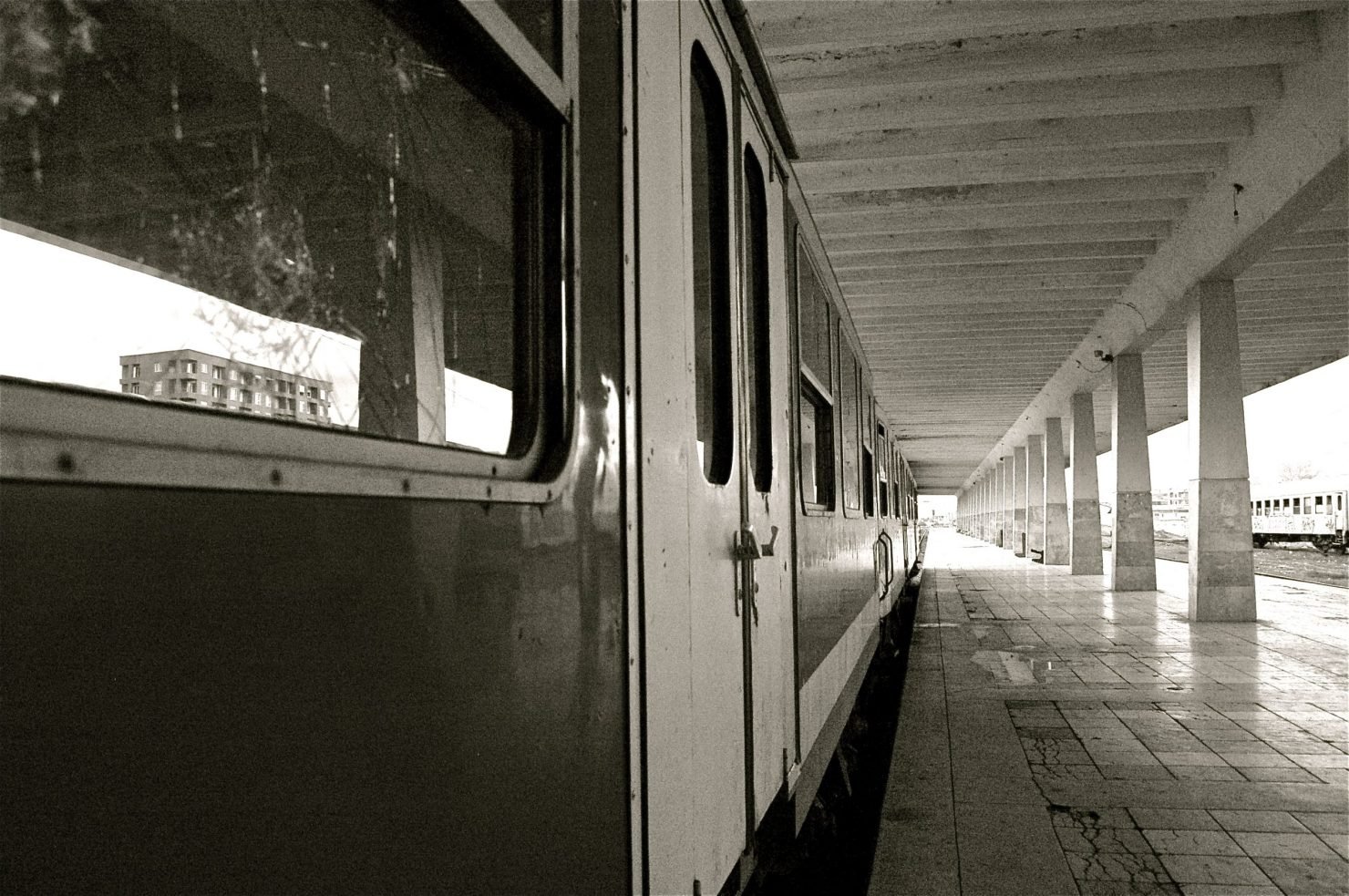
© Photography by Eda Zari. Tirana railway station, 2012.
I am not drifting into mysticism.
I am simply saddened by the thought that very soon Tirana may have lost too many of those beautiful old pockets of social and cultural life where people had, over time, built monuments out of their own memories.
I think of the disappearance of the famous Café Kursaal in central Tirana, where the Albanian elite once had a refuge of its own.
Tirana railway station had become almost a shared waqf for everyone — a kind of common endowment, belonging in memory to everyone without distinction.
People made pilgrimages there, each with their own rituals.
I reread the approved decision to demolish the railway station in Tirana and the same bitterness rises again.
I felt something similar when, some time ago, I heard rumours — may they never come true — that the battered Pyramid beside the boulevard might also be demolished.
Are these the signs of Tirana’s apocalypse?
Someone will say, and someone already has:
“Oh please, it was no architectural miracle. The station was only sixty-four years old — and between us, don’t make me talk about the smell of urine in those stairs and corners.”
Fine, brother.
But when your honour had not yet seen daylight, and your older brother was still chasing the cat with a spoon — in other words, when you lived beyond seven mountains, streams and caves and had never set foot in Tirana — some 29,000 men and women were grinding down their bones so that the railway could reach that station.
And what do you say to that?
They did it almost entirely by hand, man.
During breaks some of them were taught the alphabet, they were given a piece of bread, and then — off again toward Qafë Krrabë.
Nobody dared raise a voice.
The first punishment might have been a public denunciation sheet, and you can imagine what might come afterward.
Think for a moment about the monumental value of that labour in collective memory — not simply the architecture.
The railway and Tirana station should be treated as material witnesses to a period burdened by dictatorship.
Painfully, I would call part of that history an Albanian version of the logic behind the words Arbeit macht frei, whether we like the comparison or not.
© Photo by Eda Zari. Dachau concentration camp, Bavaria, 2016.
Here I make a deliberate parallel with the Dachau concentration camp, which I have visited personally.
The first permanent concentration camp established by the National Socialists carried the slogan “Arbeit macht frei” — “Work makes you free” — formed in iron letters and placed in the iron gate at the main entrance.
Dachau, near Munich, opened on 22 March 1933, less than two months after Hitler came to power.
Another slogan painted on the roof of the main building at Dachau quoted Heinrich Himmler, then chief of the Munich police and later head of the Gestapo and Reichsführer-SS.
It presented a path toward freedom through obedience, diligence, honesty, order, cleanliness, sobriety, truthfulness, sacrifice and love of the fatherland.
The Dachau memorial preserves authenticity because only material remnants whose authenticity cannot reasonably be doubted can protect historical truth against denial.
The farther genocide recedes into the past, the greater the danger of relativization and denial.
Authenticity is a powerful shield in the service of truth.
© Eda Zari.
The Albanian dictatorship used similarly exalted language toward the generation that built railways, roads, terraces and major public works without ordinary payment, under the pseudo-voluntary labour system.
That generation was obliged to sacrifice youth, health and self to an Idea imposed from above.
Many objects connected with that history remained part of our past and are now deliberately left to disappear.
Forgetting becomes a second negligence toward the lost youth of a generation — a generation to whom, for all their suffering, we owe gratitude.
Anyone with a healthy view of history — putting nostalgia aside, or what I would rather call the threads of life — and looking at things with some distance, as Germany, the United States, France, Italy and others often do, might say:
New plans? Of course.
Let Tirana become a worthy metropolis.
Let it expand and stretch as far as it needs, because the population has grown and the city must breathe.
I agree.
But beans need their salt — and salt needs measure.
One thing still makes no sense to me:
Why must the station be moved all the way to Vorë when cities around the world keep major railway stations in their urban centre?
“And what did they have against the bridge, for heaven’s sake?”
Exactly.
On 23 February 1949 the 38-kilometre Shkozet–Tirana railway was completed, when miner Sadik Sinani drove the final spike into the rails.
From a highly informative website devoted to Albanian railways, I learned more about the history of construction, accompanied by fascinating photographs and film material for both adults and children.
The archive also documents the consequences that led to the numbing of these transport arteries, without which much of the wider world has been unable to imagine modern life since the nineteenth century.
I read and moved my eyes across the material with great curiosity.
I will not deny it:
a handful of nostalgic sand seemed to fall over me.
My childhood returned.
Those evenings when, without fully understanding any of it, I became part of the conversations buzzing through our home.
My father came back to me — may his soul be in light — talking with his friends.
He was an engineer and specialist in tanks, tracked recovery vehicles and other armoured military machines.
They were passionate enthusiasts for the iron world of trains, rails, mechanics and the whole enchantment of mechanical engineering.
They would argue about a particular Czech or Chinese locomotive, about the metallic composition of wheels, interrupting one another:
“No, the English use stainless steel.”
“The Germans are economical and excellent recyclers, so they use a proportion of recovered metal and cast-iron or lead remnants.”
They discussed stamping and decorative work on passenger carriages.
Sometimes they talked about Russian propaganda documentaries shown only to officers in particular military units.
They discussed the refinement of pistons described in Russian manuals on locomotives of the 1940s and 1950s.
And so on, endlessly.
I keep walking through the most beautiful station of my life.
Childhood.
Longing is easily corrupted by euphoria, so while I write I remind myself to remain sober.
I look at the photographs.
“Tirana railway station”, 1975, 1980.
It always appears with its single platform and those thick columns behind which we leaned bundles, a camping stove, a kettle, a black inflatable tube, buckets and my butterfly net.
I hid behind them and played with my father and brothers.
Every summer, in the burning heat, we poured ourselves toward the sea from that platform.
I remember it vividly, as love and joy sometimes arrive without warning.
How many summers have sunk between my “yesterday” and today.
Travelling by train was always a small adventure for me.
It was filled with laughter — nothing like those great cinematic odysseys in which people climb onto trains and travel for days across distant lands before arriving in some metropolis where fate is waiting for them.
We set off carrying modest wishes.
Every row of seats seemed to share the same menu:
bread with cheese and heart-of-ox tomatoes, and one orange soda, boza or bottle of tap water.
As soon as the train arrived, before the carriages had even emptied, my brother Ilirjan — may his soul shine wherever he fell — would lift me onto his shoulders.
Then I would crawl through the train window.
With all my tricks, legs and arms everywhere, I would perform one quick tactical operation for the family:
I would seize the seats.
Afterward I felt victorious over all victors.
I had prepared for this little ritual before leaving home.
So that nobody would see my underwear when I climbed through the window, I wore shorts.
That was advice from the girls in our apartment block.
That is how the mind of an eight-year-old worked.
It makes me laugh.
How I loved getting the window seat.
And how eagerly I waited for the stations:
Kashar, Vorë, Sukth — where people sold paper cones filled with cornelian cherries, white mulberries, honey-sweet ripe figs, roasted corn, and an endless list of other things — then Shkozet, where we often got off, and finally Durrës.
At the station the military-style loudspeakers always dominated the atmosphere.
Grey metal horns, peeled and rusted beyond belief, mounted in groups of four along the roofline.
And suddenly the legendary announcement still flashes back into my ear:
“ATTENTION, ATTENTION! THE TRAIN FOR DURRËS IS READY TO DEPART!”
That is why I still carry a sense of loss over the light going out at Tirana railway station.
The happiness of that time and the station in my memory still smell of the sea.
That is why.
Monuments are witnesses of human history.
They help us understand how people faced everyday life within particular periods and systems — how they lived, worked and acted.
They keep alive the memory of lived reality across generations.
This may be a modest coal mine, a provincial railway station, an agricultural estate, a city villa with a lemon garden, a dictator’s boulevard, a livestock market, a factory or a port.
In Albania in particular, substantial relics of the industrial era bear witness to the technical and infrastructural achievements of a time when the country exchanged knowledge, labour and technology with Chinese, Soviet and Yugoslav partners.
Theatres, cafés, cinemas, gardens, furnaces, winding towers, military harbours, railway stations and other pieces of cultural heritage form an urban landscape whose historical meaning cannot simply be recreated by whatever replaces them.
I am not inclined to justify nostalgia by praising every corner of the Tirana of my childhood.
But I am also not afraid to say that I love beautiful values and material witnesses to history — even when they come from a past we would never wish to repeat — in the same way linguists love ancient Greek, Aramaic or Latin because behind those languages lies a real world.
And if I use that comparison to defend my argument, then I must add:
none of us can escape responsibility.
Bureaucracy and decision-makers often remain officially anonymous.
And when the person who acted disappears into anonymity, responsibility evaporates too.
There is an English expression:
“stop and think”.
No one can truly think without stopping.
A sense of responsibility cannot be formed by stepping over the corpses of values, evidence and unnamed facts.
Responsibility grows only when we reflect — not just on what we do, but on what we fail to do.
What wounds most is the lack of transparency in the banquet arranged by those in power in the vast living room called Tirana.
Were the citizens of Tirana asked about the decision?
Was their voice heard?
Was there a major petition against the destruction of the railway station?
Was the civic courage of the capital’s residents taken seriously by the “High Authorities”?
The person closest to my heart finally brought me down to earth with these words:
“Very few people breathing in Tirana carry the memories and thoughts you are talking about. Who is going to organize your petition? Don’t speak as though you are standing on top of a penthouse.”
Düsseldorf, 3 September 2013.
All rights reserved.
Note: This essay was republished on 13 February 2020 by Peizazhe të Fjalës. For that edition I added several reflections and new photographs from my visit to the Dachau concentration-camp memorial in Bavaria, Germany.
All photographs are mine.
Tirana railway station no longer exists.
If you would like to share a thought on the subject of our collective memory — perhaps a memory connected to a common place that no longer exists — please share it with us.
Yours, Eda Zari.
CONTINUE READING →