Jazz in the Liturgy — Soli Deo Gloria à la John Coltrane.
Eda Zari examines the liturgical potential of jazz, its roots in African-American sacred music, John Coltrane’s A Love Supreme and the long relationship between improvisation, faith and worship.
Soli Deo Gloria à la John Coltrane
The liturgical potential of jazz and the prejudice against jazz within religious space.
Psalm 150:3–6:
Praise him with the sound of the trumpet; praise him with harp and lyre. Praise him with tambourine and dance; praise him with strings and pipe. Praise him with sounding cymbals; praise him with resounding cymbals. Let everything that has breath praise the Lord. Hallelujah.
In the biblical narrative, communication between God and human beings repeatedly appears through musical contact.
Hundreds of biblical verses explicitly refer to music, singing or musical instruments.
However the words of Eve and Adam may once have sounded in our imagination, should we be surprised that biblical tradition repeatedly presents the human voice as song, prayer and praise?
From the beginnings of human culture, the relationship between music, religion and ritual has been inseparable.
The word of God cannot simply be carved into the human being by force; it must sound gently within the soul and mind.
Music seems to have been a defining feature of early Christianity.
Pliny the Younger [1], whose letters and chronicles remain important historical sources, considered it significant enough to note that the new religious community met before dawn and alternated in singing a hymn to Christ as to a god.
Music and faith share an inescapable affinity.
They strengthen one another.
Faith gives form to hope.
It is individual and bears witness to a spiritual dimension that cannot be seen but can be felt.
Music is similarly abstract, and similarly capable of bearing hope and witness.
Music and faith — this sustaining pair — influence our vitality and repeatedly restore the human spirit.
The more I think about this, the more insistently one question returns:
Why should it seem impossible to move with the Zeitgeist and with contemporary cultural dynamics when even Pope Francis has called for sacred music capable of speaking more directly to the hearts of people today?
Why, in Albania, is music in church still met with prejudice — especially jazz performed with instruments in religious spaces?
When will we leave behind the cliché that jazz belongs only to smoke-filled late-night clubs, places where the cradle of sin is supposedly rocked?
We still hear this stubborn prejudice.
But how, in reality, are religion, jazz and church connected?
How does the acoustic and symbolic space of a church influence the language of jazz?
A short historical perspective is necessary.
When enslaved Africans were forcibly brought to the Americas, they carried with them cultural, social and musical inheritance.
That heritage encountered European religious musical traditions already present in the new continent and formed a multicultural field of encounter.
In many African cultures, music was directly connected to social and ritual life.
Call and response formed a characteristic expressive practice in which words were rhythmized through vocal lines, percussion and movement.
African melodic practice could not simply be contained within the European tonal system because intonation and pitch treatment often differed.
As musical cultures interacted, what we now describe as blue notes and pentatonic structures became central elements — although music theorists continue to debate their precise origins and development.
The end of the American Civil War and the abolition of slavery created new social conditions in which musical forms later identified as blues, gospel and jazz developed and transformed.
Scholars such as Gunther Schuller have stressed how difficult it is to assign a single date to the emergence of jazz as an independent genre.
Other historians, including Jeffrey H. Jackson, point to early recorded and public forms of Dixieland and related styles when describing the moment jazz became recognizably distinct.
In African-American Protestant churches, gospel developed as a sacred musical genre of its own.
Collective gospel singing later achieved international recognition through concert performances by groups such as the Fisk Jubilee Singers and through major artists including Paul Robeson.
This music breathes the realities of everyday life while seeking liberation from them.
Blue notes — the lowered third and seventh, as well as the tritone in particular musical contexts — became expressive vehicles for social hardship and emotional ambiguity, and remain so today.
If we listen carefully to the pastoral spirit of this repertoire, even the hardest situations of life are translated rhythmically and musically into modest notes of hope, rising gestures of worship and, often, a triumphant coda in which faith is strengthened.
Modern jazz continued that tradition, singing to a complex urban world while cultivating within itself the elevation of faith and the possibility of peace.
When life itself seems to offer neither order nor meaning, faith and music can create an order and a meaning of their own.
They can unite a community in a place where shared burdens are lamented and transformed inside the house of God.
I interpret this as a need among believers — and among those simply present — to make the realities of life more audible within worship.
The spirit finds rest even where words are insufficient or fail completely.
It is precisely there that music begins to sing its hymn.
In this sense, jazz musicians have long carried personal spirituality and belief into their work.
Thomas Andrew Dorsey, who served as music director at a major Baptist church in Chicago and became one of the central figures in the development of gospel, helped bring professional solo singers into the church alongside choirs.
Artists associated with sacred, popular and jazz traditions increasingly crossed those boundaries.
Mahalia Jackson and Della Reese became major examples of artists whose careers connected religious and secular performance.
Later, George Lewis and his ragtime-jazz ensemble recorded Jazz at the Vespers in 1954, an early LP placing hymns within a jazz orchestral language.
Jazz musicians have frequently maintained close relationships with religion.
Louis Armstrong openly spoke about faith and sacred music.
Duke Ellington composed his Sacred Concerts with enthusiasm, combining elements of European church music with the sound of the big band.
And then there is John Coltrane.
Inspired by spiritual awakening and the idea of rebirth, Coltrane became one of the decisive figures associated with what later came to be called spiritual jazz.
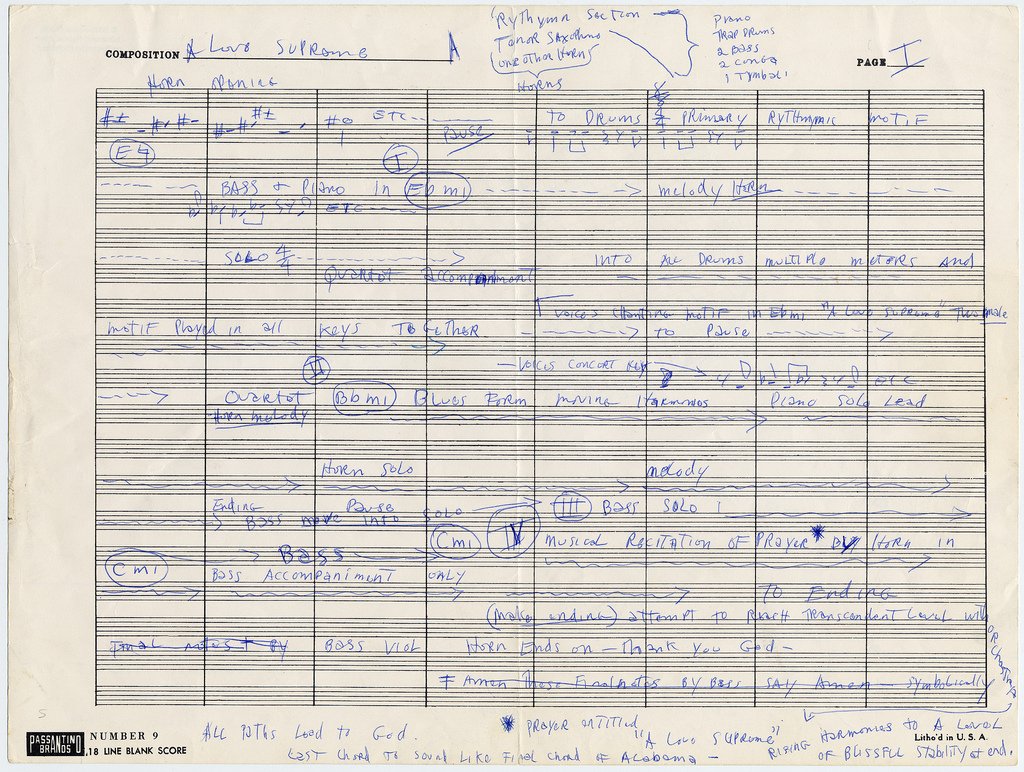
In 1965 he released one of the defining albums of modern jazz spirituality: A Love Supreme.
That “supreme love” was for Coltrane a new stage of artistic and spiritual awakening.
The album became a historic moment in jazz and remains one of the best-known works of modern improvised music.
Alice Coltrane later recalled that the spiritual idea behind the suite had roots reaching back to experiences John had carried since his military years.
She described how, in the late summer of 1964, he came downstairs at home holding the completed concept for the suite — “like Moses coming down from the mountain”.
Acknowledgement, the opening part of A Love Supreme, immediately signals that something unusual is happening.
Coltrane begins with a short fanfare.
It demands attention and announces the significance of what is about to follow.
Within the spiritual architecture of A Love Supreme, it feels like a welcome, almost a blessing.
The final section, Psalm, moves toward a restrained and melancholic ending.
Its sound is subdued, prayerful and inward.
Here Coltrane reveals a musical structure in which metre and rhythm become less important than emotional intention.
Piano, bass and drums create an atmosphere of humility.
Inside the album sleeve, Coltrane printed a prayer-poem.
The saxophone line of Psalm follows the rhythm and contour of that poem so closely that the instrumental solo can almost be heard as a wordless liturgical recitation — a kind of liturgical text spoken through the saxophone.
A Love Supreme helped strengthen the foundations of what we now call spiritual jazz.
Saxophonist Branford Marsalis often reminds students in workshops in the United States, Europe and Africa that churches have historically functioned as spaces of cultural and social encounter.
Contemporary artists such as Brian Blade, Tord Gustavsen, Ike Sturm, Bobby McFerrin, Kirk Whalum and Kurt Elling continue, each in a different way, to explore the sacred and spiritual possibilities of jazz.
I would willingly place some of this work within the broader field of contemporary sacred music.
The spiritual-jazz tradition is also powerfully present in Western Europe.
A central example is Officium, recorded in 1994 at the monastery church of St Gerold in Austria’s Bregenzerwald by Norwegian saxophonist Jan Garbarek and the British Hilliard Ensemble.
Garbarek’s improvisations enter into dialogue with medieval and Gregorian vocal repertory.
The extraordinary harmonic balance between avant-garde jazz meditation and sacred song introduced Gregorian sound to a new generation of listeners.
It is hardly surprising that Officium sold in enormous numbers and was followed by extensive concert tours.
The project demonstrates again that liturgical musical heritage can remain alive without being locked inside nostalgia or ascetic laboratories.
At the same time, this non-commercial musical concept shows professional maturity by taking seriously both artistic value and the contemporary listener’s need for new musical forms within sacred space.
Jazz inside worship can become an ambitious prayer for tolerance and encounter:
a global troparion in which earthly sounds are gathered and raised toward the divine in praise of
Soli Deo Gloria.
(To be continued.)
[1] Pliny the Younger, c. 61–113 CE, was a Roman lawyer, magistrate, senator and writer. His letters are an important historical source for early Roman imperial life and early Christianity.
© Eda Zari. All rights reserved. Published 1 May 2018 in Peizazhe të Fjalës.
Cover image: handwritten sketch-score by John Coltrane for A Love Supreme.
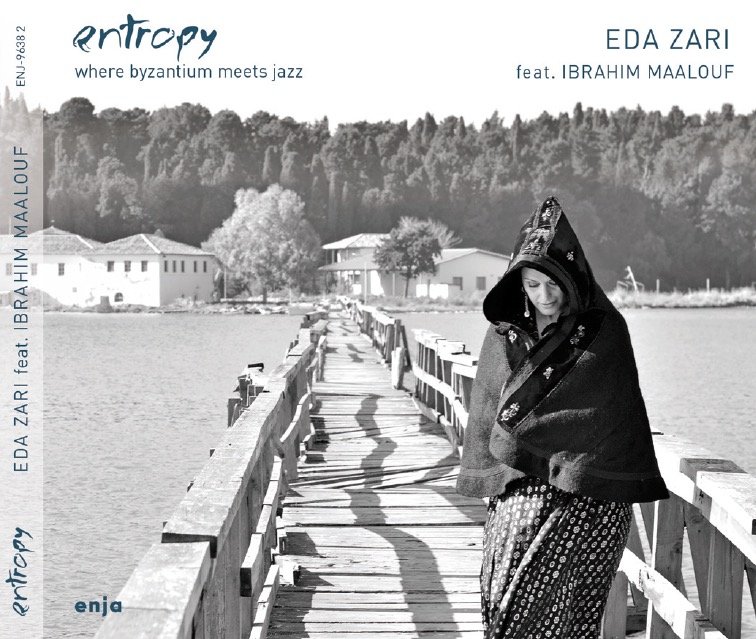
In connection with this subject, I also invite readers to watch the documentary about the making of Entropy — Eda Zari feat. Ibrahim Maalouf — where Byzantium meets jazz, released through Enja Records, Germany, and to read the reflections of Prof. Vasil Tole and musicologist Mikaela Minga on the album.
CONTINUE READING →