From “ICE Out!” to “Albania Is Not for Sale”: When Global Music Collides with Our Reality.
A reflection on Bad Bunny, Puerto Rico, migration, folklore and Albania’s own civic protests — on how music can carry resistance, memory and dignity across borders.
“I don’t want to leave this place. This is my home. They want to take our river, they want to take our beach. They left us in darkness, the lights go out again, but we are the light that never goes out. This land is ours, it is not for sale, even if they come with millions and documents, this sun is mine, this sea is mine.
What happened to Hawaii? They took it and turned it into a hotel. Now they want to do the same to us. But this is my country, these are my people. Out with the foreigners who want to buy it! We are the ones who live here, we are the ones who suffer here. You who come only to take and give nothing: pack your bags, because this place has an owner!”
Is this happening to Albania?
“El Apagón” is the title of a Bad Bunny song from his successful album Un Verano Sin Ti, a homage to Puerto Rico that places the history of Hawaii’s colonization beside Puerto Rico’s own experience of exploitation. At the end of the song, the music stops and we hear part of a sung manifesto by Gabriela Berlingeri beginning with the words “Yo no me quiero ir de aquí...” — “I don’t want to leave here.”
The comparison is direct: Puerto Rico is being pushed toward becoming a place for tourists and luxury resorts alone, repeating something of what historically happened to Hawaii.
No one leaves simply because they want to.
Precisely because it rises from this pain, the song gains weight and becomes an anthem for all lands denied justice and for people subjected to violence and displacement — Venezuelans, Cubans, Nicaraguans, Colombians, Haitians and many others.
And then I turn my eyes toward the “Flamingo Revolution”...
What about us? Are our rivers being taken from us, our beaches, our sunsets behind the mountain stretching all the way to the horizon of the sea? Are we the next Hawaii?
From the perspective of an artist, I ask why Bad Bunny’s folklore contains the protest and the peace the world is missing — a bell whose “dong-dong” can be heard all the way where we are.
What is it in the genetic memory of sound and rhythm and what we so readily call “world music” that, just when words fail and walls rise, manages to bring people together?
Why can a single strike on a traditional conga, or an old melody from a Caribbean village, pierce straight through our plasticized world, saturated with artificial rhythms and cold algorithms?
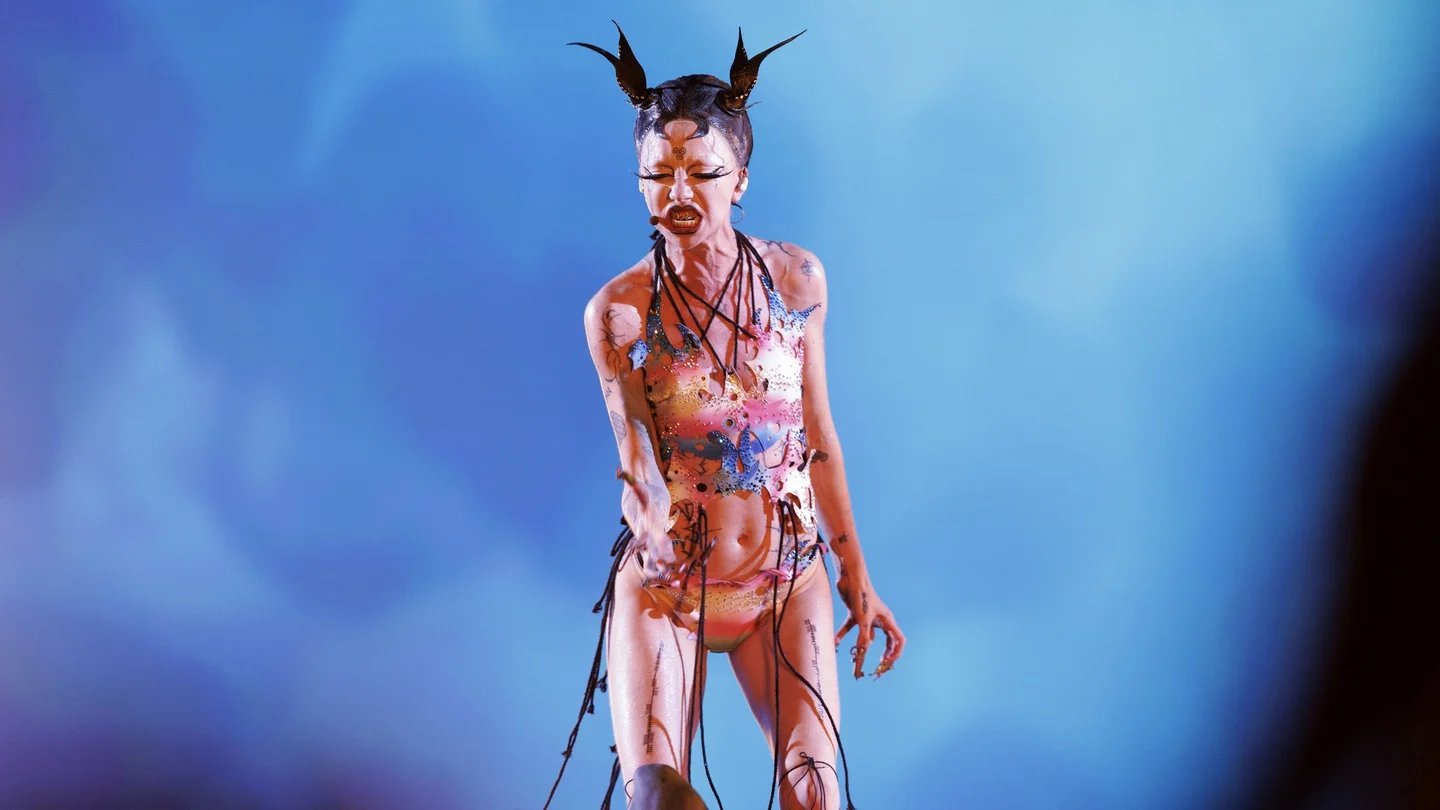
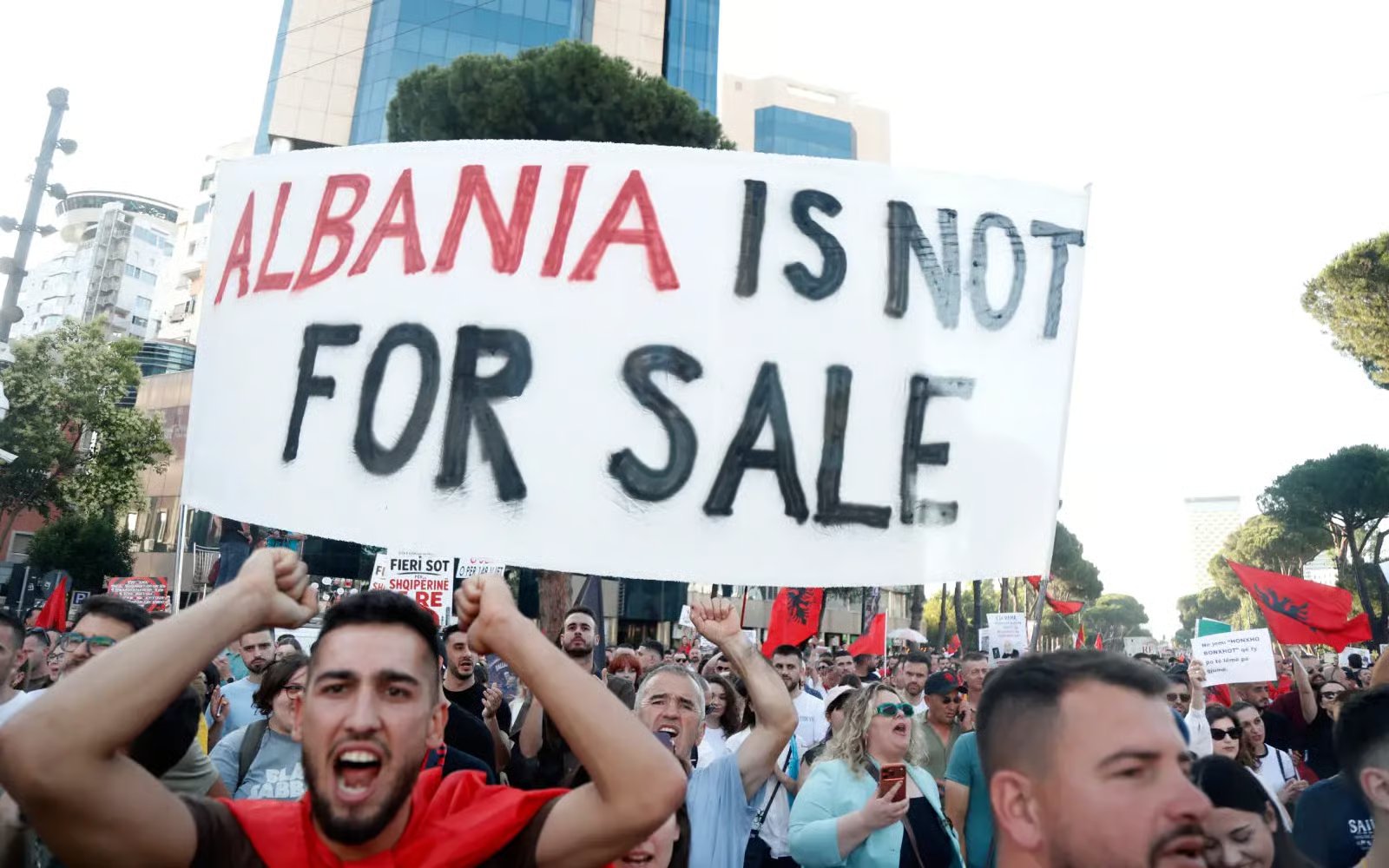
The weekend of 20–21 June brought two electrifying nights to Düsseldorf’s Merkur Spiel-Arena, with more than 50,000 spectators, at precisely the time when thousands of voices along Tirana’s boulevard were calling out every afternoon: “Albania is not for sale.”
The June protests in Albania.
In the middle of Europe, this Puerto Rican artist demonstrated his distinctive ability to bring cultures together through a colourful mosaic of songs, showing that his music is not merely an invitation to dance but a true manifesto of identity.
The force of his success does not lie in some utopian message of peace, like pink icing spread over a cocktail — “let us all love one another.” His answer lies in a desperate need for sincerity.
And today that paradox is embodied with extraordinary beauty by Benito Antonio Martínez Ocasio — known around the world as Bad Bunny.
As he climbed toward the summit — as the lights of the Super Bowl came on in Santa Clara — Benito, the young man who once packed grocery bags in a Puerto Rican supermarket, would show the world that the living music of a people cannot be domesticated by the rules of power.
It may wear Gucci jackets and be danced to by 80,000 people, but at its core there remain those old bongos, those sugar-cane fields, those grandparents playing dominoes at the neighbourhood café, those young women painting their nails and lending grace to the block, those same songs keeping time as if to say: “We are here, and we have no intention of leaving.”
Bad Bunny live — Düsseldorf.
Yet the eyes of the planet were not only on the grand Super Bowl finale. Attention shifted entirely toward the man who dared turn the most commercial stage on earth into a megaphone for cultural identity.
Bad Bunny, the most-streamed artist on the globe, who had just taken the Grammy for Album of the Year with an album entirely in Spanish, DeBÍ TiRAR MáS FOToS — “I should have taken more photos” — made an unprecedented gesture.
As he stepped onto the polished, aristocratic-looking stage of the American music industry, he declared sharply: “Before I thank God, I say: ICE out!”, directly confronting the U.S. immigration agency and transforming the luxury hall into a real barricade of protest.
(Photo: album cover DeBÍ TiRAR MáS FOToS)
Through the ache of photographs never taken, Benito is not speaking merely about a lost love, but about the modern human being’s inability to stop the flow of time, to drop anchor in happiness and moor oneself to values.
He refused to stage a single concert in the United States during his world tour, as a protest against harsh immigration policies. Deliberately removing the most profitable market in the world from your tour so that undocumented fans do not risk checks or arrest while queuing to enter stadiums shows that his success is not merely a matter of numbers.
It is a position: activism shaped into a cause of human dignity.
From an ethnomusicological point of view, Bad Bunny’s movement represents a monumental return toward origins.
The word folklore itself means the living memory of a community.
On his sixth album he does something remarkable: he takes reggaeton — a genre often accused of industrial vulgarity and hypersexualization — and gives it a musical blood transfusion from Puerto Rican folklore, rural forms, Afro-Caribbean styles and salsa rhythms.
From my perspective as an artist, this is active syncretism.
This “bad bunny” is not merely producing beats to be consumed on TikTok. He is using the organology of his island to tell the public: this movement has its roots in the artisan labour and sweat of the artist, not in AI and not in anonymity.
Although I do not speak Spanish, I adore Latin music, especially Cuban, Puerto Rican and Brazilian traditions. I am particularly moved by its approach to arrangement — above all by Bad Bunny’s organic, acoustic Tiny Desk performance, where reggaeton is stripped of effects and brought back to its roots.
But the desire to understand what lay behind the songs pushed me to dig into his lyrics.
There I discovered that beyond superficial rebellion and street slang, the essence of his creative work deserves deep respect.
On the musical level, he manages to bring together urban avant-garde and traditional folklore; on the literary level, he transforms everyday speech and slang into a political language of resistance.
It is precisely this duality that makes me take my hat off to him.
At the point where rural tradition is laid across urban rhythm, the audience in Düsseldorf’s stadium experienced a magical night last weekend, a meeting of eras in which “BB” built an intergenerational bridge between youth and tradition, between Europe and the Caribbean.
My friends, we are living in the age of a great paradox: the cultures of the world are melting into a single digital pot, while the real bridges of dialogue between people are disappearing.
The message of love carried by Benito’s music is not an invitation to a pacifist embrace, but a peace claimed through dignity.
When he sings in “Lo que le pasó a Hawaii”: “They want to take our river — and the beach as well,” he is doing what folklore has always done from the beginning: chronicling resistance against gentrification and colonialism.
Puerto Ricans have been U.S. citizens since 1898, after annexation, but are treated as second-class citizens who cannot vote in presidential elections. For that reason his folklore becomes the “passport” of those denied a voice.
Benito chose to dig deeply into the roots of Latin music, which are far more complex than a simple “tun-kituki-tun” rhythm — plena, bolero, salsa, son and more.
He joined forces with a historian, placing an explanatory finger on the darker chapters of Puerto Rico’s history. Together with C. Tangana and other artists in this current, he is, in my view, reviving a kind of new Buena Vista Social Club for the modern age.
If the legendary Cuban Buena Vista Social Club showed the world at the end of the 1990s that Cuba was not merely a politically isolated island but a living treasure of genres such as son, bolero and danzón, Benito is doing something comparable today for Puerto Rico and the wider Caribbean.
The only difference — and it is crucial — is that he is doing it from the position of one of the biggest mainstream artists on the planet.
Protest and celebration.
In the study of musical folklore there is a golden rule: war dances and harvest dances often share the same step, only the rhythm changes.
Celebration and protest are not opposites; they are two faces of the same coin.
That is why I return once more to the moment when Bad Bunny said at the Grammy Awards: “Before I thank God, I say: ICE out!”
But the words that followed were the heart of a humanist ethnomusicological vision:
“We are not savages. We are not animals. We are not aliens. We are human beings, and we are Americans.”
When we look at Albania today, on what has become the twenty-fourth or twenty-fifth consecutive day of protests, with people in squares and streets speaking against poverty, the lack of prospects, for rivers and natural heritage, against depopulation, Bad Bunny’s lines stop being simply a Caribbean song.
In the author’s reading, they become a mirror of Albanian reality.
Bad Bunny’s “river and beach” become, in Albania, public assets that have been alienated.
The most painful points at which, for me, today’s Albania meets Bad Bunny’s manifesto are therefore emigration, nature and dignity.
The Puerto Rican artist dedicates his awards “to all those who had to leave home to pursue their dreams,” while the song keeps resounding: “I don’t want to leave.”
THEREFORE — we need only turn our eyes toward our own squares in the daylight of this twenty-fifth day of protest, because today Albania itself is singing its own song of dignity and hope.
CONTINUE READING →