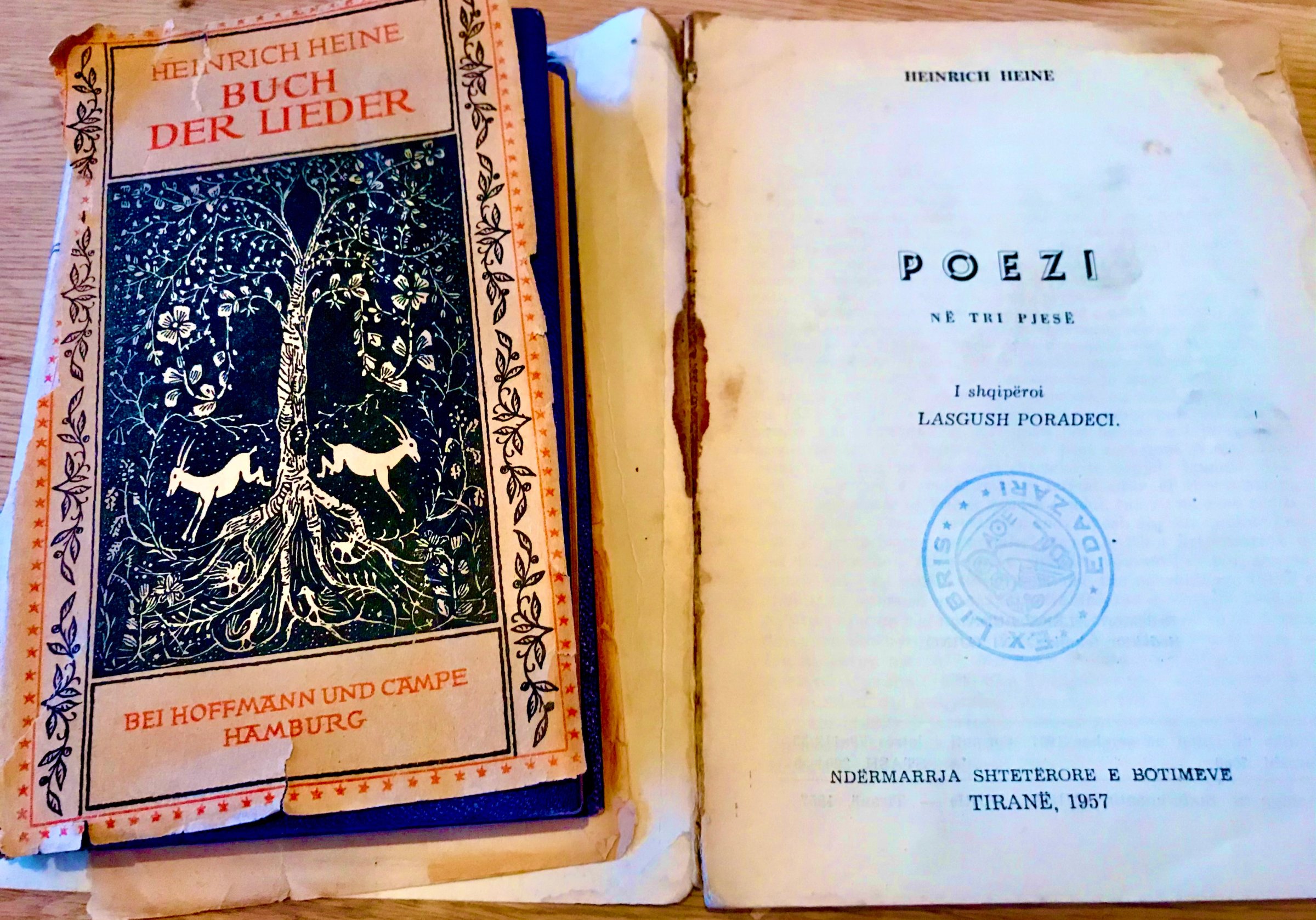
“Qan lulja për lulen” — The Beauty of Polyrhythm. Eda Zari
Eda Zari reflects on Myslym Lela, Muharrem Gurra and the urban musical tradition of central Albania, tracing the song “Qan lulja për lulen” toward jazz, mixed metres and a new interpretation with Elchin Shirinov, Christian Kappe and Henning Jung.
Beyond the songs of Përmet, the kaba, laments and song-dances performed by masters of intense artistic feeling such as Remzi and Myslym Lela, I also absorbed from them the resonance of divan songs — songs of sevda, of mood and of the urban festive culture of central Albania.
These included repertoire by masters such as Isuf Myzyri and creators such as Muharrem Gurra.
Seen from today, this repertoire played an important role in my musical formation.
Alongside songs that came directly from his own creative world — for example the well-known song dedicated to my grandmother, Tëta, “E para është nëna e dyta më je ti” — Myslym Lela also brought back interpretations of beloved songs from the urban musical tradition of his contemporaries.
Myslym expanded the musical spectrum of songs dedicated to beauty and to love for the companion, the wife, the woman of the heart, the sister and the mother.
He did this according to an aesthetic principle shaped by emotional state: sometimes slowly, with a mixture of joy, lament and longing; sometimes vividly; sometimes almost fading away beneath pleading promises.
I often heard his version of Muharrem Gurra’s “Qan lulja për lulen”.
With Myslym — who had an extraordinary vocal range — I always noticed his phrasing, especially around the key word of the lyric:
Lule. Lulja. Lulen.
The leading tone came from the chest register, shaped with a finely controlled masculine falsetto.
It gave the opening of the song a firm keel and carried the flower’s fate faithfully to the end, trembling all the way.
He beautified and decorated the song with ornamentation that was neither regional nor conventionally traditional.
I would say that, in his autodidactic way, he had created his own glissandi, trills and double melismatic mordents, often microtonal, which to my ear sometimes resemble Byzantine vocal declamation.
But it would be poor analysis to stop only at the ornaments.
Myslym’s phrasing, his broken and mixed metres within a single bar — deep inside the same musical phrase — often remind me of the blue pulse of Brubeck’s Take Five.
I do not know why he loved rhythmic mixtures so much.
Perhaps it came from the instinct of an instrumentalist, because Myslym played clarinet and violin as primary instruments.
He experimented constantly, turning verses into heterometric structures — unusual rhythms for that period — much as Brubeck did in Pick Up Sticks in 6/4, Unsquare Dance in 7/4 and Blue Rondo à la Turk in 9/8.
And Myslym did not stop with merely “Take Five” or “Take Seven”.
He consciously made the stanza more complex, inviting the accompanying musicians to open up their instruments and enter harmonically through transitions and note progressions.
I do not hide the fact that, in making this analogy between Myslym and Brubeck — one self-taught, the other formally educated — I hear in both performance and composition something that strongly reveals the biography of the soul.
Gurra’s “Qan lulja për lulen” is catapulted by Myslym into an improvised urban blues.
To this widely known song Myslym undoubtedly gave what the spirit of “society” at the time longed to hear.
On our Grundig TK 246 HiFi Stereo tape recorder from around 1970, my brother Agim would place reel-to-reel tapes to listen to Santana’s guitar solos.
Every now and then Myslym’s voice would suddenly emerge from underneath:
“e këpusin çunat, o bobo!”
Obviously my brother had recorded Santana or Hendrix over Myslym.
Yet Myslym’s song remained the cell inside that reel.
A kind of sonic palimpsest — tape as parchment, rewritten with art.
In honour of Myslym, master Isuf Myzyri, composer Muharrem Gurra and the generation that formed the musical bedrock of central Albania — and also in honour of 1950s jazz, which itself absorbed influences from world music — I was inspired to approach precisely “Qan lulja për lulen” and give it something of myself together with colleagues from the jazz scene.
Pianist Elchin Shirinov of the Avishai Cohen Trio, from Azerbaijan; German trumpeter Christian Kappe; and Henning Jung on electric bass — my son — join me in revisiting “the plucked flower”, based on Myslym Lela’s interpretation.
What refreshes us most is the metre.
It modulates from stanza to stanza and at times assumes the character of an acephalic rhythm — a rhythm that begins without the expected initial beat.
As in the original form, the song does not carry a rigid metric scheme.
In our version, the trumpet solos over the A-A structure, then returns toward the ending through a repetition of the mode.
I invite you to enjoy this song, which takes us on a musical excursion — not without nostalgia.
Note: “Qan lulja për lulen” is released today with a music video on my YouTube channel, with videography and production by Ergys Shehu.
Premiere: 5 June 2021
Düsseldorf, 5 June 2021
All rights reserved.
CONTINUE READING →