CAPRICCIO — PORADECI, HEINE AND SOUND.
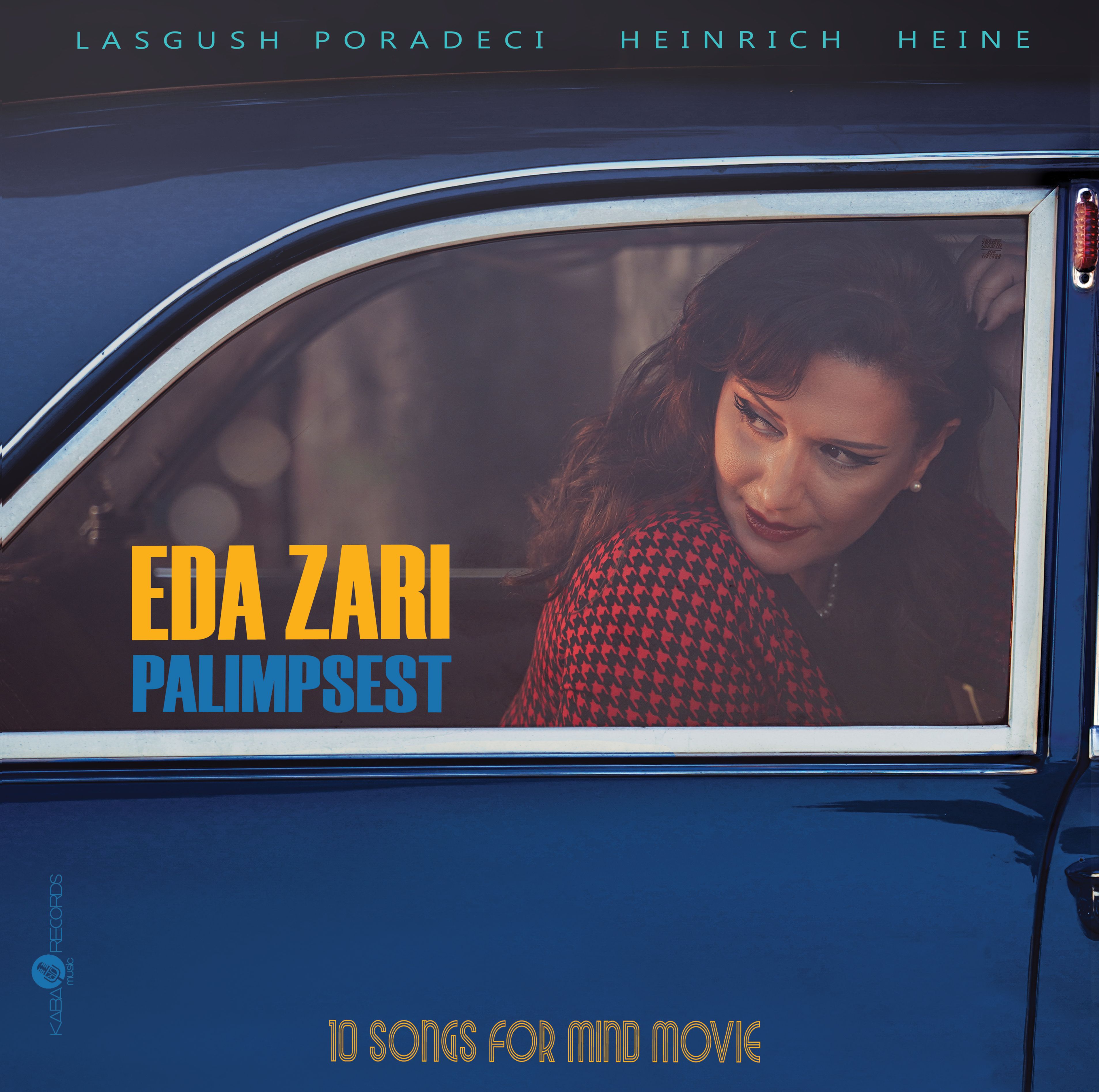
Eda Zari reflects on whether music comes before words or words before music, moving through Schopenhauer, Strauss, Ronsard, Lasgush Poradeci, Heine and Schumann while tracing the making of her bilingual album Palimpsest.
Music first and then the word — or the word first and then the music?
Like the human being, music too seems to have two sides: mind and soul.
The latter allows music to express what words alone cannot fully contain.
Yet philosophers, poets and composers have always drawn from one another’s ideas in order to refine either the sound of thought — or the thought within sound itself.
A little tangled, perhaps?
Shortly before the coronavirus period, I was invited by colleagues to a hard-bop concert.
The audience seemed musically prepared for the demanding language of that music.
At the end, as tradition requires, the public called for a Zugabe — an encore — and the saxophonist began playing a composition which, to my surprise, was titled Die Welt als Wille.
The composer was referring to Arthur Schopenhauer’s Die Welt als Wille und Vorstellung [1].
The fusion of philosophical thought with melodic line, hard-bop improvisation and modal jazz was intriguing.
Yet while watching the musicians perform — both collectively and as soloists — I began to wonder:
Is it easier to express an idea or philosophy instrumentally, without a verbal subtext, than it is to raise an existing poem to the level of song while leaving the word in its rightful place — preserving the work of the mind within sound?
The saxophonist left me with the impression of a musician searching for a common language with the philosopher.
The World as Will and Representation had clearly ignited his imagination and encouraged him to identify the language of thought with the language of sound.
It is hardly a new discovery that instrumental music can speak without wedding itself to a libretto or written text.
Schopenhauer elevates the composer when he writes that:
“The composer reveals the innermost essence of the world and expresses the deepest wisdom in a language that his reason does not understand.”
Yet no matter how much Arthur’s philosophy excites me — and even when he proclaims that “music is the highest of all the arts” — I still find myself thinking that composers have not infrequently neglected the weight of thought, the elements of language and the force of poetic vocation.
There are many moments in which music or composers give one the impression that poetic language — words — had not yet been invented.
In the correspondence between Richard Strauss and Clemens Krauss [2] concerning Strauss’s final opera Capriccio, we find their opposing views on the relationship between language and music:
“Zuerst die Musik und dann die Worte” versus “Zuerst die Worte und dann die Musik”
— first the music and then the words, or first the words and then the music?
Eventually Krauss succeeded in winning Strauss’s enthusiasm through the choice of a sonnet by Pierre de Ronsard [3] for Flamand’s aria.
He created an environment symbolizing the bond between poetry and music — a difficult discovery, almost Sisyphean in its labour — but one that ultimately established the importance of that relationship inside the very category by which the opera defines itself:
“A Conversation Piece for Music.”
It is interesting that Ronsard’s Les Amours had already found its way into music much earlier, in settings by Antoine de Bertrand (1580–82) and Jean de Castro (1540–1600).
Ronsard’s earliest sonnets were set to music as supplements to poetic volumes by some of the most important composers of the period.
Today, Francophone musicologists regard these developments as a symbol of humanist attempts to secure the lasting life of French Renaissance poetry through the combination of music and verse.
Since 2011, living within the biotope of Lasgush Poradeci’s language, I have long carried the idea of bringing not merely one poem but many of his poems together on a single album and raising them to the level of song.
Equally compelling and rare is the case in which the Poet translates the Poet.
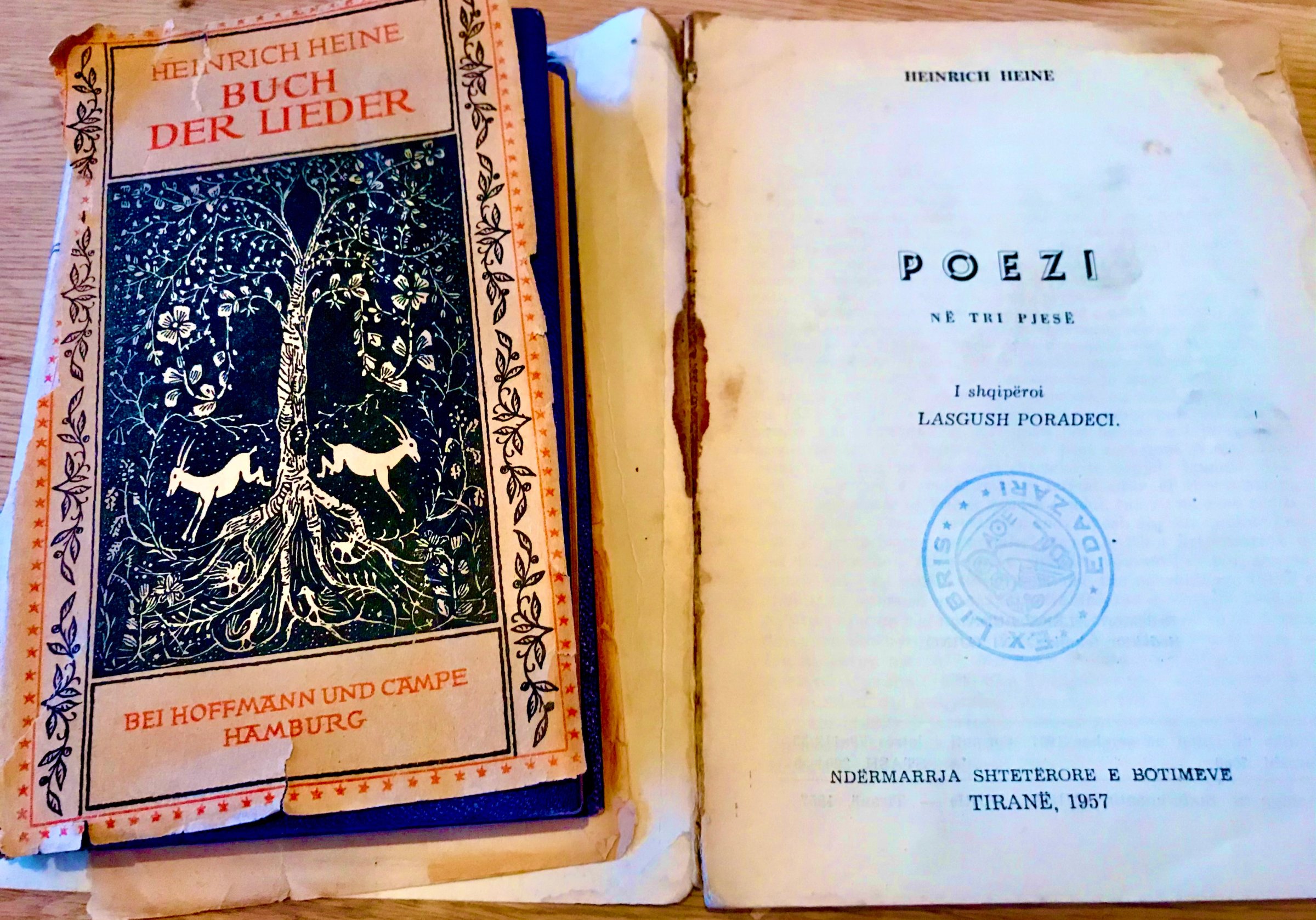
That is why Llazar Gusho’s Albanian translations from Heinrich Heine’s Buch der Lieder — Libra e Këngëve [4] — are jewels I could not imagine leaving out of this bilingual album, which would reach the public in autumn 2021.
I have before me a 1945 edition of Buch der Lieder from Hoffmann & Campe Verlag in Hamburg, together with the 1957 Albanian volume translated by Lasgush.
Personally, if I had to look for the word music inside poetry, I would call that word Lasgush Poradeci.
I am today as I was last year, I will be tomorrow as always. In body, in heart I am, in your soul.
“Ewigkeit — Përjetësia.”
There it stands:
not merely form, but the perfection of a work of the mind — an Opus Magnum in prophetic words, under the cult of a temporal Trinity.
The poet wants nothing less than to create hidden worlds, to devise new harmonies, metre and poetic rhythm capable of resisting every fashion and short-lived trend.
To do this, he reaches for the stars and the core of the earth: the heart — at the same time.
The poet possesses an immense instinct for poetic longevity and for the musical exactitude of verse.
In his own words:
“Poetry is also made by tone. Tone makes the music.”
During one discussion I once raised the question:
Has the sound already been found?
And to what extent can music — as language — be overlaid upon the language of Llazar’s poetry?
Among the musical settings created from the poet’s work, one particular song stands apart for me because of its melodic aesthetic and the highly specific interaction between music and poem.
Composer Josif Minga, in Mora shoqezën përkrah, consciously elevates the function of the word — which intensifies the intimate memory held between two lovers — by using quartal harmony.
It is no accident that the melodic opening begins with two pure fourths, one after the other.
They immediately place the song in a minor-key, deeply personal terrain, almost like the phrasing of a fado or a lament by Jacques Brel.
The melody is restrained, almost a cavatina [5], carrying a modest sound coloured by longing, omen and a sense of fate.
“Matmë rrugën ca nga ca” — within one motif, the composer repeats the combination of fourths, underlining the clarity Lasgush himself claimed for his poetry [6]:
before the day had set, before the night had covered us.
Then, after the chord progression, Minga almost seems unwilling to settle on the tonic.
Why?
Because the chord is intentionally left unresolved.
“As rroj as vdes, po jam pa mend” — neither living nor dying, but without reason.
For me, by withholding resolution on the tonic, Minga creates an intelligent suspension charged with emotional and harmonic depth.
When the theme returns, it is sung an octave higher, placed rhythmically in triplets and phrased with rubato.
Through sound, the composer supports the shaping of the highest point of intimacy — the place, the experience of the divine act, everything the poet sees in the “feminine lake”.
Played today with accordion or bandoneon in a simple a piacere tempo, this song could still bring fresh air into love:
“When I remember, ah, that place.”
Standing humbly before Lasgush’s work, however, one must take care not to fall blindly into the assumption that poem and song automatically create an idyllic frame.
I therefore prefer to remain faithful to the principle that poetry is as important as music — and that music, too, has rights of its own.
Raising the word into melodic-rhythmic form is not simply an excuse to write any melody or any rhythm, cover it with arbitrary orchestration and dynamics, and then justify the result as “the composer’s creative freedom”.
In his correspondence with Kuteli, Poradeci writes:
“The true artist does not ask where he takes the raw material of his creations from; he asks whether from this raw material he has created an original work — new, powerful, full of personal expressiveness.
Imitation, the scholars will say!
A new creation, the poet will say!
A new creation from old material […]
Not one of the artistic works with universal life is entirely original in body; their body is borrowed. Only their soul cannot be disputed by anyone.”
Lasgush does not insist on creative consciousness without reason.
“The true artist does not ask…”
And then, almost unintentionally, we return to Capriccio.
Literarily and musically, it is as though we seem to grant creation an unlimited freedom of movement.
It is well known that composers and poets belong to a stubborn class of human beings, even if the desire to reach perfection — whether of sound or language — repeatedly breaks their egos along the way.
That lesson has stayed with me for a long time.
They intertwine and reconcile the impulses of two fundamentally different arts, while form preserves the works of the mind inside sound.
I have understood that the pursuit of perfection can sometimes become a kind of illness, almost an obstacle to the work itself.
That is why my thoughts increasingly swing toward the necessity of creative courage.
I tell myself silently:
Just leave it as it is and move on.
Otherwise it will never be finished.
Or the work will become something polished to the point of lifelessness:
without feeling and without energy.
As my own album developed — with Lasgush and Heinrich Heine constantly present through their lyric poetry — I needed to approach the creative structures connecting Robert Schumann and Heinrich Heine.
Two Düsseldorfers:
one poet, one musician.
They do not only share the same year of death, 1856.
Through the cycles Dichterliebe and Junge Leiden [7] from Buch der Lieder, their poetry and music achieved some of the most celebrated international resonance of the nineteenth century.
Many of Robert Schumann’s compositions were created in the Schumann house at Bilker Straße 15 in Düsseldorf, today a museum.
Reading there, I discovered that the Schumann-Heine terrain was almost a minefield.
It is often assumed that Schumann did not fully understand Heine’s poetic irony and sarcasm.
But even if that were true, one could equally ask whether Heine fully understood the unique originality of Schumann’s music.
From the perspective of a performer — especially a singer — I believe Schumann raised musical aesthetics to a true, absolute sound for Heine’s texts.
One might even say that perfection became Schumann’s ideal, especially when it came to carrying poetry into song.
The real problem was the dark material of Heine’s language — the colours of the coffin and inferno, the resistance both for and against love — especially in Dichterliebe.
But how does one dress this “romantic” irony in music?
How does one give sound to the unrest and perception of reality within Heine’s Jewish-German cosmos of an embittered poet, now entirely alone in exile in the Paris of 1840?
How does one clothe a sentence such as:
“Lass mich in Ruhe” — leave me alone?
Another capriccio?
Here collisions between word and music can happen very easily.
Does Heinrich offer us an aggressive command, or a weeping plea of resignation?
Which sound corresponds to the form?
Schumann seems to have plunged straight into the body of Heine’s work without continuing to ask:
Choose one — sound or poetry.
He did not see himself only as a composer.
In his youth and later, he was also a man of letters who wrote poetry.
The same kind of double identity can be found in Heine, who in some sense understood himself as a “musician”.
Schumann’s dedication appears directed not toward Heine the person, but toward the poet.
And Lasgush puts it sharply:
“Heine remains a great poet because he has one volume of very good poetry. That is enough for him.”
Using his own language over Heine’s language, Schumann created something unparalleled in vocal-instrumental form, something scarcely imaginable within the Zeitgeist of his period.
A clear example is the song Ich hab’ im Traum geweinet — In a dream I wept.
It begins with a restrained vocal recitative in E-flat minor.
Voice and piano do not play simultaneously until the final stanza.
The vocal line underlines the poet’s loneliness completely.
The dream unfolds over a repeated pitch, and even after waking the abandoned poet continues, eyes open, to see separation from his muse.
At night, dreams vary just as tonalities cross and shift between the middle and ends of the stanzas.
Schumann intentionally creates a minimal pianistic sketch, giving the song extraordinary depth of sound.
The same happens in Allnächtlich im Traume seh’ ich dich — Every night I see you in my dream.
The piano accompaniment is equally simple.
Although the manuscript suggests that the piano line might still be rearranged, shortly before sending the score to print Schumann deliberately and rightly abandons the idea of “redesigning” it.
“In a dream I wept, I dreamed you lay in the grave. I awoke, and still the tears ran burning down my cheeks.”
Albanian translation by Lasgush Poradeci, from the Dichterliebe cycle.
Original:
“Ich hab’ im Traum geweinet, Mir träumte, du lägest im Grab. Ich wachte auf, und die Träne Floß noch von der Wange herab.”
And I went further.
Looking at Lasgush’s Albanian version, I tried singing “Në ëndërr po vajtoja” in Llazar’s language.
The magical breath of Lasgush’s sounding word settled astonishingly naturally inside Schumann’s melody.
Lasgush himself reminds us:
“And a person who knows poetry, for example, will understand: Lasgush must have translated this.
To translate a poem into a different line length is like translating Eugene Onegin, written in nine syllables, into eight.
That means changing the tone of the poem, giving it another tone.
And what makes music — the notes?
No.
If you change that tone, you have changed the poem.
There is no language incapable of translation, but there are poets who do not know how to translate — just as there are poets who do not know how to write poetry.”
If we follow the thread all the way to its end, it becomes clear that the relationship between language and reality becomes clearer by the fact that poetry is not merely a realist art.
Heine, but also Nietzsche, in their compositional [8] and linguistic attempts to bring these two arts closer, did not provide a final solution to the problem.
On the contrary, they often seem to seek out new problems.
Perhaps that is the philosophical purpose:
to keep thinking so that new questions can arise, while sound resolves the problem differently.
Nietzsche writes:
“Behind all cold words there trembles a longing soul; I hear it singing, because my own soul sings when touched.”
To find an adequate example, a letter by Felix Mendelssohn comes to mind.
He writes that language between two people can deceive them, but music, as a direct expression of the heart, cannot deceive — that feelings between human beings, expressed through sound, are free.
I have gone on at length and still cannot quite finish.
I realize that I have begun to discover a special beauty in this subject, fermented by the yeast of contradiction and caprice itself.
So let the first thing be what the listener feels — what generates emotion.
To restrict oneself to one side or the other would mean refusing to live in accordance with the spirit of the time.
The soul seems to invent one caprice after another, just like:
Music and Word — Word and Music.
“Art has its own mysteries, which not even the artist himself can explain.”
— Llazar Gusho, Lasgush Poradeci
Düsseldorf, 16 April 2021. First published in Peizazhe të Fjalës on 17 April 2021.
© 2021 Eda Zari. All rights reserved.
Note: Photographs of the books are from Eda Zari’s private collection.
Notes
[1] Die Welt als Wille und Vorstellung — The World as Will and Representation — by German philosopher Arthur Schopenhauer. The Albanian rendering of Vorstellung raises a translation problem. Schopenhauer is referring to the world as an idea or mental representation: “The whole world around us is an idea that we form through our senses and our mind.” In this sense, Vorstellung can also carry the meanings image, conception or imagination, not merely “representation” in a literal institutional sense.
[2] Clemens Krauss — Austrian conductor and collaborator on the libretto of Richard Strauss’s opera Capriccio.
[3] Pierre de Ronsard is considered one of the most important French poets of the second half of the sixteenth century and a major representative of Petrarchism during the French Renaissance.
[4] Forbidden things intensify desire. After Heine’s writings were subjected to censorship, public interest in his work grew, and publishers found methods of circumventing restrictions. Buch der Lieder became one of the greatest lyrical publishing successes of the nineteenth century. Before Heine’s death, approximately 30,000 copies had been sold.
[5] Cavatina is another form related to the aria or arietta, often shaped in a recitative-like manner for the expression of love, longing, hope, hatred, memory and related passions.
[6] Lasgush says: “Which of my poems is unclear? Which of my poems is dark? Which of my poems is incomprehensible? None.”
[7] Lasgush, this “master” of German, translated Buch der Lieder with remarkable skill. He wrote: “Translating poetry is difficult because poetry itself is difficult. It becomes even more difficult in translation. In the original you make the line yourself, as you wish, whereas the foreign text does not let you; you must dress according to its style…”
[8] Hymnus an die Freundschaft — Hymn to Friendship — is one of Nietzsche’s final musical compositions, written between 1872 and 1875.
CONTINUE READING →