Hitler, Too, Declared May Day a “National Day of Labour”.
A personal May Day reflection moving from childhood memories of socialist Tirana to the history of the labour holiday, its appropriation by totalitarian regimes, and the need to distinguish communal memory from political spectacle.
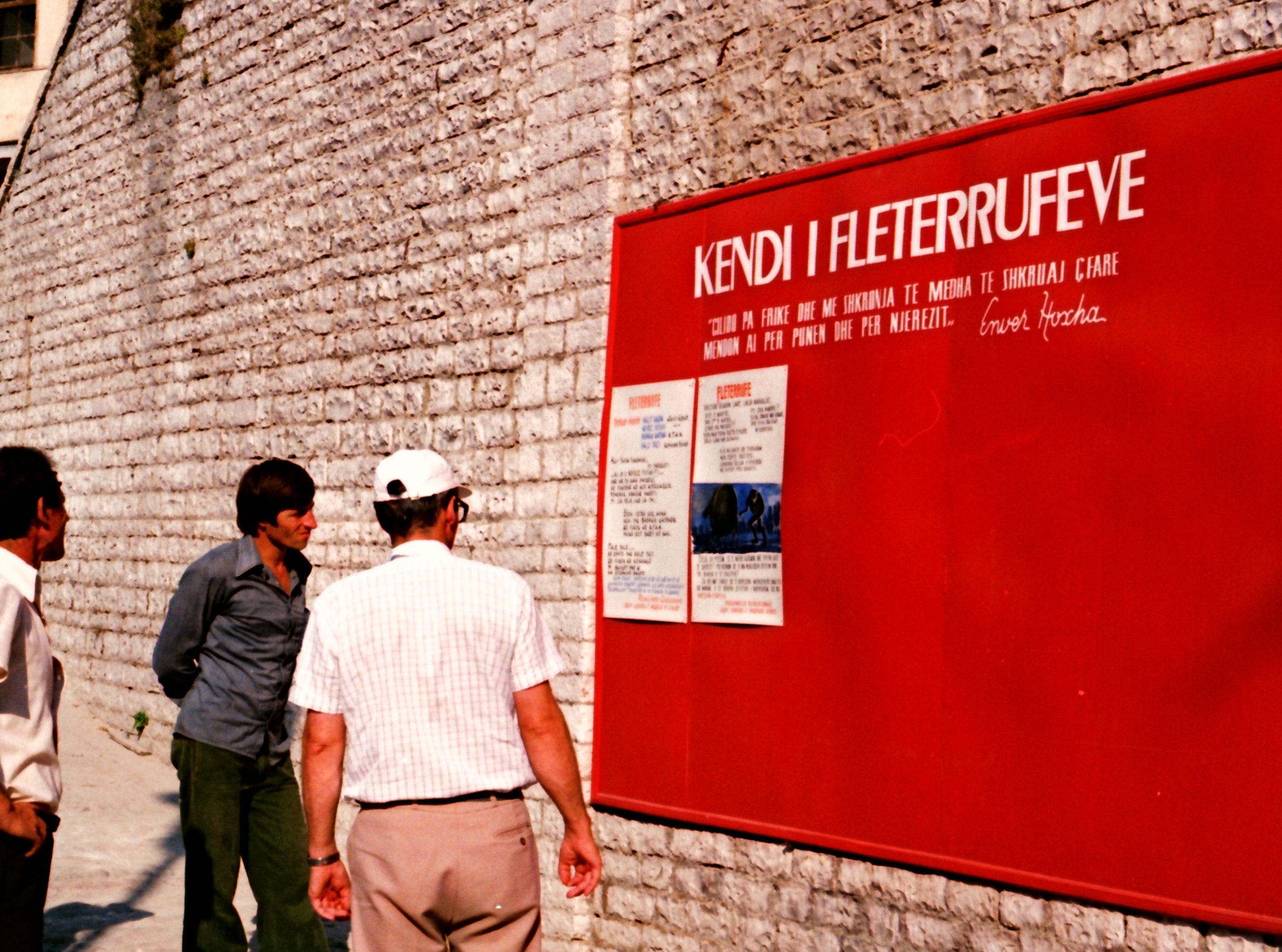
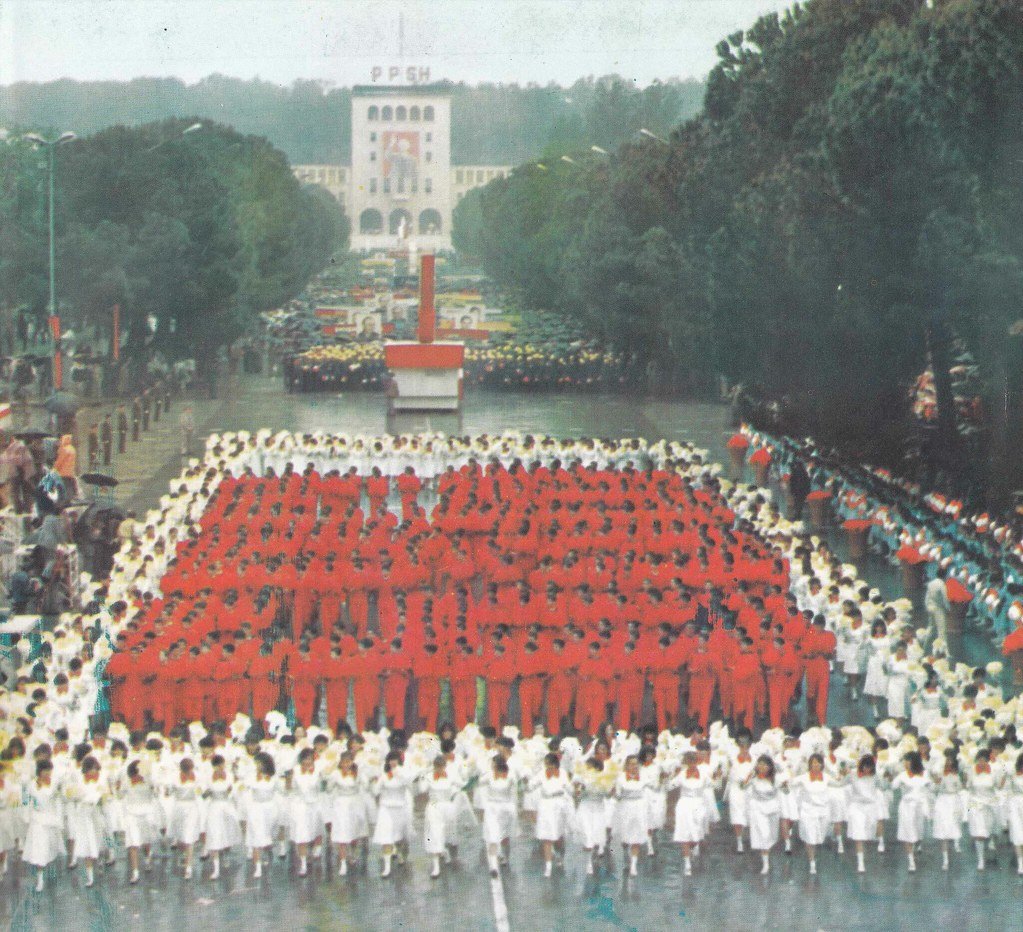
In my childhood memories of Tirana in the 1970s and 1980s, as a girl from the 21 Dhjetori neighbourhood, May Day was a day of colour and marches — a May Day marked by the unison rhythm of feet moving “in step together”, the cadence of the socialist citizen.
I remember myself as a little girl, my white socks pulled up to my knees, wearing my prettiest red dress and two ribbons in my hair. My white sandals were ready for the “adventures” of morning and afternoon, when I would go with my father to visit relatives. In later years we often went for picnics by the lake, where a festive atmosphere seemed to be everywhere.
The morning of May Day began early, before daylight had properly arrived, around five o’clock, when the sound of the military band — dominated by the tuba — travelled down Rruga e Kavajës in a 4/4 rhythm.
The fanfares and unfamiliar marches created a martial atmosphere.
Before dawn, water trucks carefully washed the asphalt, as though preparing a red carpet for a major event.
At the 21 Dhjetori intersection the scene built toward an increasingly impressive crescendo.
Work collectives hurried through the crossroads carrying red and white paper and delicately made wreaths of crepe and crumpled Chinese paper. These decorations often took the form of roses attached with copper wire and wrapped in green paper — evidence of a kind of ritualized craft.
From the window of our home, next to the barber shop at 21 Dhjetori, this film unfolded before my eyes.
The uniforms of high-school girls and boys, and the clothes of university students, looked so orderly and carefully arranged that they might have been carved in ice.
I remember my father in the room facing the street, where we played dominoes. Wearing his white undershirt, shaving foam on his face, he would calmly shave, glance quickly behind the curtain and, with an indefinable smile, say:
“I don’t know how the people from my department are going to manage in today’s parade!”
There was a kind of concern in his voice despite the light irony.
At around ten o’clock we watched the parade on our Iliria television set: the reviewing stand, the solemn speeches, the pioneers embracing “Uncle”, the cheers of the crowd — together with the familiar voice of the much-loved commentator and journalist Alfons Gurashi. All of it engraved the annual ritual into my memory.
Even though it was a dictatorship, what I remember is that people were together.
There was a sense of collectivity, a common reason to celebrate.
Beyond ideology, the day was also an opportunity to go out, dress well, look good, meet friends and relatives and feel a certain joy in the neighbourhood.
Later, when I was around fifteen, May Day also became an opportunity to dance in sandals with heels and straps crossed around the ankle.
These are the colours and sensations of May Day through my childhood eyes — memories that even now preserve a kind of almost sacred warmth.
Today’s longing is not simply a return in time, but an ongoing dialogue between the innocent self I once was and the conscious self I am today.
The 35-metre width of Dëshmorët e Kombit Boulevard in the Tirana of my childhood, I now understand, was not simply a pointless stretch of concrete.
Those empty metres seemed made deliberately, like a great stage designed for one particular spectacle: the May Day parade.
Before my child’s eyes passed, with great pomp, the Central Committee, the ministries and all the imposing institutions of the state, displaying their visible power to the rhythm of military marches or to the coloratura-like opening of the song “Për ty atdhe” — “For You, Homeland”.
And yet those thirty-something metres remain in my memory bound to that powerful image of May Day long ago, when the boulevard seemed to breathe only for that single day, filling with the imposed solemnity of power.
Under the pressure of dictatorship, paradoxically, an intensified human intimacy also flourished — a shared need for warmth and connection under the shadow of control.
I, a child not yet touched by the weight of ideology, experienced the world through the filter of family love and close human bonds. The dictatorship was an incomprehensible background to everyday life.
The longing I feel today is not only nostalgia for games and innocence, but also for that strong sense of a community forged through survival, in which people relied on one another in the absence of individual freedom.
Today I look at that celebration with different eyes — eyes startled when I think about the origins of May Day, the workers’ strikes demanding a humane eight-hour working day, and the violence and bloodshed committed in the name of justice.
The old Roman phrase comes to mind: “panem et circenses” — bread and circuses — the perfect instrument of any power seeking to keep the masses calm and under control.
Dictatorships, as we knew all too well in the Albania of that period, had mastered the art of turning ideology into celebration and compulsion into spectacle.
The irony of history is bitter.
A day born out of the struggle for workers’ rights was used by totalitarian regimes to conceal oppression and the real absence of freedom.
Hitler, too — the man who destroyed independent trade unions and instrumentalized every aspect of life for propaganda — declared May Day a “National Day of Labour” in 1933.
It was a cynical inversion of the very meaning of the day.
“Arbeit macht frei” — “work sets you free” — was a monstrous lie, forged in iron above the gates of concentration and extermination camps such as Auschwitz and Dachau.
There, work did not liberate.
It destroyed, dehumanized and ultimately killed.
Meanwhile Hitler, who orchestrated this brutal system, decreed May Day as a holiday honouring “labour and workers”.
By making May Day an official holiday, Adolf Hitler was not honouring the sacrifice of the Haymarket workers’ struggle or the aspirations of the socialist international movement.
He was creating a façade: a state-controlled celebration in which “labour” was no longer presented as a site of exploitation but as a “noble” duty to the nation, defined and directed by Nazi ideology.
The irony is profound, because the same ideology that proclaimed labour liberating at the entrance to an earthly hell used the “holiday from work” as yet another instrument to control and deceive its population.
It is as though the butcher were celebrating the day of knives.
Hitler chose the devil’s path: appropriating one of the labour movement’s most important symbols.
The historical irony remains that a dictator institutionalized the holiday, and that it continued to be a public holiday in Germany after the fall of his regime.
That can be seen as an interesting paradox, but the meaning and importance attached to May Day in Germany today are fundamentally different from those of the Nazi period.
Today, the day is understood primarily through the historical achievements of the labour movement, not through the decree of a dictator.
So today, with this double memory — the naïve dream of childhood and the bitter reality of history — I wish everyone a May Day lived with awareness.
A day on which to remember the sacrifices of those who fought for our rights, but also to reflect on the way power, in every form, tends to wear festive masks to conceal its real face.
Perhaps more than ever, we need to remain alert to the “bread and circuses” of our own era and seek the genuine substance of freedom and justice beyond slogans and choreographed celebrations.
1 May 2025.
© Eda Zari. All rights reserved.
CONTINUE READING →