Women in Music — A Guilty Pleasure?
Starting from Beethoven’s 250th anniversary, Eda Zari turns toward the women who were pushed to the margins of music history — Hildegard von Bingen, Clara Schumann, Emilie Mayer, Alma Mahler and major women performers of today.
Through this wretched pandemic year, Beethoven’s 250th birthday has been “celebrated” through online concerts performed in empty philharmonic halls and auditoriums for virtual audiences.
We are in the last days of December and the festivities are still going, taking their cue from the anniversary of the composer’s baptism — not his birth — in Bonn on 17 December 1770.
The celebrations have even eclipsed many Christmas concerts.
This time not even Deutsche Telekom could resist the euphoria, decorating its social-media presence with Ludwig and sponsoring a Beethoven Night.
So I thought: all right — I will join the atmosphere too.
I already had a text — an article I wrote about Beethoven in January for Peizazhe të Fjalës — and I decided to look at it again to see whether I had done his work an injustice.
Instead, without intending it, I found myself thinking in counterpoint [1].
Almost by reflex, I realized that the person I had truly short-changed was women in music.
While Bach, Mozart and Beethoven are names known everywhere in the world, women creators — composers and brilliant instrumentalists — never received anything close to equal attention as their male colleagues, let alone jubilee years with fanfares.
I remember a lecture on music history in Professor Lehmann’s class at the Cologne conservatory in 1999.
In his analysis, almost with a sense of embarrassment, Lehmann described the marginalization, neglect and undervaluing of women’s compositional, practical and theoretical work across the centuries as a “blank spot” on the map of music history.
Some years later that “white spot” led me to buy a lexicon devoted to European women musicologists, composers and instrumentalists of the eighteenth and nineteenth centuries.
It included around seven hundred musicians, many of them still little known.
The volume also reached further back in history and contained names especially dear to me: women teachers and creators who worked as instrumentalists and composers and made contributions to musicology and composition with an almost liturgical devotion.
If we place beside the titanic male composers mentioned earlier the name Hildegard von Bingen, she still does not stand beside them in the public imagination.
Yet in the creative “ark” of this philosopher, composer, poet and remarkable Benedictine teacher — more than nine hundred years ago — between roughly 69 and 77 musical works with their own texts have survived, alongside other writings of great value.
Her Symphonia armoniae celestium revelationum [2] alone should be enough to prevent us from treating her as a footnote.
Was Hildegard’s music perhaps a “guilty pleasure”?
Although Hildegard von Bingen was revered as a saint not only in Germany but in many other places, the process of her canonization was repeatedly examined in Rome without a definitive formal conclusion for centuries.
In the Roman Catholic calendar, 17 September [3] became her memorial day.
After 833 years, in October 2012, Hildegard von Bingen was finally officially recognized as Saint Hildegard of Bingen and named a Doctor of the Church.
She was the first woman to establish her own monastery with a largely autonomous economy — something almost unimaginable at the time.
Von Bingen composed liturgical songs sung by nuns at a period when women’s public liturgical singing was highly restricted.
She produced scientific and medical writings, privileges long associated primarily with male monastic scholarship.
She allowed her nuns to dance during religious celebration in white garments with their hair loose.
And she wrote about her own life and preaching journeys.
Hildegard has my unconditional admiration.
I also want to bring into view one of the pioneers of the modern piano tradition: Clara Josephine Wieck — Clara Schumann.
At the beginning of the nineteenth century, Clara helped modernize both pianistic form and performance.
Rather than treating virtuosity merely as self-display, she increasingly concentrated on reforming repertoire, interpretation and the seriousness with which piano literature was presented.
She understood herself as a servant of musical method, composition and instrumental craft.
Her Nocturne in F major [4], composed while she was still very young, remains for me an essential statement of Romantic piano music.
Clara impresses me even more when we consider the strength of her artistic identity within her marriage.
During sixteen years of marriage to Robert Schumann — the Schumanns lived in Düsseldorf — she gave birth to eight children and endured two miscarriages.
Whenever she performed publicly, she also had to confront the displeasure of her famous husband and defend the space in which she could continue creating.
After Robert Schumann became mentally ill and eventually died, Clara did not end her commitment to music.
On the contrary, she entered a more independent professional life, intensified the intense emotional and artistic relationship she shared with Brahms, and returned with extraordinary success to concert stages.
She inspired women of her own generation and continues to influence pianists today.
She showed a male-dominated musical world how effective networks among women artists could be and helped redefine what pianistic authority could look like in a woman.
Her work weakened the old cliché among male colleagues that women’s musical performance was little more than a decorative guilty pleasure.
Anton Rubinstein could dismiss women’s piano playing as meaningless banging or weak rustling across the keys, while Liszt and many critics of the period still framed pianistic force and authority through masculine assumptions and standards.
It was Clara Schumann, among others, who helped bring major works by Emilie Mayer [5] back into concert life and into the attention of musicologists.
Mayer’s output includes eight symphonies containing a remarkable tonal imagination and a high degree of virtuoso craft.
After her death, much of her work fell into neglect.
And then there is Alma Mahler.
Her story reminds us again that nothing nourishes the spirit of a woman composer more than the simple freedom to create.
Her husband Gustav Mahler later expressed regret in letters for the restrictions he had placed on Alma’s artistic life.
She had written:
“I want to compose, but I am forbidden to.”
After eventually discovering and seriously examining her songs, Gustav wrote to her with shock:
“What have I done? These songs are simply beautiful. I insist that you look through them again and that we publish them. I will have no peace until you begin working again. God, how narrow-minded I was.”
But by then Alma’s creative spirit had already been pushed into the background.
Her Lied der Ernte — Harvest Song — remains one small reminder of what might have developed under different conditions.
When I add that habits of this kind still exist in offices, dressing rooms and backstage spaces, I am saying nothing particularly new.
Personally, I prefer to stay far away from the loudspeakers that proclaim hostility toward men as a form of liberation.
But I am equally uninterested in Anton Rubinstein’s contemptuous claim from 1890 that women supposedly lacked depth, power of thought, emotional horizon and freedom of musical line.
I would rather stand closer to Martha Argerich’s way of thinking:
Some things need to be said directly and called by their real name.
The pianistic and compositional world has historically been dominated by men who often denied women the recognition they deserved.
When men play the piano, the concert hall is easily transformed into a temple: faith is reconstructed, new exegeses are formulated and the world is reinvented.
When women enter the concert hall, the same space is too often treated merely as a fashionable salon.
What was once regarded as marginal has now been recognized as something that still survives on artistic stages — and this is true not only of music, but also of women in visual art and literature.
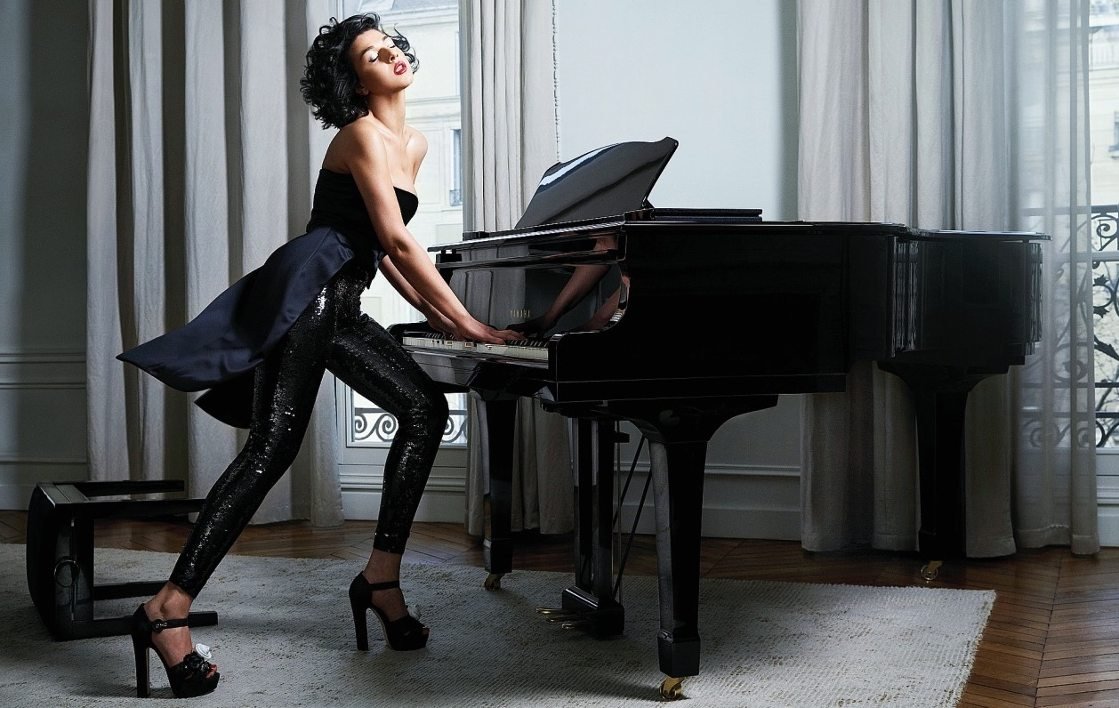
Whether in jazz or classical music, artists such as Diana Krall, Nina Simone, Carla Bley and Hiromi Uehara, or pianists such as Gabriela Montero, Yuja Wang and Khatia Buniatishvili, are still frequently reduced to entertaining or stereotypically “feminine” qualities.
Certain media voices indulge themselves by calling women artists valuable marketing products or burdening discussion of their work with sexist connotations.
When critics encounter the musical quality of a composer or instrumentalist such as Martha Argerich — still intensely active well into her late seventies — they sometimes believe the blunt sentence “she plays like a man” is enough.
But that supposed compliment does not describe professional quality.
It merely implies that she plays forcefully, dynamically and with command and purpose.
The “masters” of the pen never learned to formulate the more obvious truth:
Martha and her colleagues are the Beethovenian women of our time — in their own right.
Yes, they may have grey hair or uncovered shoulders.
They can be sexy, magical, virtuoso, mothers, sisters, wives, protesters, provocateurs and debaters.
And they have one shared name:
human being.
Here I insist on saying something that is still blurred on the stages and festivals of so-called serious music — E-Musik, Ernste Musik — in Beethoven’s country of birth, where I live.
Today there are relatively few pianists who truly have something distinctive to say.
Many lack the interpretive relationship with the instrument that gave masters such as Alfred Brendel, Vladimir Horowitz, Friedrich Gulda and Glenn Gould their unmistakable authority.
Today pianists are often celebrated for eccentric gestures and for producing themselves as a second Brendel or a second Glenn Gould.
At times we see male pianists performing with precisely the theatricality that, in an earlier century, was stereotypically expected of women.
Many of the women pianists mentioned above, however, no longer approach music, composition or instrument as weapons on a battlefield.
They are not fighting in the name of feminism or emancipation in the old sense.
They have been conducting that battle for years through their work — through playing that can be just as Beethovenian, Rachmaninoffian or, if you prefer the tongue-twister, Shostakovichian.
These women — with or without décolleté — keep alive the compositions of the famous male creators already mentioned, while also returning forgotten women colleagues to the repertoire.
They know how to endure even beneath the shadow of underestimation and sexist cliché.
And they have long since found their throne in music.
Gender clichés have long been, and remain, a mirror of society.
Today, in the time of COVID-19, art and culture suffer from isolation and silence and often seem deliberately pushed aside.
In the middle of all the troubles surrounding us, perhaps we should move closer to one another.
Women’s art must not be seen only through a male narrative.
In the end, what remains essential is the hope that one day the gender game among human beings will dissolve into sound.
For me, sound remains the truest form of love.
A toast — to Art.
© 2020 Eda Zari. All rights reserved. First published at Peizazhe të Fjalës.
Notes
[1] Counterpoint: the musical idea of “note against note”, independent lines acting in relation to one another.
[2] Symphonia armoniae celestium revelationum — Symphony of the Harmony of Celestial Revelations, a collection of Hildegard’s liturgical songs.
[3] Saint Hildegard von Bingen was born in 1098 in Niederhosenbach and died on 17 September 1179 near Bingen on the Rhine.
[4] For me, Clara Schumann’s Nocturne in F major stands as one of the essential statements of Romantic piano music, written while she was still very young.
[5] Emilie Mayer, German composer, 1812–1883. In the book Beethoven as Benchmark? Women Composers in the Shadow of the Cult Genius, Dr Martina Helmig describes Mayer as a “Beethovenian woman”.
CONTINUE READING →