Ennio Morricone — By Death He Trampled Death…
Eda Zari remembers seeing Ennio Morricone conduct in Cologne in 2016 and reflects on his film music, experimental practice, musique concrète, collaborations with Sergio Leone and his unique synthesis of the tonal, atonal, sacred and popular.
…and gave the music of this world something eternal.
It was 18 February 2016.
Lanxess Arena, Cologne.
I considered myself lucky that night; today I feel even luckier.
Nearly ten thousand people — on the arena floor, in the stands, galleries and boxes — waited in breathless anticipation for the legend to arrive onstage.
He came without fanfare, without a presenter announcing him, without effects à la “pop star”.
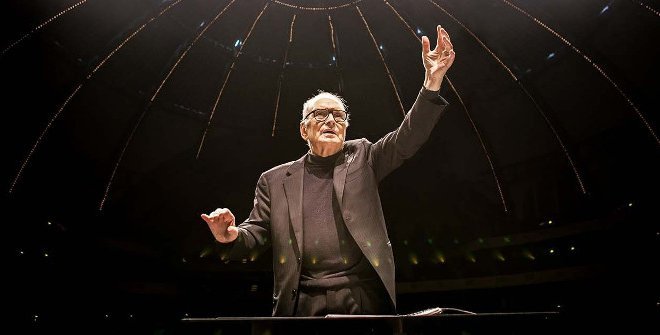
The Maestro approached the centre of the stage with modest, quiet, careful steps.
As he climbed onto the conductor’s podium, the enormous stage — free of those LED walls that often assault the eye — held three principal musical bodies:
the Czech National Symphony Orchestra and two mixed choirs, the Kodály Choir and the choir of the Csokonai National Theatre in Hungary.
The most celebrated composer in world cinema greeted the euphoric audience, which would not stop applauding, with a restrained but warm smile.
Nothing of the clichéd Italian grin.
He motioned gently for us to settle down and take our seats.
Morricone’s conceptual refinement followed a simple motto:
simplicity is more.
There was no giant cinema screen in the blue background, as so often happens in these hybrid “film music” concerts, where images are used to explain or illustrate the score.
Morricone’s music seduces and is absorbed by the listener without requiring the visual paradigm of the film to justify it.
That is the thought with which I sat down to listen properly.
The Maestro had made an intelligent selection and divided the programme into thematic suites.
The music became a distinctive current of sound, rocking and propelling the audience’s memory through countless cinematic scenes.
Morricone opened with a homage to director Giuseppe Tornatore.
The suite from The Legend of 1900 began with a harp solo.
The arena filled with a timbre of hope, dreams and the breath of a love not yet known.
Beyond their technical unity, the orchestra sent clusters of shimmering sound into the audience — sometimes spherical, sometimes fragile — while the choirs sang like mythical voices escaping from a magical forest.
But while I was enjoying that first suite, I was seized by a kind of panic.
It was the fear that seizes us in moments of absolute happiness, precisely because we know they cannot last.
I did not want the orchestra, the choirs, the music to end.
I wanted Ennio never to stop conducting.
I was already resisting the end of every suite before it had even begun.
Inside me, before its moment had even arrived, I could already hear the army of strings accompanying the solemn kisses in Cinema Paradiso; the flute taking up the love theme; the piano solo wrapped in the velvet of the double basses; the clarinet adding emotional weight to separation, loss and belated rediscovery.
And then those sounds arrived.
Morricone began conducting the Childhood and Manhood suite.
The scenes of the film rest on the gradual expansion of Toto’s theme, passing the melodic line from solo violin to flute, then to alto saxophone, until a coda crowned by woodwinds and piano.
Then came Malèna.
I immediately saw the boyish glances following Malèna’s dress, the two dark seams of her stockings running behind her calves, while the oboe — Ennio’s favourite instrument — washed the sinful thoughts of a boy whose face had barely met a razor, kneeling in imagination at her threshold.
Morricone was conducting Morricone.
For the eighty-seven-year-old Maestro, conducting seemed like a jubilant journey through time.
I watched him with that dizzyingly precise baton in his hand — no theatrical mannerisms, no empathetic gesturing for its own sake — and understood his message.
He was stripping the suites of the skin of legendary cinema, of the iconic garment and the metaphysical aura imposed on them by film.
Because, as Ludwig Wittgenstein wrote:
“The world is the totality of facts, not of things.”
Exactly.
Music begins to breathe when the score leaves the drawer and air becomes Music.
Then came the suites connected with the director whom Morricone said had given him world fame.
Or was it the other way around?
Sergio Leone called their partnership “an involuntary marriage”.
Because of that marriage, cinema encountered something it had never seen or heard in quite the same artistic dimension.
At least not before.
What remarkable times those were when, in 1964, Sergio Leone declared war on the “sacred” American Western through the films that came to be called spaghetti westerns.
He did not simply put dirty, brutal, thieving, cynical “heroes” on the screen.
He stripped them of the noble myths and models that had once represented the pioneers of an idealized America.
And as though that were not enough, the music itself carried disruptive tones and strong dissonance.
The unbearable lightness of playing could no longer remain safely in major keys.
Morricone brought the darkness of the Song of Death with him.
Thanks to Morricone, Leone’s films gained an extraordinary amalgam of human sound:
concrete music, a cabinet of owls, jackals, crows wheeling in flocks, flies over corpses, gusts of desert wind, scratches, tearing, whip-cracks, hoofbeats, Mexican whistles controlling horses, bells in abandoned villages, gunshots, detuned saloon pianos.
In other words:
a parodic symphony, a hand-woven tapestry of sound — never canned, always assembled acoustically à la carte.
Ennio did not write decorative background music.
He did not make “pictorial” music merely to support a cinematic image.
He recalled that Pier Paolo Pasolini once came to him with a list of composers — Mozart, Beethoven, Vivaldi — asking him to insert passages from their music because they fitted the images.
Morricone’s response was direct:
“Very well. Go to those composers and finish what you have in mind. But remember: I am a composer, and my work is composition.”
That is why the creative bond between Morricone and Sergio Leone had its own theorem:
visual dramaturgy plus multicoloured orchestral art.
The legendary ostinato in cinema.
Between commerce and the avant-garde, Bach and many other facts.
A day of mourning.
6 July 2020.
The Maestro left us.
After a conversation with a colleague — a composer and pianist at the Italian Cultural Institute in Toronto — about Morricone, we arrived at a famous Stravinsky observation about composition:
“Tell me how you listen to music and I will tell you how you write it.”
Beyond tonal music, Morricone considered the atonal sounds of everyday life essential.
He listened to the city’s narrow streets and corners:
tavern music, songs from Roman barbershops, harsh tones at railway stations, the quarrels of women neighbours beating dust from carpets, provincial weddings near churches, passionate amateur tenors singing through neighbourhoods, the sound of carpentry saws near his home — everything that belonged to urban musical culture.
He needed musique concrète [1].
He stored that entire sonic library inside his tonal memory.
“Notes, sounds — they are in my head. I write music in my mind, so I do not use the piano. When I put the idea onto the score, I always sit at a table, not at the piano. I use the piano only when I have to illustrate fragments of themes for directors.”
That was Morricone.
One of the defining features of his art is the conceptual separation he created from one film to the next.
He often begins the orchestral world with archaic fragments and sounds, bringing in instruments that do not belong to the standard orchestra:
rustic flutes, a pocket comb wrapped in paper like a primitive kazoo [2], harmonica [3], banjo, mandolin or folk percussion.
These become powerful sonic equivalents drawn from the sonic memory I described above.
They personify alleyways, empty landscapes, cactus fields, heroes, prostitutes and saints, mafiosi and godless loners, the human world and the metaphysical one.
The main themes of Once Upon a Time in the West, and especially the impact of the leitmotif in The Man with the Harmonica, demonstrate how deeply the Morricone sound comes from living urban timbres.
At that time, the harmonica was a highly unusual instrument with which to open the essential frame of a film.
That opening — insisted upon by Leone — becomes a messenger motif, creating the necessary emotional tension and leaving sonic traces later taken up by the Fender Stratocaster [4].
The inclusion of such instruments contributes to the unique sound required for sweat-drenched faces, duels and deadly “dances for two”.
Equally characteristic is the combination of orchestra with a cappella fragments and onomatopoeic choral writing.
Morricone often constructs a theme from a tiny cell.
In The Man with the Harmonica the repetition of a small three-note idea acquires iconic status.
Played on harmonica, it becomes an ostinato transmitting the mounting tension of the legendary pistol-duel scenes.
Something similar happens in The Good, the Bad and the Ugly.
There Morricone creates one of cinema’s most recognizable melodic signatures by imitating the howl of the coyote.
Just as classical music has the mysterious Tristan chord [5] in Wagner’s Tristan und Isolde, Morricone creates an ambivalent cry of danger through a compact tonal signal:
a caesura and a turning point at once.
In other films he adds electric guitars, ecstatic vocal coloratura, erotic telephone sighs, typewriters clicking in detective offices.
The whole narrative becomes a double-sided tonal and atonal mirror that gives his music its contemporary face:
sex, drugs and rock ’n’ roll, but also morbid suggestion, blood, paranoia and psychological games — depending on the film and director, especially in Pasolini.
Talking about the Maestro led us naturally to experimental music — to another Morricone, one that is not unfamiliar to his serious admirers.
He was an active member of Gruppo di Improvvisazione Nuova Consonanza, the improvisational collective founded by Franco Evangelisti and devoted to the discovery of new sounds.
Morricone engaged intensely with the Italian avant-garde.
That answers the predictable question from anyone who knows only one side of his musical personality:
Did Morricone compose only for Leone?
Of course not.
The album Musica su Schemi by Nuova Consonanza — I am proud to own the vinyl, inherited from a collection — released by Cramps Records in 1976, documents work based on twelve-tone and experimental music, strongly influenced by figures such as John Cage and Luigi Nono.
It explores atonal thinking and the use of real instruments not for their classical function but as sources of new acoustic discoveries.
Morricone’s extraordinary ear made a valuable contribution to the inclusion of serial and electronic techniques in experimental development.
It is fair to say that some of his film concepts were nourished by this atonal origin.
His relationship with serial music never frightened him away from the broader compositional techniques of the twentieth century.
In the Morricone universe, autonomous concert music and functional film music approach one another without damaging either style.
Instead, the meeting generates new aesthetic and tonal possibilities.
This also helps explain Morricone’s ambivalent relationship with his own enormous success as a Hollywood film composer.
Yet the Morricone icon knew how to make the right move at the right time not only in music but in life.
Chess helped him.
“Playing chess helps you in life. It trains you to adapt to joy and disappointment.”
Morricone was practical.
As an Italian householder and family man, he never hesitated to admit that serious concert music interested him deeply, but was a difficult way to feed a family.
Beyond the orchestration and film scores for Leone, and beyond roughly five hundred film scores, he also wrote or contributed music for hundreds of television productions, not counting advertising.
He tried almost everything, at musical levels and dimensions rarely heard before.
The Maestro also orchestrated highly successful songs for artists such as Milva, Gino Paoli, Mario Lanza, Chet Baker, Charles Aznavour and Miranda Martino.
At the same time he wrote works with sacred musical architecture, such as Vuoto di anima piena.
Morricone conceived such music so that it could also be performed outside church walls for a wider public, not necessarily only for a religious community.
That idea reminds me, in another context, of my own conceptual work on Entropy.
Morricone tried to include in his music only elements that conceptually served the compositional purpose.
In The Sicilian Clan he based his thinking partly on Johann Sebastian Bach’s Prelude in A minor, BWV 543 [6], for organ.
The central motif consists of only four notes.
On those notes Ennio built the core of the orchestral idea.
“It sounds and looks simple, but it took me more than a month to place a Sicilian motif over Bach,” Morricone told the German magazine Der Spiegel.
“I had two melodies fighting against each other because the Sicilian clan was fighting the French gang when Roger Sartet steals the jewels.”
The fact that the four notes can be heard as B-A-C-H is no accident.
It is an aficionado’s debt to the god of ideal music:
Bach.
The giant screen has known many great film composers:
John Williams, Jerry Goldsmith, Bernard Herrmann, Max Steiner...
For me, Ennio Morricone occupies the highest throne in film music.
I do not know how to end.
Actually, I do.
It makes more sense to listen to the Maestro’s music than to read all these lines.
So I invite everyone:
those who have never listened to him;
those who walked part of their life with his music;
those who lost Morricone and then found him again —
turn off the computer, turn off the phone, go to your own island of peace, the most gracious one you know, and listen to Ennio.
Today I will begin with Gabriel’s Oboe from The Mission.
Maestro — thank you, directly and from the heart.
Eda Zari © 2020. All rights reserved.
Notes
[1] Musique concrète differs from traditional composition in that concrete sounds from surrounding objects and environments — industrial noises, urban sounds, machines, sirens, doors and so on — are recorded and later processed in the studio. In simplified terms, abstractly composed music enters into a marriage with concrete sound.
[2] Kazoo: a small resonating instrument working on a principle similar to the old trick of blowing and humming through the teeth of a comb wrapped in thin paper, producing a muffled, saxophone-like buzz.
[3] Harmonica: a small free-reed instrument with parallel air channels, played directly by mouth using breath and tongue techniques. It appears widely in blues, jazz, folk and pop.
[4] Fender Stratocaster: one of the most famous electric-guitar models, associated with Jimi Hendrix and countless rock, jazz and metal guitarists.
[5] The Tristan chord is often described as one of the most mysterious and ambiguous chords in music history. Endless analyses have been written about it. It consists of only four different pitches, yet its resolution remains harmonically elusive, neither comfortably major nor minor.
[6] BWV means Bach-Werke-Verzeichnis, the standard catalogue system for Johann Sebastian Bach’s works.
CONTINUE READING →