The Charm of Vinyl and the Narrative of Music-Listening Culture.
A personal essay on the ritual of concentrated listening, the tactile pleasure of vinyl, childhood radio memories, streaming culture and why Palimpsest was released as a limited-edition double LP.
The one positive thing the coronavirus left behind was the slowing of everyday life that came with the pandemic.
People say character reveals itself in times of crisis, but crises also remind us of beautiful rituals and forgotten ceremonies.
Life suddenly stopped, and the effect of the crisis did not come like an avalanche. It came like snow, quietly and almost stealthily covering everything little by little.
Many of us began looking for ways to make isolation as inspiring or cheerful as possible for ourselves and our families.
During the long pandemic days and nights, I often heard friends say that in lockdown they had transformed the dinner table into a games corner.
Dominoes, a hand of cards, the rattle of the dice in Mensch ärgere dich nicht, Monopoly and games of charades helped provide amusement during that damned isolation.
Then I watched, in the news and on social media, people singing from balconies and musicians playing together over the internet, performing live from their homes.
And look what happened:
the crisis reminded us that leisure and the muse belong to a conscious state of being.
They are practices we cultivate — forms of active immersion that make us happy because we dedicate ourselves to something that has meaning in itself.
Perhaps during the first lockdown, when I was writing Këngëlutje kundër murtajës — A Song-Prayer against the Plague — for Peizazhe të Fjalës, I was also trying to show that the right music in a time of crisis can be good medicine for coping with emotional and social stress.
We human beings are, above all, narrative creatures.
We often understand our world through stories and songs.
For my part, I have always tried to shape a “film of the world” in my mind, placing myself and music within it, trying to understand the relationship between us.
What does any of this have to do with vinyl and with the narrative of musical listening?
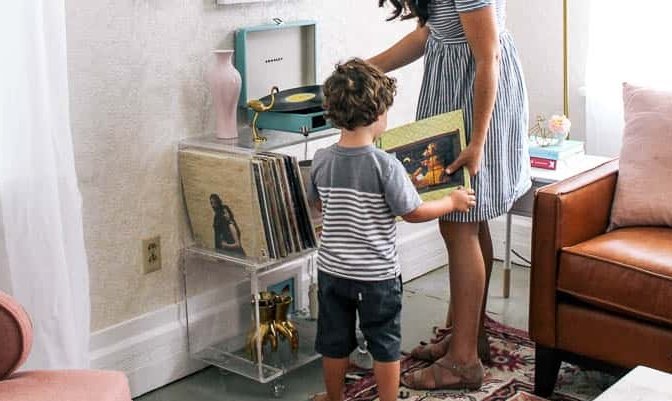
From the pandemic onward, I decided to revive at home, in the evenings, the beautiful ceremonies of listening to music, with each person choosing a record — a vinyl LP — or a favourite album.
Placing a beloved record on a Technics SL-1200M7LEG turntable [1], or on the Dual [2] — the latter adding a few nostalgic notes to the romantic mood — watching the needle travel through the grooves, turning the record over after twenty minutes: this whole ritual lent the monotony of confinement a precious charm.
It was like a package tied with a ribbon. When you open it, you are surprised.
Nothing is left to chance, because listening to music on vinyl means choosing.
For me, a record player [3] is like a fireplace without which the ritual cannot begin: the moment you switch it on, it spreads comfort and atmosphere.
A beautifully designed vinyl cover [4], with a booklet that you leaf through in silence, promises a kind of inward renewal.
The grooves of the spinning record, the look — and the smell — of the inner sleeve, the mechanics of the platter turning the vinyl, the strobe light [5] shining in the darkness of the room: all of it is seductive and fascinating.
It seems to whisper a declaration:
A passionate lover of music lives here.
A disc containing music?
“Utopian,” people must once have thought — before the first records were commercially produced in the late nineteenth century.
I will not hide the fact that, for me, an album is a tactile experience in its own right.
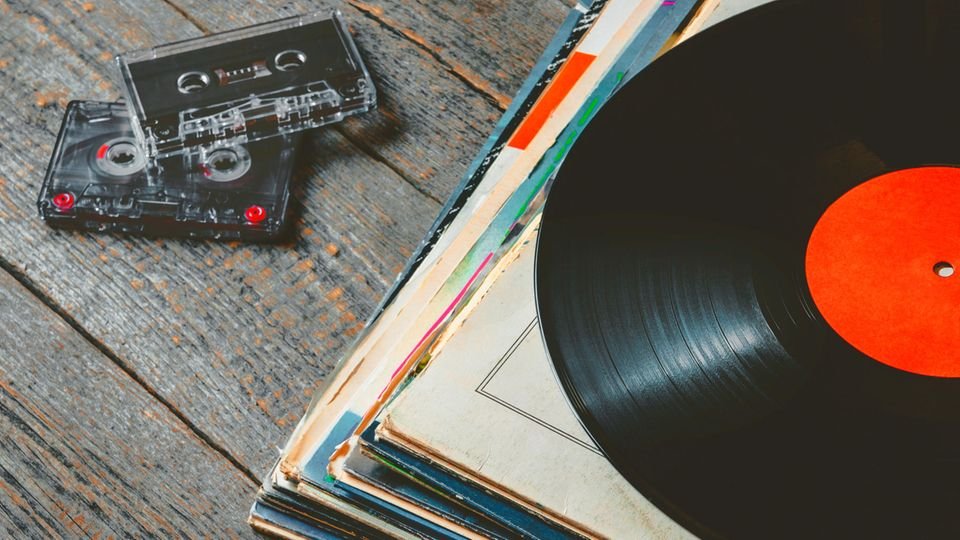
It includes the artwork on the cover and in the booklet. It includes the faint crackle — recalling the old Deutsche Grammophon shellac records [6] — that vinyl preserves across years, drawing beautiful moments and whole periods of life close again.
It can even set an imaginary film playing in your mind about the people from whom you inherited a vinyl or gramophone-record collection: how they personalized those objects, how they lived with them.
“Music, this organized human act, is an essential freedom, freeing us from the imposed beat of biological and physico-mathematical clocks. The time music ‘needs’ while we perform or experience it is the only free time we should enjoy before death.”
That is how the much-valued George Steiner invites us to think about it.
Personally, I regard music as a medium that has allowed me, since childhood, to witness something beautiful.
Ancient philosophers also understood the musical dimension in this way: they treated beauty as a virtue in itself.
Anyone who dedicates themselves to beauty — in music, in art, in modest pleasures, like a gardener tending lavender and jasmine, or simply by spending time with the person they love — truly lives nobly and more readily finds the muse of inspiration.
And when we speak about music, at its core it is made out of another human language, one that does not necessarily require formulation through words.
It expresses its own absolute with a precision beyond the reach of words.
Put differently:
is it not beautiful to build, organically, a period of rest away from the pixels of “smart” screens and Wi-Fi, and simply listen to and emotionally enjoy music?
But to make that possible, we have to take command of our own will.
You may quite rightly say that there are all kinds of ways to listen to music.
Everyone listens to music.
Everyone is surrounded by music.
Agreed.
But that sentence is both true and misleading, because it does not come close to describing the claim I am making:
attentive, concentrated listening — listening as an act in itself.
And here an unavoidable footnote appears.
I begin with the question:
Why do we listen to music?
Eating, drinking and even sex make obvious sense because they are fundamental to survival and clearly increase individual well-being.
Listening to music makes just as much sense.
Music rewards the brain by releasing dopamine — commonly called the “happiness hormone”.
At a subconscious level, we gravitate toward music that suits our mood.
Without realizing it, we choose music that corresponds with our state: in the car, at a celebration, while doing Pilates, or while cooking in the kitchen.
We know music has universal properties and affects us emotionally even when we are not conscious of it.
But we should also admit honestly that a large part of society consumes music so as not to feel alone, or simply for fast and easy entertainment.
That is not what I mean here by dedicating oneself to beauty, or by meeting music consciously and entering it as a fully conscious visitor, without noise and without simultaneously handling other things nearby.
“To sit alone, to read, to think without shouting and noise in the background has become almost an elite and difficult achievement. We live in apartments with thin walls from which the neighbour’s pop music arrives. In America, eighty-five per cent of young people can no longer read without listening to music. The young are afraid of silence.”
George Steiner writes words to this effect.
Have you not noticed it?
When you savour a book, or listen to music in comfort without doing something else at the same time, without multimedia radiation or social networks — Facebook, Instagram, WhatsApp and so on — the effect — that welcome sense of wonder — reminds us to develop new habits or cultivate good habits we have forgotten.
I belong to a generation that listened to music — beyond the facts of my own biography, in which music in my mother’s family was like a daily meal and I regularly went to the opera with my sister — through a wooden music cabinet and valve radios.
On winter nights my father had created a small luxury for me.
At the head of the divan on which I slept, he placed an Orion radio.
I regarded the radio as a generous old friend who, though already old, took the time to introduce me to music and artists about whom I knew nothing in those distant years.
I loved the sound of that radio: rounded, warm, accompanied by the yellowish light from the glass dial on which the station frequencies were marked.
I remember that late every Friday night, one of the Yugoslav stations broadcast big-band music, and the programme’s signature tune began with Take the A Train in Duke Ellington’s version, arranged especially for big band.
When my father and I sat listening to the radio together — may he rest in peace — the music often opened the door to memories, situations and events.
Once he told me:
“When I worked as a crane operator building the Palace of Culture in Tirana, month after month I put money aside to buy a radio. Later they told me it was no use; without authorization I had no chance. From friends I learned that a fanatic of Italian music named Spahi-Spahi sold an entire field in Sauk in order to buy a radio.”
I think of it today and something in me lights up.
My father considered it worthwhile to preserve everything connected with radio technology, portable radios, tape recorders and reels, and later cassettes and CDs.
At home we had three radios:
the Orion, a Mimoza and a battery-powered Chinese portable radio.
Some years later, around 1979–80, we bought a Grundig tape recorder [7] — that moment deserves a story of its own, but I will leave it for another time — along with those transparent BASF tape reels.
A little later, during my years at the arts high school, ferrochrome audio cassettes became the high point of my first tangible music collection.
Even today I remember how carefully I preserved all these media that were so precious to me.
Today, of course, it is extremely practical to pick up an iPhone — that object that stubbornly interferes everywhere, twenty-four hours a day, seven days a week, at every step of our lives — connect it via Bluetooth to a good system and search for music in the digital ocean containing millions of songs.
Yet the triumphal march of music streaming does not always feel entirely sweet.
Streaming has brought another cycle of consumption to the music market.
But this “good fortune” has also unsettled cultivated listening habits that audiophiles had lovingly built with passion.
Suddenly, the question of what music you listen to — not only in genre and style — no longer depends on the size of your collection of reels, records, cassettes and CDs.
It depends merely on whether you have internet access.
Without the slightest doubt, consumers will continue to use these functions.
The question is:
for how long, and in what balance?
Speaking from the position of producer and creator, I feel compelled to say this:
if we are speaking about music, it belongs to the deeper ambition of the music-maker that a musical work should be allowed a long life.
That means ensuring that a work exists not only on museum shelves or in archives as a score, but also as an object and testimony in the hands of listeners — for the sake of the music itself, so that it is not forgotten.
That is why I decided to release my latest album, Palimpsest, on vinyl.
Offering an album in a limited quantity — a Limited Edition — is, I believe, an intelligent contemporary answer that many artists now use to challenge the rhythm of the music industry in another way.
Personally, I feel that music on vinyl feels as though it returns something tangible to the physical world.
When someone comes to me and says they bought my record, it means something truly special to me as its creator.
Perhaps we have become accustomed to getting everything we want immediately.
But waiting for a song, an instrumental solo or a particular passage while the record turns, and actively following it, has a beauty all its own.
We should not forget, however, that in the end the decision belongs to the artist and creator, just as listeners have their own personal audiophile preferences.
Although producing a vinyl edition is expensive and difficult, the growing number of audiophile fans appear to agree that a limited product rather than a mass-series object can be worth every cent.
In this context I repeat my thesis, but also make a plea:
listening to music is losing its ceremonies, customs and the pleasure of anticipation — the feeling of waiting to hear something that you first have to unwrap.
After all, you bought it with your own money, or someone gave it to you as a gift, perhaps tied with a ribbon.
As in the past and still today, I still feel the need to experience the anticipation of a new album.
There is the smell that greets you when you open it for the first time in the shop — something that simply cannot be compared with searching for music through digital platforms.
As I hold a record in my hands, the album begins to acquire a personal life.
I make it mine, leaving fingerprints on the cover.
Why not?
I deliberately leave my trace there, declaring first of all to myself that this product, this music, this sound, the needle’s faint traces across the record belong to my own experience.
The unexpected return of vinyl to the market around 2014, now reflected in impressive sales figures, is repeatedly attributed not only to the haptic experience but also to the beauty of analogue sound.
Some may call it material obsession or even fetishism.
The fact remains that buying music on vinyl will remain with us for a long time.
I think of records and titles:
Blue in Green by Bill Evans, Acknowledgement by John Coltrane, Monteverdi’s Laudate Pueri, or albums by Anton Heiller — especially his interpretation of Johann Sebastian Bach’s Passacaglia.
I cannot omit O Fortuna from Orff’s Carmina Burana, Verdi’s Va, pensiero, or film scores long available on vinyl: the suites from Out of Africa and Somewhere in Time, or Ada’s Theme from Morricone’s 1900.
Without hesitation I can say that in those moments the world around me falls away and the music itself begins to turn with the record.
It is a feeling of being outside time and space.
When I listen to a record with my eyes closed, I am overtaken by what only music can do when it strikes the heart and is capable of shaking the foundations of your existence.
Where does the absolute happiness of listening to music on vinyl lie?
Through these ceremonies I increasingly feel myself moving away from haste and the tense rhythm of everyday life.
Immersion in sound and the emotional memory carried by a vinyl recording become a form of meditation — a way of stepping outside the commotion and the countless forms of noise and sensory pollution imposed on ear, eye and the whole being.
These days I more often deliberately listen to a complete record in the evening, deliberately, from beginning to end.
Combined with my fondness for Spirit of Wine [8], the result can be perfect.
Simply take time to close the day with a worthy moment of rest, comfortably listening to an album without multimedia radiation from other channels.
For me, listening to music can become an event — perhaps something for which we might meet, listen to vinyl together and share our own collections.
There, too, lives another form of happiness.
© 2022 Eda Zari. All rights reserved.
The article was published on 12 October 2022 by Peizazhe të Fjalës.
Eda Zari’s album Palimpsest is available as a Limited Edition double LP on Blue Ocean Vinyl.
Notes
[1] Technics: equipment for playing records. The company became especially well known for its SL-1xxx series; among the most famous models is the manually operated Technics SL-1200MK2, introduced in the 1970s.
[2] Dual was founded in 1907 by the Steidinger brothers in St. Georgen in the Black Forest, Germany.
[3] A record player is a device for playing discs. Its predecessors were mechanical machines invented in the late nineteenth century, including the phonograph and gramophone. Emile Berliner, inventor of the gramophone disc system, patented his gramophone in 1887. After electrically driven motors and electrical pickups became common, the modern turntable developed.
[4] A vinyl cover is the printed cardboard sleeve used to package records. Cover and spine design became particularly important for the marketing and distribution of vinyl from the mid-1950s through the end of the 1980s, when vinyl was the dominant format for recorded music.
[5] Many turntables carry rows of dots around the platter and a strobe lamp shining through a small window. The stroboscope is used to adjust platter speed accurately; its frequency corresponds to standard speeds such as 33 and 45 rpm.
[6] Shellac is a natural resin. When heated it is elastic enough for records to be pressed; at room temperature it becomes hard and durable, though brittle if dropped. Emile Berliner founded a company for manufacturing gramophones in the late nineteenth century.
[7] Grundig is a German electronics company founded by radio dealer Max Grundig, associated first with Fürth and later Nuremberg. Its major products included radios, televisions, tape recorders, video recorders and hi-fi systems.
[8] Spirit of Wine is the first brandy from Çobo Winery, aged for approximately six years in barrels previously used for some of the winery’s finest wines. It is valued for its aroma, body, intensity and long finish, qualities that make it a distinctive Albanian brandy.
CONTINUE READING →