
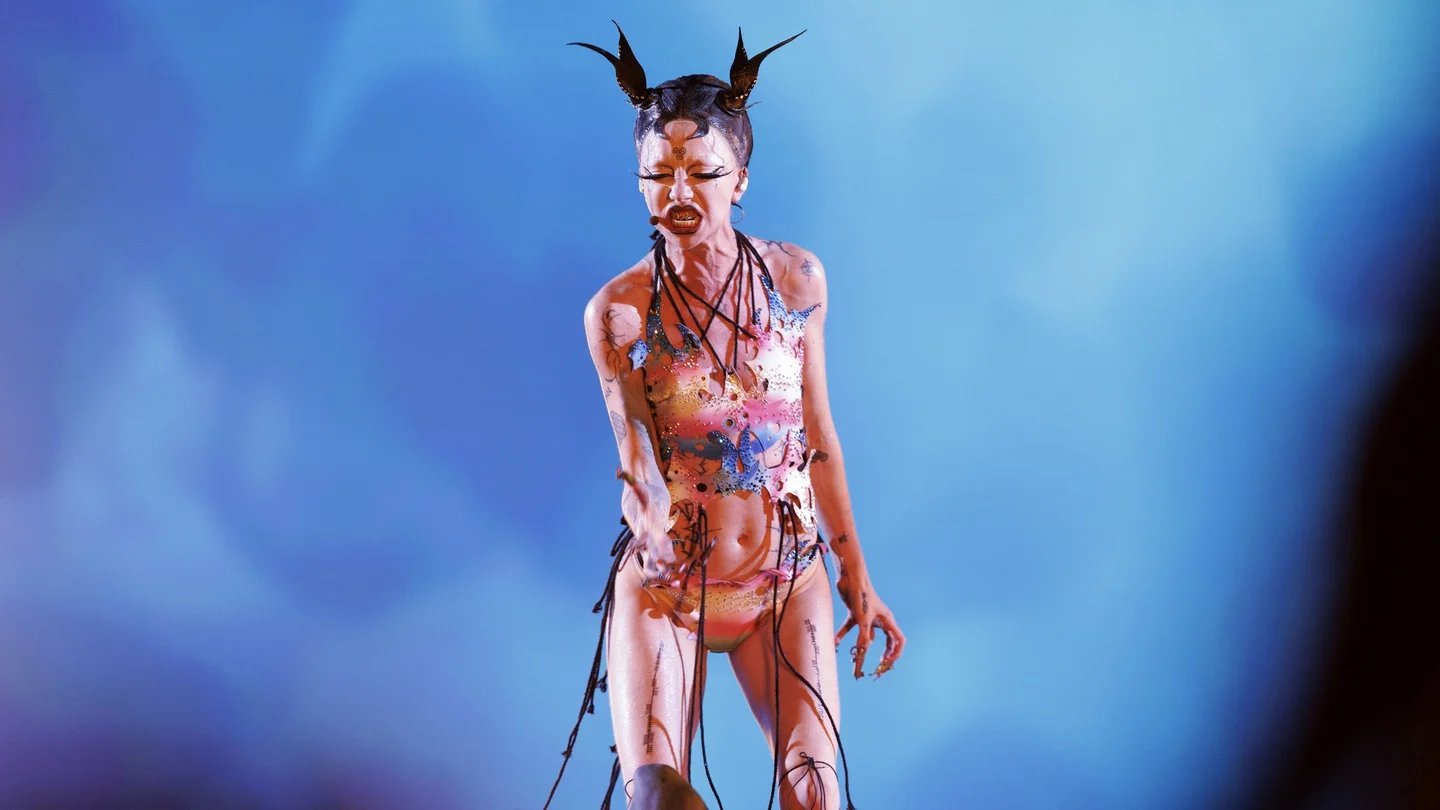
Artist or Robot? The Debate over Authenticity at the 68th Eurovision Song Contest.
A performer-producer’s reflection on Eurovision 2024: dazzling stage technology, next-generation audio, vocal perfection, the temptation of processing, and the artistic value of human imperfection.
First, a message for everyone taking part in Eurovision: please remember that sometimes “simplicity is more” — in other words, simplicity is an art.
Especially when it comes to fireworks, LED walls, technological glitter and, above all, reaching too readily for the Auto-Tune menu on vocals.
Despite the deep cracks in the façade of international musical unity at the European festival under its now rather ironic slogan “United by Music”, my reflection here will not concentrate on the geopolitical conflicts and debates that so often accompany the event.
A large number of performers did, however, end their appearances this year with messages of peace. Perhaps a small act of rebellion against the ESC rulebook?
Instead, I want to direct attention toward other perspectives — those of the creator, performer and producer.
In 2011 I happened to be an active member of the leadership of the Albanian delegation at Eurovision, which was held where I live, in Düsseldorf, at the Esprit Arena.
That experience gave me a close look at many of the ESC’s rules, criteria and principles, which were already being criticized at the time for their strongly commercial character and geopolitical influences.
After the avalanche of criticism and analysis that appeared that year through institutions and scholars connected to the study of popular music — including IASPM circles in Germany, Austria and Belgium — and through academic journals such as Popular Music, Music & Letters and the Journal of Popular Music Studies, which periodically publish research on the Eurovision Song Contest, its cultural impact, musical tendencies and artistic development, I rather naïvely hoped that the ESC might shift away from its commercial thinking and move closer to the essence the competition claims to embody.
Technically, I was fascinated by the way this year’s Eurovision combined extraordinary technology with inventive stage design.
Malmö Arena, with its movable LED cubes and floors, offered a striking visual environment for every performance.
From colleagues in the field and from technical information published around the event, it was clear that Malmö Arena was equipped with state-of-the-art technology.
Among other things, a range of cameras was used to create an unusual live visual experience and, above all, a meticulously engineered screen experience for viewers.
Anyone can find these specifications online.
Broadcast cameras: High-end digital cameras providing sharp, extremely clear close-ups of performers. Examples: Sony HDC series, Panasonic AK-UC4000.
Robotic cameras: Remote-controlled cameras running on rails or dynamic moving cranes for unusual angles and perspectives. Examples: Telemetrics OmniGlide, Shotoku TR-T Touch.
Handheld / shoulder-operated cameras: Cameras used by camera operators for flexible shooting and close-up audience imagery. Examples: Sony PXW-FX9, Canon EOS C70.
Railcam systems: Cameras moving along rails beside the stage to create smooth, stabilized movement without shake.
Spidercam systems: Cameras suspended on cables and able to move freely over the stage, creating distinctive aerial perspectives.
Other technologies:
LED walls and floors: A very large LED surface — around 1,000 square metres — formed the visual centre of the show. It enabled spectacular visual effects and animated backgrounds with interactive elements.
Movable LED cubes: Five large LED cubes floated above the stage, contributing additional visual effects.
Augmented reality (AR): AR elements were integrated across the festival nights to insert virtual objects and effects into the real environment.
Digital stage mapping: Projection and mapping techniques were used to place complex images and animations onto the stage and props, creating an immersive environment.
Lighting: A sophisticated lighting system delivered dramatic effects and supported the atmosphere of individual performances.
Pyrotechnics: Fireworks and other pyrotechnic effects highlighted selected moments in the show.
Does this technological menu leave you thinking HD, 4K, 8K, 16K?
It is almost unnecessary to add that the evolution of visual components for mass entertainment seems to have advanced at something close to the speed of light.
But what about the audio — the singer’s voice, the performer?
Eurovision has now met “Next Generation Audio” (NGA).
The MPEG-H Audio format (1), also known as Next Generation Audio, has changed the way we can experience sophisticated sound content — both directly, in a theatre, concert hall or stadium, and indirectly through television — as during the ESC 2024 shows.
NGA can deliver immersive 3D audio and improve sound quality for a striking listening experience.
The term Next Generation Audio — one of the latest developments in radio and television broadcasting as well as live streaming — sounds seductive, yet at the same time invites scepticism.
Singers use high-quality condenser microphones designed to deliver clear, precise sound, connected to wireless transmission systems that allow free movement on stage.
Amplification and signal processing run through professional mixing consoles and audio interfaces.
Yet despite all that technology, my concern is that performances often appear exaggerated and overly focused on visual effects, losing sight of the actual core of what is still supposed to be a song competition.
As a singer I know the challenge of singing live while performing complex choreography.
In recital concerts, opera and musical theatre, a professional singer knows how to adapt vocal technique to the demands of the stage.
During an aria, when emotional depth and vocal substance are essential, movement is reduced in order to preserve breath control and economy of vocal projection.
During recitative passages, where acting and dialogue take priority, the singer can move more freely.
Eurovision is different.
A performance is limited to only three minutes, and singers are expected to remain in almost constant motion, dancing and executing elaborate choreography while simultaneously maintaining an apparently flawless vocal line.
The paradox becomes particularly visible when we compare Eurovision with long operatic performances, musicals or concerts, where singers have space to recover and refocus on vocal technique.
At Eurovision, vocal perfection seems to be presented as an effortlessly achievable standard, regardless of the physical demands of the performance.
This leads me to ask whether that perfection is real, or whether it is partly an illusion created through studio technology.
It is certainly tempting to believe that singers achieve such an extraordinary degree of vocal control while performing complex choreography.
But there is another problem.
If everyone begins to sound the same, music becomes predictable — and therefore boring.
It is important for the ESC to find a balance between technology and the preservation of each artist’s individuality and unique style.
You do not need much imagination to test this for yourself. The three festival nights can be found on YouTube: compare the startling vocal consistency — and monotony.
Compared with earlier contests — where an occasional wrong note or mini-scandal during a live performance gave the competition a certain life — I was struck by how, this year, performers’ voices seemed to sit at the same vocal level across all three nights.
Backing vocalists, too, sounded consistently perfect in intonation, while performers remained immaculate and camera-ready.
That inevitably raises questions about the live authenticity of the performances.
Instead of genuine interpretation and musical spontaneity, performances risk becoming prisoners of a script — an elaborate plan fixed in advance — and can lose their real connection and emotional exchange with the audience.
Is it not ironic that artificial intelligence, precisely through its ability to imitate and generate, makes us recognize how precious and irreplaceable our genuine, unprocessed, imperfect emotions are?
Eurovision 2024 was a spectacle of dazzling light, choreography and polished vocals — vocals that at times sounded almost too perfect to be true.
At a moment when technology can create an illusion of perfection, where, then, does artistic truth remain?
In the end, perhaps it does not matter to the average viewer whether every voice sounded exactly as it did in the room.
The Eurovision audience is not made up only of music critics; it is a mass audience looking for entertainment.
In that respect, ESC 2024 fulfilled its mission.
But for those seeking more than an explosion of colours and sounds, a bitter aftertaste remains — not to mention the slogan “United by Music”.
It is the taste of illusion, artificiality, of an artificial reality that may be beautiful but can never replace the unprocessed beauty of a human soul in song.
Perhaps it is time for Eurovision to return to its roots, abandon part of the façade of technological perfection and offer us again what makes music truthful.
Or perhaps it is time to accept that perfection in music, as in life, is an unreachable illusion.
Maybe the time has come to celebrate imperfection: to embrace the crack of an off-pitch moment in the voice, an uncertain note, every tremor of the heart that makes us feel human.
After all, as Leonard Cohen wrote: “There is a crack in everything. That’s how the light gets in.”
Perhaps those cracks, those imperfections, are what make music real, alive and capable of touching us deeply.
© 2024 Eda Zari. All rights belong to the author.
Note: Images are from BRS Media.
(1) MPEG-H Audio can, for example, bring something of the stadium experience into the home during a televised football match. You can hear supporters from every side, the referee’s whistle from the correct direction and sports commentary as though the commentator were nearby. It can even allow the listener to personalize the level of different sound elements and emphasize the ones that matter most.
CONTINUE READING →