“Orgy” — Else Lasker-Schüler
Eda Zari’s Albanian rendering of Else Lasker-Schüler’s 1910 expressionist poem “Orgie”, accompanied by notes on the poet, Franz Marc and their remarkable artistic correspondence.
Else Lasker-Schüler German poem written in 1910 Albanian version by Eda Zari
Orgy
Evening kissed, mysteriously, the budding oleanders. We played and built Apollo’s temple and, brimming with longing, reeled into one another.
And the night sky poured its black fragrance into the swelling waves of the brooding air, and centuries sank and stretched themselves and rose again, golden, into tendrils forged of stars.
We played with the happiest happiness, with the fruits of paradise in May, and in the wild gold of your tangled hair my deepest longing cried out, like a black bird of the jungle.
And young heavens fell, unforeseeable, wild-sweet scents; we tore away our coverings and cried out — drunk on the must of the air.
I bound myself to your life until I dissolved entirely within it, and again and again took shape, and again and again dissolved.
And our love exulted in song — two wild symphonies!
Original German
Orgie
Der Abend küsste geheimnisvoll Die knospenden Oleander. Wir spielten und bauten Tempel Apoll Und taumelten sehnsuchtsübervoll Ineinander.
Und der Nachthimmel goss seinen schwarzen Duft In die schwellenden Wellen der brütenden Luft, Und Jahrhunderte sanken Und reckten sich Und reihten sich wieder golden empor Zu sternenverschmiedeten Ranken.
Wir spielten mit dem glücklichsten Glück, Mit den Früchten des Paradiesmai, Und im wilden Gold Deines wirren Haars Sang meine tiefe Sehnsucht Geschrei, Wie ein schwarzer Urwaldvogel.
Und junge Himmel fielen herab, Unersehnbare, wildsüße Düfte; Wir rissen uns die Hüllen ab Und schrieen! Berauscht vom Most der Lüfte.
Ich knüpfte mich an Dein Leben an, Bis dass es ganz in ihm zerrann, Und immer wieder Gestalt nahm Und immer wieder zerrann.
Und unsere Liebe jauchzte Gesang, Zwei wilde Symphonieen!
Albanian translation: Eda Zari, Düsseldorf, 10 May 2020
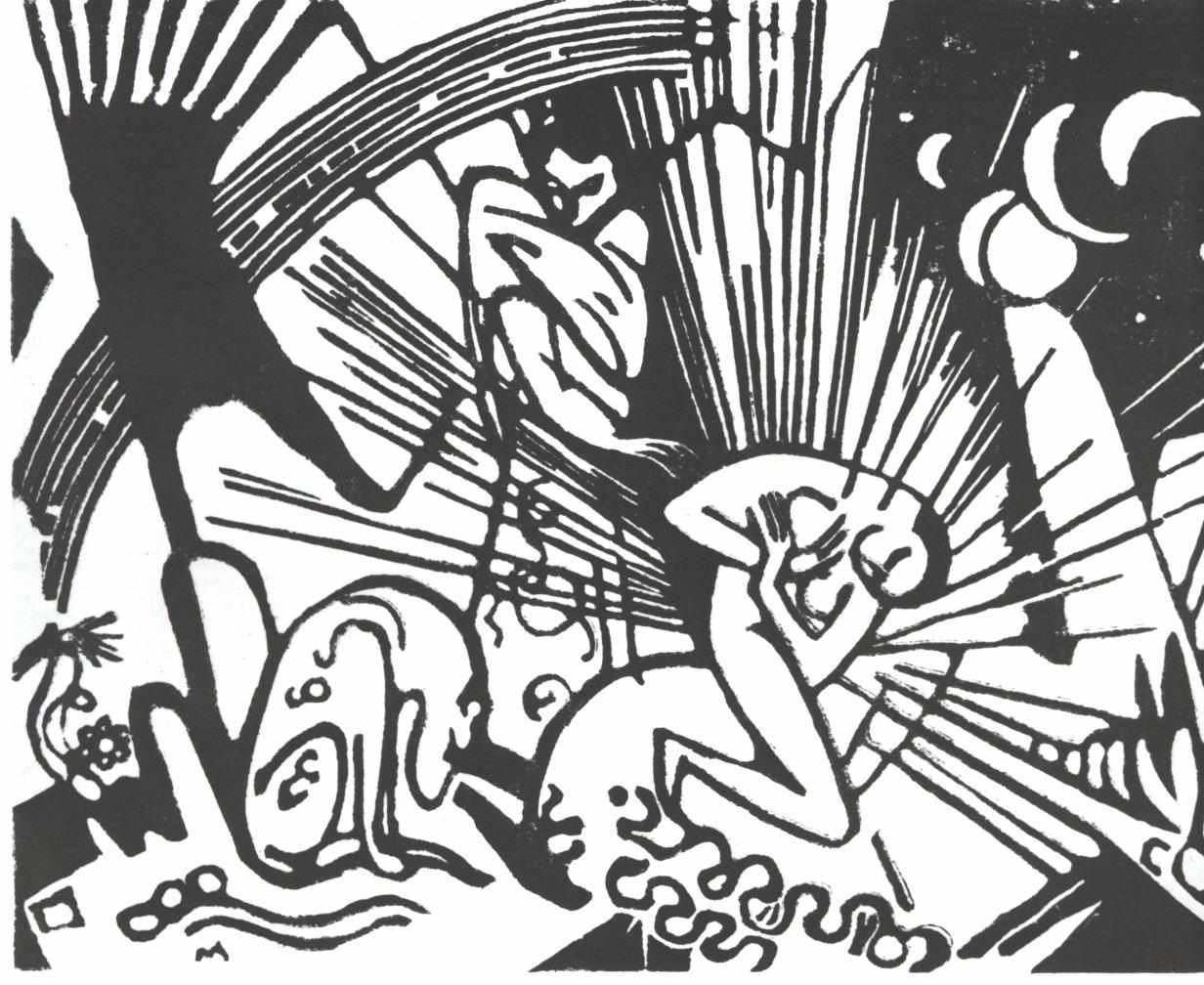
Illustrations: 1 — Franz Marc, “Versöhnung” (“Reconciliation”). 2 — A postcard by Franz Marc to Else Lasker-Schüler.
Notes by Eda Zari
Else Lasker-Schüler was born in 1869 into a German-Jewish family in Wuppertal. Alongside poems of deep religious inwardness, love poetry occupies a vast space in her work; the two currents repeatedly flow into one another.
Her later writing is particularly rich in biblical imagery and references to Oriental culture. Lasker-Schüler’s language is remarkably free of the formal rules of her time. She is fearless about invention and willing to create, for poetry itself, a kind of “Neusprache” — a new language.
I first encountered Else Lasker-Schüler — often simply called Else Lasker, and described as a “Wunderkind” because she could read and write at the age of four — while reading about the painter Franz Marc.
Between Prince Jussuf von Theben, Lasker-Schüler’s alter ego, and Franz Marc of the Blue Rider circle, there was a vivid correspondence until the summer of 1914. Of their private greeting cards and hand-painted letters, 66 by Lasker-Schüler and 28 by Marc have survived.
What makes this friendship so distinctive is the double artistic gift of both figures. Marc’s cards and letters reveal, beyond the painter, a poetic imagination; Lasker-Schüler answers not only in an elevated poetic language but as a remarkable draughtswoman and illustrator in her own right.
With Meine Wunder (“My Miracles”, 1911), Lasker-Schüler established herself among the defining voices of German Expressionist poetry.
© 2020 Eda Zari. All rights reserved.
CONTINUE READING →