
The New Album “Palimpsest” — Poradeci | Heine
Eda Zari introduces Palimpsest, her bilingual Albanian-German concept album built around the poetry of Lasgush Poradeci and Heinrich Heine, where memory, exile, language and music are layered like a rewritten manuscript.
“Palimpsest” Lasgush Poradeci and Heinrich Heine
My life is a palimpsest — and so is yours.
“What is the human brain but a vast palimpsest? My brain is such a palimpsest.” — Thomas De Quincey, Suspiria de Profundis
The metaphor belongs equally to the heart, to poetry and to music.
Parchments and manuscripts that were written over again were called palimpsests. That layered complexity forms the inner architecture of Eda Zari’s bilingual Albanian-German album Palimpsest.
Five years after her previous album, Eda Zari returns with a new work — again, a concept album.
Unlike the “supreme love” through which John Coltrane, in his suite A Love Supreme, gave musical expression to his aspiration to live a truly spiritual life, Zari’s aim is to create a musical work of spiritual scope around the poetry of Lasgush Poradeci and the cosmic concept that the poet places above all others: Love.
Musically, Zari moves naturally among jazz, cinematic music and the broad field of world music.
To honour Lasgush Poradeci’s verse, she developed her own melodic-rhythmic vocal vocabulary, designed to translate the poet’s words into song without flattening their singularity.
Why Palimpsest?
“With Palimpsest, I want to bring the richness of Lasgush’s Albanian into coexistence with a newly written acoustic melodic-rhythmic vocabulary, brought into the realm of song.
The past becomes present by being rewritten — perhaps as a song one remembers easily in the morning, perhaps as a leitmotif between two people who have promised themselves to one another.
Over time, the ‘palimpsest’ can acquire new layers.
This concept allows us to experience the past within the present and the present within the past, through the unpicking and re-stitching of memories, language, words and sound across time and space.
Through music we rewrite our own biography with the poet’s words: the sensation of what love sounds like, or how the pain of farewell might be composed.
The album can be leafed through like a book of sound.
Music is ‘read’ just as poetry is ‘sung’.
You read the sound, and you sing the experiences as a biographical collection — as a continuing, intoxicating narrative.
Palimpsest seems to speak directly to the core of my album concept, which rises from a biographical triangle between me, Lasgush and Heine.
It is this creative trio in exile, separated and connected within a temporal trinity: past, present and future.
For me, the beauty of music is that it exists both with and beyond every verbal message.
And what better evidence could a poet find for the success of a verse, or a composer for a composition, than the musical consonance of tone and word?”
— Eda Zari
The question seems, at the same time, to contain its own answer — and to have given Zari the final impulse to build the central pillar of the album.
A number of historical parallels and points of divergence between Llazar Gusho and Heinrich Heine strengthened the idea of creating a record not only around Poradeci’s own poetry, but also around his Albanian translations from Buch der Lieder by the great German poet.
All of this develops in the name of a humanist principle in art: the encounter between poetry and music, and bilingualism within one artistic idea — a response to the realities of contemporary multicultural and multilingual coexistence.
“In Heine and Lasgushi I hear the reflection of inner sounds translated into verse.
The poets’ lines reveal the tremor of their inner song.
That is why Lasgushi gives us his insistence on the new song:
‘From the depth of my own self I will sing a new longing.’
Sometimes someone would read or recite Lasgush to me — even from a distance, over the telephone — or address me through his lines with affection:
‘You are coming from so far away…’ ‘Because I found you as a woman, therefore…’
Immediately I would begin orchestrating the colour of the melody in my head like a film score, while deliberately keeping away from an overt ethnic treatment, without leaning heavily on folkloric rhythm, melody or harmony.
I see the emotional melody of Lasgush’s verse entirely as a cinematic event, or as a photograph recounting fragments of Poradeci’s biography in Graz, Cologne, by the lake, in Bucharest.
I see the interiors, the characters, the woman, the mise-en-scène.
And I see the solitary nights of the Jewish poet Heine in exile, wandering through the ‘Capital of the Revolution’ or the ‘Pantheon of the Living’, as he called Paris — the place from which he wrote about disappointment, hatred, love and longing for Düsseldorf, the city of his birth.
For that reason, the greatest care, the direction and the very essence of the melody are completely dependent on the semantic substance of the word.
The word influences my voice, my tonal emphasis, phrasing, intimate colouring, a cappella segments and lyrical recitative, in order to give the poet’s song the truth it needs.
In this way the word becomes more durable — made enduring through sound.”
— Eda Zari
The powerful symbolism of Palimpsest lies in threading the memories of heart and mind along a single red line of sound.
It is a musical vocabulary rewritten over a poetic vocabulary.
It is a garment of love that Zari, through her voice, wraps around Lasgush’s word.
In collaboration with Henning Jung and Leon Brückner, and through new compositions, Palimpsest leads us on an inward journey through the soul — through layers of longing, hope, separation, loss and rediscovery; through the physical and the spiritual.
It is a journey in which the written word is rewritten through music not only in the form of a score, but also performed and sung.
Poetry comes alive through sound every time it is played and sung again, generating an acoustic space that gives the work a new dimension and carries it toward an entirely new completion.
Poradeci writes:
“…The essence of lyrical poetry is spiritual music, and spiritual music is created by spiritual tone, and spiritual tone by spiritual trembling — movement, spiritual shock — while that spiritual shock, or to use a neologism, spiritual emotion, is created by nothing more and nothing less than inner poetic inspiration, which is seen, felt and understood directly in the emotional transfiguration of the poet’s present idea, feeling or image…”
_________________________
Concept and composition
Giving voice to the poems — poems that Llazar himself frequently revised and rewrote — was a bold challenge and led this song cycle into different musical directions, without forcing it into one named genre.
Over a three-year process — including the confrontation with the pandemic — we managed to uncover many layers and colours within the poems and use them musically.
Lasgush’s poetry, together with the poems from Buch der Lieder so masterfully translated by him, became an inexhaustible source of inspiration not only for me but also for the artists participating on the album.
— Eda Zari
Through Zari’s polyphonic vocal layers, the repetitive guitar figures of Henning Jung — himself deeply interested in repetitive music — the rhythmic variety of percussionist Rhani Krija (Sting), and the balafon, the listener is drawn into vivid soundscapes and shifting rhythmic environments.
The idea of repetitive motifs grows naturally out of the very structure of the verse.
Repetition changes the way the listener finds orientation not only in the word but in the sound itself.
It invites the listener into an active position, almost encouraging them to imagine the rhythmic energy or the next word before it arrives.
Drawing on aesthetic principles familiar from film music, the arrangements deliberately open some ballads with bandoneon, performed by Santiago de Arias of Buenos Aires, a student of the great Argentine bandoneonist Dino Saluzzi.
With his a piacere playing in the spirit of Tango Nuevo, Arias paints the restlessness of the two poets and enriches the string ensemble with a rare melancholic nostalgia.
These introductions create direct contact with the listener.
In “Morgens steh’ ich auf und frage”, for example, the bandoneon gives way to a duet between mother and son — Eda Zari and Henning Jung — sung in German and Albanian.
Through their different voices and interpretive identities, they expose the essence of waiting and the ache of an absent beloved.
The ballads “Ewigkeit — Përjetësia II” and “Prandaj” are especially striking.
Pianist Maestro Frank Chastenier works from improvisational technique, working with pianistic minimalism and a harmonic elegance that holds and surprises the ear all the way to the coda.
Zari and her carefully selected musicians seem determined not to submit blindly to any one musical genre, but instead to remain faithful to the precision of the poetic message.
A first-class line-up
“For the musical development of the album, beyond its other conceptual dimensions, it was important for me, retrospectively, to listen closely to all of my previous albums.
I also listen to a great deal of film music, which is itself part of my working life.
Anyone who deals intensely with the relationship between poetry and music — especially in film music — knows how difficult it is to turn thought into the sound of a moving image.
Because of my enthusiasm for film and particularly for film music, I never abandoned the idea of assembling an ensemble of musicians capable of producing a cinematic sound in which Lasgush’s word could rise above minor and major tonal environments, while places, events, the woman and the friend could be completed through sound.
For this I brought on board my favourite pianist and sound aesthete Frank Chastenier; the renowned Moroccan percussionist Rhani Krija, who is present throughout my albums; virtuoso double bassist Martin Gjakonovski; Berlin trumpeter Sebastian Studnitzky; New York drummer Jochen Rückert; the excellent Buenos Aires bandoneonist Santiago de Arias; Belgian bassist Nicolas Fiszmann; guitarist Henning Jung, who is also my son; and the string and brass groups from IMM Düsseldorf.
This mixture of musicians gives colour to the cinematic sound of Poradeci’s poetry and also mirrors my own cultural stations between Germany, Albania and beyond.”
— Eda Zari
How does a word clothe itself in sound?
Although “translations of Poradeci’s texts into German are usually condemned to fail,” as Hans Joachim Lanksch has said, Eda Zari appears to take on, through voice and music, the task of “translating” these texts for German-speaking and wider audiences — audiences for whom Balkan turbo-folk clichés are not enough.
The processes of thought within the texts become emotion through Zari’s distinctive voice and through the instrumentalists around her.
The poetry therefore becomes tangible beyond cultural and historical boundaries.
The arrangements are conceived so that, aside from the singing voice, acoustic instruments remain predominant.
Making an album under unusual conditions
“Being alone in the studio, singing without my colleagues physically present, intensified the feeling of absence and the longing to create together.
The songs themselves speak about love-longing, so what moves from my sound and breath toward the listener is also the desire to see one another again, to make music together again, to praise love among the public — with the public.
That is my greatest wish now.
That is why I insisted on this idea: to bring colleagues together during the COVID-19 period in this way, to cross all the barriers and share something of the spirit.
At its core, Palimpsest can also be heard as a collection of deeply personal declarations of love and longing — sung and sung again, spoken anew in corona and post-corona times.
Almost none of the musicians who appear on this album ever met together in the same studio.”
— Eda Zari
Yet the instrumental lines, played by internationally known musicians and layered over time, one after another, formed a puzzle whose result is an artistically coherent production.
On it, Zari demonstrates not only her ability as a vocalist but also as a producer.
Whatever the circumstances, all the threads of the production ultimately converged in her voice.
Together with producer Henning Jung and arranger Leon Brückner, she realized the demanding artistic concept of Palimpsest.
Zari’s artistic identity results in a vocal layering that is deeply authentic and highly distinctive.
Palimpsest in two languages
With Lasgush’s Albanian, as with the original German, Heinrich Heine’s lines sound warm through Zari’s voice — touched by solitude, but never by pathos.
The same is true of the German language of Hans Joachim Lanksch, who translated Poradeci’s “Ewigkeit — Përjetësia II”.
“I kept asking myself:
In which language can I express feeling, longing, loss and love most fully?
In which language is there still something missing, something that does not yet feel sufficient?
During my years in classical music, I sang in many languages: Italian, Czech, Hungarian, Latin.
But in this context, Heine’s language, his lines in German, and Llazar’s Albanian versions are genuinely moving.
They justify my desire to keep my homeland and my second home connected through poetry, music and culture.”
— Eda Zari
Eda Zari has now lived in Düsseldorf for three decades — more years than she spent in the country of her birth.
Yet she seems deeply grateful to this cultural mixture, because it allows her to mirror in her music the cultural stations and inflections between Germany, Albania and the wider world.
It is no coincidence that the culture of the city in which she lives is strongly present in her work.
Düsseldorf was a place where Robert Schumann and Felix Mendelssohn Bartholdy worked and developed their artistic activity, and it was also the birthplace of poet Heinrich Heine.
“My classical compass has always drawn me toward the song repertoires of Mendelssohn Bartholdy and Schumann and toward their musical responses to Heine’s poetry.
For years I had been working with the correspondence between Heinrich Heine and Robert Schumann, where contrasting views appear regarding the relationship between language and music.
For my own project, the persistent example of Schumann’s engagement with Heine’s poetry was particularly meaningful — and so was the challenge of carrying Lasgush’s poetry into song.”
— Eda Zari
Thirty-one years of Eda Zari’s life between Albanian and German now bring us a “hidden glow” inside the palimpsest of mind and heart:
Lasgush Poradeci and Heinrich Heine.
“My life is a palimpsest — and so is yours,” says Zari.
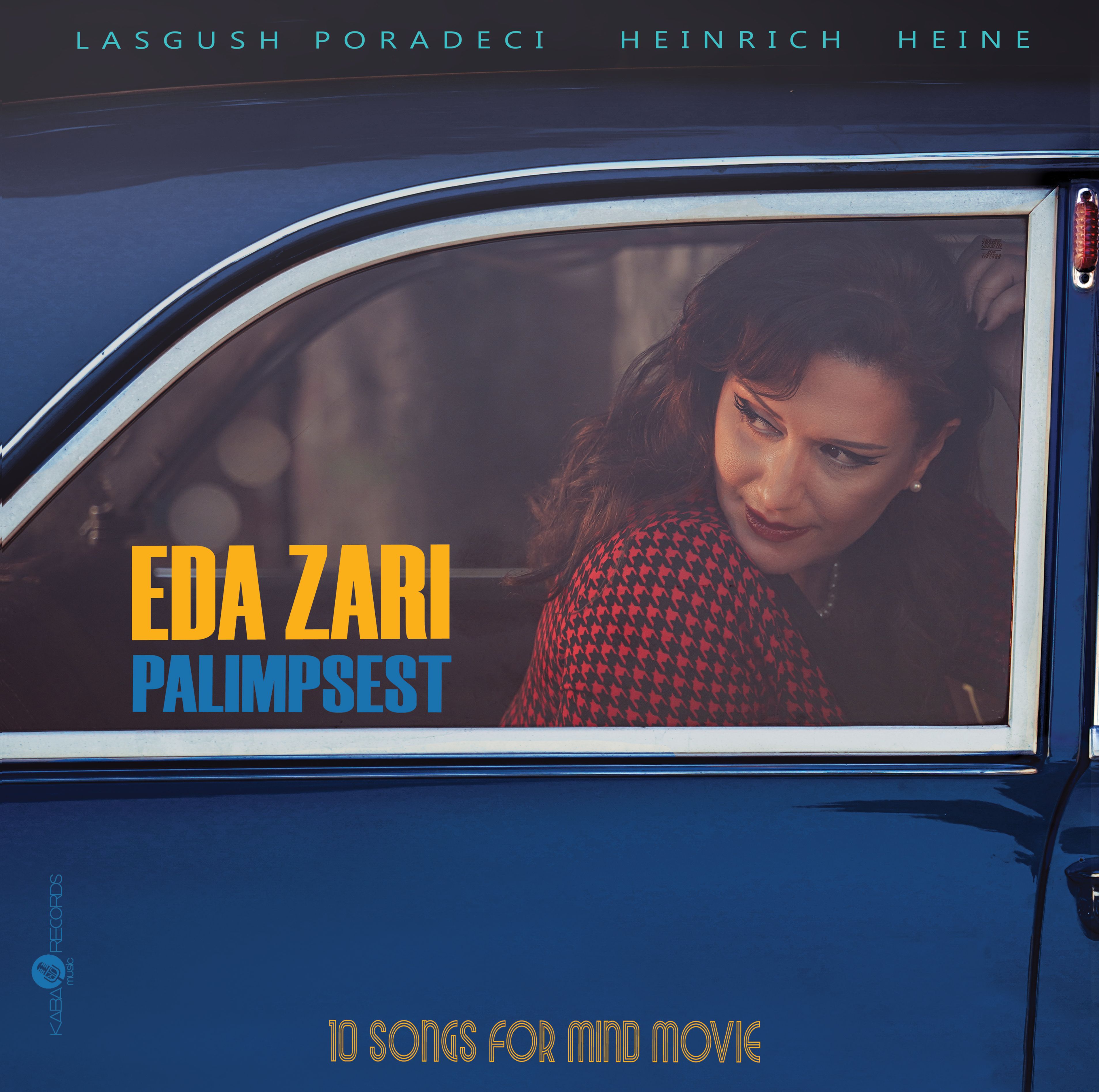
The album Palimpsest — Lasgush Poradeci & Heinrich Heine — contains ten songs for the mind’s cinema.
It became available on Spotify, Apple Music and worldwide digital distribution on 9 October 2021, with pre-order beginning on 2 October 2021.
A physical analogue edition was released through Kaba Music Records: a limited worldwide run of 300 copies on 180-gram double vinyl in ocean blue.
The vinyl edition was scheduled for release on 28 October 2022.
© Eda Zari / Kaba Music Records 2021. All rights reserved. Photo and cover art by Ergys Shehu.
CONTINUE READING →