
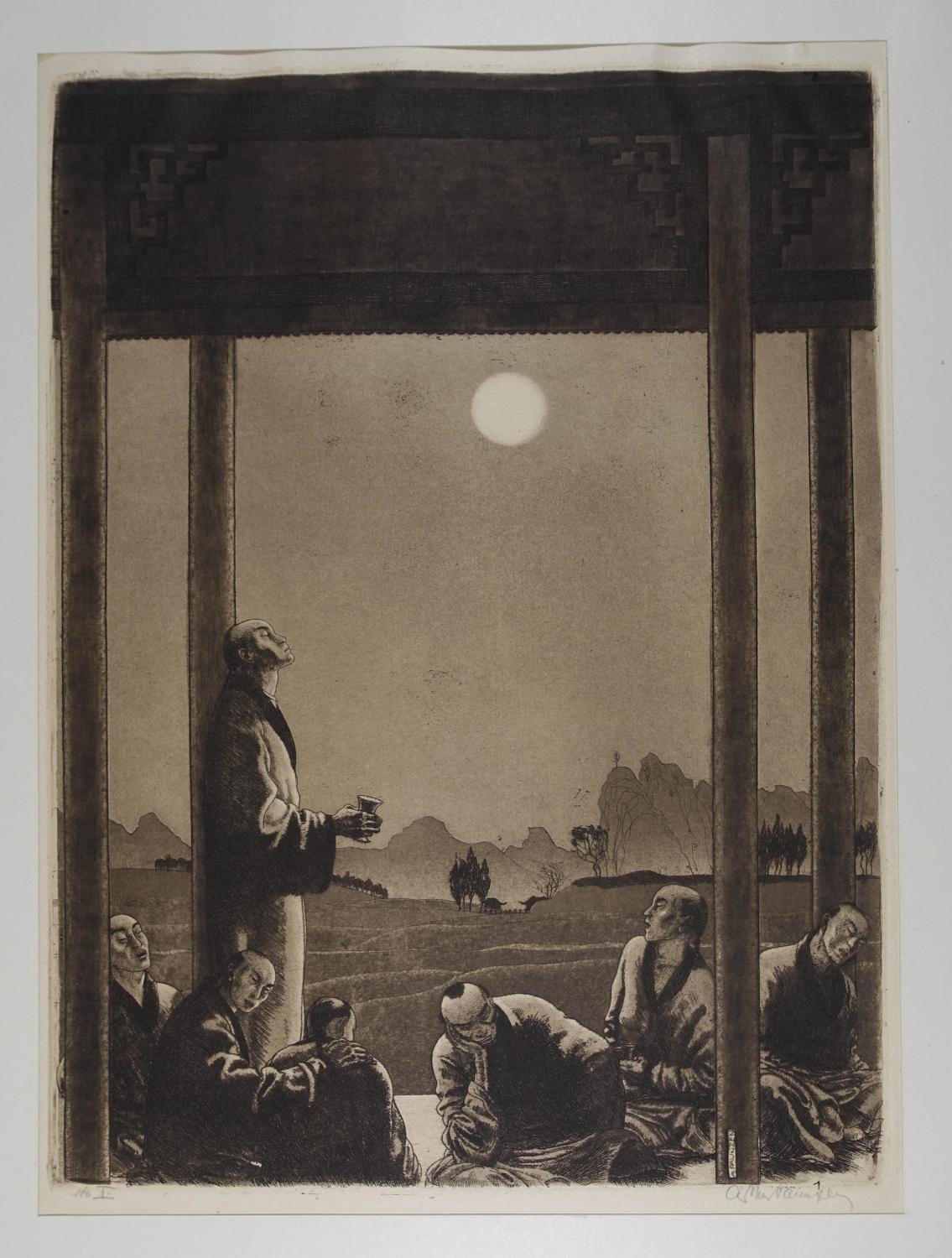
The Drinking Song of Earth’s Sorrow — Gustav Mahler.
Eda Zari’s Albanian translation of the opening song from Gustav Mahler’s Das Lied von der Erde, with notes on Li Bai, Hans Bethge, impermanence, time and the philosophical architecture of Mahler’s late work.
The Drinking Song of Earth’s Sorrow
From Gustav Mahler’s Das Lied von der Erde — The Song of the Earth. Poem after Li Tai-Po, in the German version by Hans Bethge. English rendering based on Eda Zari’s Albanian translation.
Already the wine beckons in the golden goblet, but do not drink yet — first I will sing you a song.
The song of sorrow shall ring laughing into your soul.
When sorrow draws near, the gardens of the soul lie desolate; joy and song wither and die.
Dark is life, dark is death.
Master of this house! Your cellar holds an abundance of golden wine.
Here — this lute I call my own!
To strike the lute and empty the glasses: these are things that belong together.
A full cup of wine at the proper moment is worth more than all the kingdoms of this earth.
Dark is life, dark is death.
The vault of heaven is blue forever, and the earth will stand firm for a long time and blossom in spring.
But you, human being — how long do you live?
Not even a hundred years are given you to delight yourself in all the rotten trinkets of this earth.
Look down there!
In the moonlight upon the graves crouches a wild, ghostly shape.
It is an ape!
Listen to how its howling shrills into the sweet fragrance of life.
Now take the wine! Now is the time, companions!
Empty your golden goblets to the bottom!
Dark is life, dark is death.
Notes by Eda Zari
Farewell, isolation, transience, beginning and end, past and future — Time in its many faces — and finally the dialogue with nature, love, life and death: these were the philosophical dimensions on which Gustav Mahler built the architecture of his final works, above all the epic song cycle Das Lied von der Erde.
By one of those accidents through which miracles sometimes happen, Mahler’s friend Theobald Pollack, a councillor at the Vienna court, gave him in 1907 a small book containing texts that dealt precisely with such themes: Die chinesische Flöte, Hans Bethge’s collection of free German adaptations of classical Chinese poetry.
In keeping with the Asian fashion of the Art Nouveau period — an era that, in Oswald Spengler’s terms, sought to balance the “decline of the West” with ideas from the Far East, especially the unity of nature and the human being — Bethge selected poems from the Tang dynasty and adapted them into German.
Bethge himself knew that this “China through European spectacles” was not philologically exact literature. Yet Gustav Mahler made something extraordinary possible from it.
The Drinking Song of Earth’s Sorrow is the opening movement of Das Lied von der Erde, and from the title alone we feel the contradiction.
“Dark is life, dark is death” is its inexorable refrain — inside a drinking song, a form that one would naturally expect to be cheerful.
This ambivalence, the simultaneous affirmation and negation of life, runs like a red thread through the entire cycle.
In the second song, the romantic correspondence between human beings and nature is marked by a longing for protection, buried beneath symbols of transience and fading.
In the third, imagery of the mirror intensifies themes of self-awareness, the self and the individual.
That is why the chord echoing the final word of the cycle, ewig — “forever” — gathers together the essential tones of the whole work. Yet its harmonic incompleteness seems to suggest the endless effect of time.
1. Hans Bethge was a successful editor and mediator of modern German and foreign poetry. He became particularly known for his editions and adaptations of classical Oriental poetry.
2. The engravings associated with this text are by Arthur Paunzen, born in 1890. Paunzen dedicated six engravings to Gustav Mahler’s Das Lied von der Erde; Vienna, Richard Lanyi, 1920. Source: Collection Archive for Art and History, Berlin.
Eda Zari Düsseldorf, 16 May 2020
© 2020 Eda Zari. All rights reserved.
CONTINUE READING →