Revealing the Personal and Unique World of Singer Eda Zari — Deutsche Welle / Suzanne Cords
Deutsche Welle profiles Eda Zari’s journey from Albanian iso-polyphony and classical vocal training toward jazz, improvisation and the contemporary sound world of Toka Incognita.
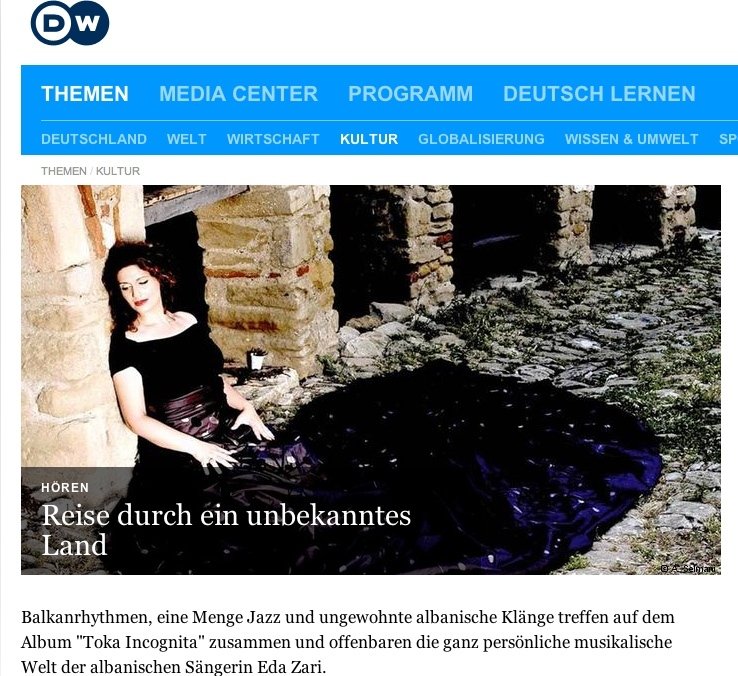
Balkan rhythms, a great deal of jazz and unusual Albanian sounds meet in the music of Eda Zari.
Eda Zari was born in Tirana, Albania.
The Albanian singer grew up learning a vocal style whose tradition reaches back more than a millennium.
In 2005, UNESCO proclaimed Albanian iso-polyphony a Masterpiece of the Oral and Intangible Heritage of Humanity as part of its programme to protect intangible cultural heritage.
At Albanian family gatherings, village festivals, funerals and weddings, men and women join together in singing the bordun — a sustained choral drone above which two or three soloists raise their voices.
The Lela musical family of Përmet developed an especially masterful form of iso-polyphony.
They sing, play a range of instruments and devote their lives to music.
Eda Zari absorbed the traditional rhythms of her homeland and proved herself a gifted soloist at an early age.
She sang traditional repertoire while simultaneously studying classical opera.
With the exception of a few masters such as Beethoven and Mozart, Western music was largely forbidden in the isolated Albanian society of Eda’s childhood.
Jazz instead of opera
“Of course we listened secretly to Italian radio at home, and sometimes someone would smuggle in a record,” the singer recalls.
So rock, pop, funk and jazz were not completely unknown to her when she moved to Germany in 1990 at the age of eighteen.
She was fleeing a regime that had killed her brother and continued to threaten other members of her family through association with him.
Building a professional career at home seemed impossible.
She left Albania and continued her training as an opera singer in Cologne, Germany.
Zari completed her studies as a coloratura soprano but says she was never disciplined enough for a conventional operatic career.
“The corset was too tight, and I couldn’t embellish the singing the way I wanted to,” she says.
Musically she wanted to break free and fell under the spell of jazz, where spontaneity and improvisation were possible.
Tradition dressed for today
The singer does not, however, want to deny her musical roots.
They form a deep layer within the melodies she composes.
She has described Albanian music as magical and sees her task as dusting it off and giving it a place in contemporary music.
“As an Albanian musician, there is nothing more natural than allowing structures from the music of my country to flow into what I write,” Zari says.
“It is not about homeland or a search for identity. It is about letting Albanian musical structures enter my music as enriching elements.
“But they are not alone. Indian and other Eastern rhythms are also very present in my music — my band is extremely cosmopolitan.”
Polyphony à la Zari
Jazz becomes the element that unifies the different musical languages brought together by Zari’s group.
“It is a carpet underneath everything else, and I weave pearls and ornaments from my own musical universe into it,” Zari explains.
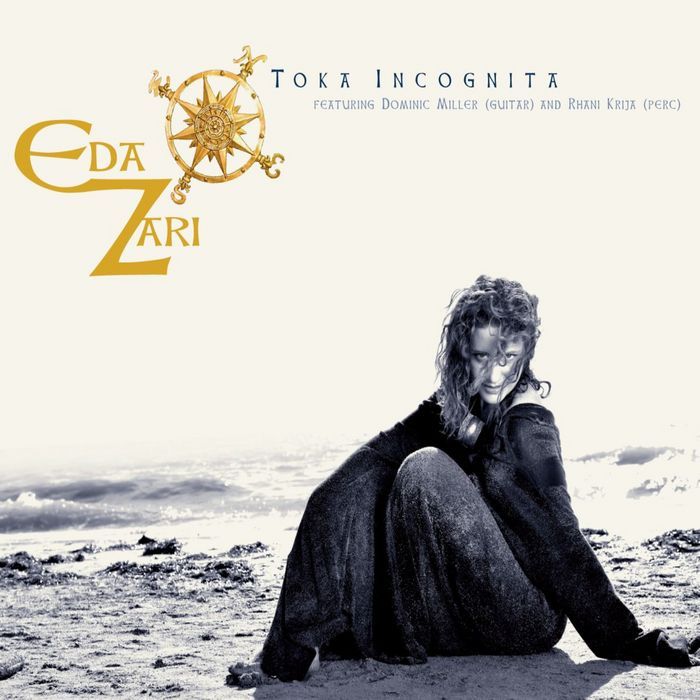
Listeners can discover a great deal on the album Toka Incognita.
One example is that the structure of polyphonic singing can also be reproduced instrumentally.
Its instrumental counterpart is associated with kaba music, another form cultivated to a high level by the Lela family of Përmet.
When the model is recreated with instruments, the solo voices may be represented by clarinet and violin, while lute and tambourine imitate the sustained choral drone central to iso-polyphony.
In Eda Zari’s compositions, bass, saxophone, piano, clarinet and harp generate the multi-voiced structure.
For the project she also brought in guitarist Dominic Miller and percussionist Rhani Krija, both long-time collaborators of Sting.
Eda Zari’s voice floats above this carpet of sound — at times joyful and magical, at times melancholic or seductive.
The lyrics evoke coquettish quarrels, a full moon, the call of a nightingale and the love of a mother for whom her child’s smile is worth more than all the gold in the world.
Zari wrote nearly all of the material herself.
In the song Kroi, however, she immortalizes her favourite poet Lasgush Poradeci, whose verse captures the microcosm of a village in pre-industrial times.
Yet love remains the subject there too: in the shy glances of a girl toward a boy who is only too pleased to help carry water home from the village spring.
Eda Zari travels through an unknown land.
In her suitcase she carries magical melodies and the universal theme of love in its many forms.
She dedicated Toka Incognita to her murdered brother.
Because, after all, love is immortal.
Deutsche Welle Suzanne Cords 17 April 2012
CONTINUE READING →