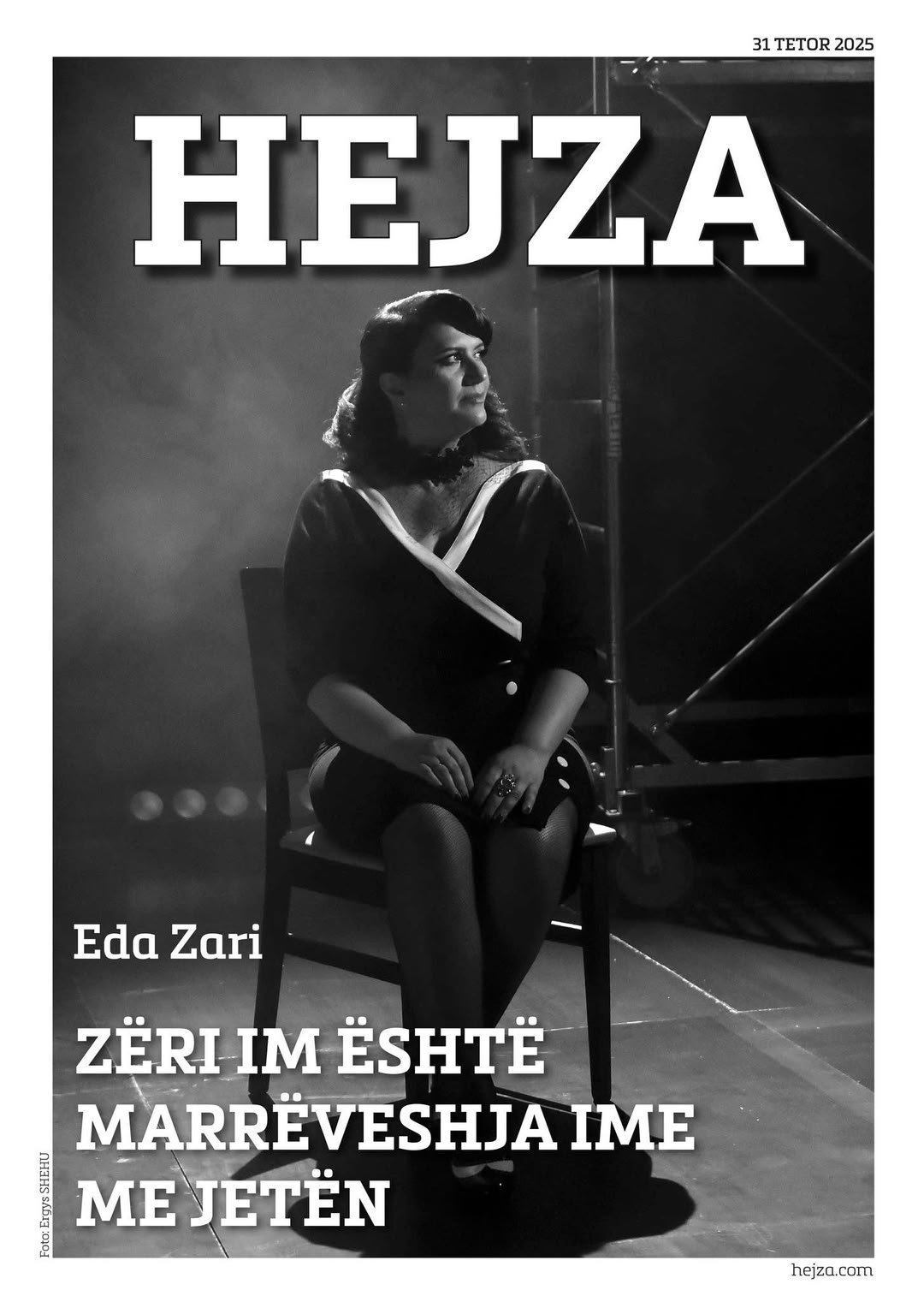
HEJZA in Conversation with Eda Zari
“My voice is my pact with life.” In this long-form HEJZA interview, Eda Zari reflects on Albanian polyphony, jazz, artistic freedom, migration, memory, the ethics of listening and the role of culture in a democratic society.
MY VOICE IS MY PACT WITH LIFE
Every sound born from her voice is a window onto silent emotions. Eda Zari does not merely interpret music; she makes it speak about life and inner memory. In every silence, in every breath, a new dimension of beauty is revealed. She reminds us that art is not only something to be heard, but a profound experience of the spirit. To see the world through her voice is to understand the depth of being.
Avni HALIMI
On the Albanian music scene, the name Eda Zari is a beautiful exception: a voice that has woven the roots of traditional polyphony into the horizons of contemporary jazz.
She is one of those artists who built their journey beyond the country’s borders without ever losing touch with the essence from which they came.
Born in Tirana and educated in Germany, Eda Zari has built, upon the foundation of Albanian heritage, a new musical universe in which every sound becomes a deep cultural and emotional experience.
From her earliest years in Germany she began to be recognized as an exceptional jazz interpreter, collaborating with well-known European musicians and developing a language of her own, where improvisation meets meditation and tradition becomes a source of contemporary inspiration.
Her albums Toka Incognita, Statement, Entropy and Palimpsest bear witness to an unbroken search for harmony between the ethnic and the universal, between memory and renewal.
In them, Eda Zari does not sing simply to repeat a heritage. She transposes it into the present, making audible to today’s generations a tradition that often remains silent in the depths.
Her voice — deep, warm and capable of carrying a broad range of feeling — has become, for many listeners, synonymous with an Albanian spirit seeking dialogue with the world.
In her international concerts, from Berlin to Rome, from Tirana to New York, she has represented an Albania that speaks through art rather than through clichés.
For Eda Zari, music is an ethical and aesthetic act: a way of keeping collective memory alive and of transforming nostalgia into creative energy.
In this interview for HEJZA, Eda Zari speaks with rare candour about her relationship with her voice, her roots, the diaspora and art as a form of positioning oneself in relation to time.
She appears as an artist who does not seek to impose her sound, but to listen to the silence from which music emerges.
A voice that belongs not only to one place, but to everyone who experiences art as a way of surviving spiritually.
HEJZA: True art is often born from a silent collision between the old and the new. In your work, you are among the few who have courageously brought Albanian polyphony face to face with contemporary forms such as jazz and experimental music. Is this a way of “rescuing” it from the folklore museum, or an act of love intended to keep the past alive? What happens to a song when we remove it from its traditional context?
EDA ZARI: For me it is essential to stay away from phrases such as “true art” or “true artist”, because they simply create confusion. What is true for me is not necessarily true for you.
For that reason I prefer to speak about meaningful art, or art with impact — art that has the power to revive something and leave behind an inspiring model.
At the beginning, when I started my activity not merely as a singer but as a creator at the end of the 1990s, far from my father’s land, I did not have a “rescue mission” in mind.
I acted instinctively, guided by the desire to pass on the musical tradition of the Lela Family — a rich chest of music and childhood memory.
It would not be honest to tell you that this was an actio ratio, a fully conscious act of reason. At that age I believed that things that come from the heart always acquire larger dimensions.
I did not try to imitate. I transformed only the harmonic carpet of traditional music, creating what I believe was an honest dialogue between what had been and what it might become.
Yet during the process I discovered something that seems paradoxical: what I had thought was a choice “of the heart” was in fact also a process of the mind.
It was a radical decision that crossed the false division between brain and heart and brought them together for a larger purpose.
“Rescuing polyphony” from folklore museums was not really a choice. It was an unconscious fusion of old and new.
What I began as an act of rescue became an organic union that transformed the chest of my past into a living force in the environment where I worked — and transformed me as well.
It all emerged naturally as I confronted my identity within a multicultural world on the international stage.
Folklore museums — not only ours — as they are often conceived today, can turn heritage into a passive object: an archival recording heard only at festivals or in academic studies, without creative interaction.
I believe every song has a life of its own. Songs do not arise from nothing; they are born out of a social and cultural context.
When an Albanian polyphonic song, a lament or a wedding song is taken out of its social skin and away from its essential purpose, there is a double risk.
The song can become an aesthetic object — something that belongs to no one and carries no active force in our lives.
I see myself as living in a glass house, so I cannot throw stones at anyone who approaches traditional songs with methods or arrangements according to their own taste.
This is not a judgment. It is an awareness.
My work is not simply to make music, but to honour the essence of a heritage.
I believe the line between rescue and cultural appropriation is extremely thin. And that line is not defined simply by the act of rearranging, but by the means, the “spices” used and the musical maturity of the artist.
My responsibility is to ask whether I am serving the song or serving my own ego.
Am I transforming the song into a beautiful object without a soul, or am I giving it a new life while preserving its essence?
That is the question I always carry with me.
The second danger can be the careless transposition of emotion.
A polyphonic song expressing profound grief or a joy that rises in waves, for example, can be reduced into a quickly manufactured product, in which its complex emotions are replaced by a commercial feeling.
To avoid that danger, transposition has to be understood as a careful dialogue between the song’s “geological” layers.
I believe the creator’s task is to preserve essential elements — the “mineral layer”, the core of the tradition, as Professor Ramadan Sokoli suggested — while reflecting a new reality without erasing the past.
In that process, I have discovered something new by returning to the fundamental question that troubles me:
“What does my personal song sound like when it embraces the past?”
HEJZA: In this creative act, where the ancient voice of a polyphonic song is blended with jazz harmony or the textures of experimental music, one question often arises: How much can a song change without losing its soul? Where is that invisible boundary between artistic transformation and being stripped of origin? Is this a danger you feel during the creative process, or do you believe the essence of a traditional song can survive and be reborn in every new form?
EDA ZARI: The soul of a song does not die.
The boundary? There is no boundary. There is feeling.
If you feel the soul, it lives.
It does not matter whether you do it through jazz or experimental music.
The difficult part is listening.
Listening to what has not been said. To what has been hidden.
That is the essence.
Not the notes. Not the rhythm. The soul.
And that soul continues to live only if you have heard it.
Personally, I believe in custodianship. I believe the essence of a traditional song is capable of surviving in every new form if it is treated as a dialogue with tradition and kept alive within the current Zeitgeist.
I do not hesitate to bring Oscar Peterson to mind — the legendary jazz pianist who adapted traditional songs in his performances.
He was deeply committed to pushing toward the boundary while preserving emotional truth and the freedom of improvisation.
HEJZA: Polyphony itself is an art of voices coexisting, an internal dialogue that does not need a conductor but requires mutual listening. When you place this ancient form alongside the structures of modern improvisation, what happens to that “old ethics of listening”? Does your music preserve this spirit of co-creation, or move it into another dimension? Could we say that you yourself have become a “meeting point” between two eras, two sensibilities, two worlds?
EDA ZARI: That is a very good question.
Let me put it briefly.
That old ethic of listening — the way people listened long ago when the wise person began with “once upon a time” and eventually arrived at a moral — exists in jazz as well.
It is the same thing.
Listen — respond.
That is music.
Polyphony has no conductor. Jazz does not need one either.
The singers listen to one another. So do jazz musicians.
Today it has even taken on another dimension.
The two are one.
Old world — new world.
There are not two worlds.
There is one.
One conversation.
And I am simply one voice in that conversation.
A meeting point, as you call it — yes.
But the meeting point is not everything.
It is only a moment.
Then you move on.
And the song must continue to be played, not sit there preserved in a tin.
HEJZA: For many people, confronting tradition brings a particular fear: the fear of appearing old-fashioned, or of confusing innovation with betrayal of one’s roots. Have you ever felt this tension as an Albanian woman artist in the diaspora — between loyalty to tradition and the need to be artistically free? Is it a burden, a privilege, or a natural act that simply occurs within the soul of a “true artist”?
EDA ZARI: I see myself simply as a human being — as a creative being, not necessarily as “woman — artist — Albanian” — labels that come afterwards.
Those are market labels. They are not the essence of who I am.
Fear? There is no room for fear.
The fear of betraying one’s roots and the need for artistic freedom is not a dilemma belonging only to diaspora artists. It is a fundamental question faced, I believe, by all creators wherever they live.
Tradition as an invisible boundary?
There are no boundaries.
There is only music.
Either you have it, or you do not.
The tension you mention is not a burden.
Nor is it a privilege.
It is simply a journey.
You take what you have from your history, your blood, the music you have heard.
For me, this dilemma between loyalty to tradition and the need for artistic freedom is an ongoing process of self-definition, shaped by a long and rich musical journey.
My journey begins with the kaba of Çobani and with the songs my grandfather Mane Lela sang — one of them “Tanë moj Tanë”; who still knows it?
Then at primary school, pioneer songs were imposed on us, things like “My rifle, my most faithful companion” — absurd, but true.
At nine I was dying to hear jazz big bands, and I managed to hold the second voice when Doris Day sang “Que Sera, Sera (Whatever Will Be, Will Be)”.
At eleven I encountered the operatic world. My sister took me to the Opera and Ballet Theatre, and I saw La Traviata for the first time.
At twelve, I realized that my voice was placing itself naturally. I could feel it resonate and vibrate through all the cavities of my head.
That instinctive discovery of the passaggio — the free transition from chest register to head register — was a crucial point at which my intuition became technique.
I experienced it like a bridge, a door opening.
No one told me: “You have to do this or that.”
My voice itself was showing me where it could be freest, strongest and most honest.
That is how we learned to work together: I as the mind, the voice as a new inhabitant of my soul.
And that sensation of internal control, that freedom of movement, is why I knew I was doing the right thing.
From childhood I loved jazz and film music without limits, and I could keep tracing the line all the way to what is mine today.
In 2014 I dared to touch Byzantine music.
What am I trying to say?
This diversity is not simply a list of influences. It is a rich internal structure that allows me to see every genre from a new angle.
But when you mention tension, the attempt to monopolize Byzantine music was something that truly did create tension for me.
It was not only an artistic debate, but a philosophical challenge to the idea of cultural ownership.
Can a tradition become someone’s “property”, or is it a universal inheritance that belongs to everyone?
That confrontation taught me that music is not a marble David, immobile forever, but a river.
It has to be free to find its path, even if that means leaving religious walls or ascetic laboratories.
So I do not choose between two worlds.
I want to build bridges.
I accept the inheritance, but I do not accept restrictions.
My roots are not a chain but an anchor.
Let us call it a kind of artistic courage: it is not about following rules, but about listening to the inner voice that guides you toward everything that is sound and circulates within our language and roots.
HEJZA: In a world rushing after noise, image and immediate consumption, art that demands sensitivity and concentration increasingly seems “out of step with the times”. Your music, Ms Zari, asks for deep listening and an inner rhythm, and so becomes an act of resistance to this accelerated climate. How does an artist like you preserve this “slow time” in an age that demands only presence and exposure? And what is the cost of remaining faithful to the spirit when the market often asks only for form?
EDA ZARI: All right, I understand.
This is a matter of pathways.
We have to move beyond the flower and speak about the difficult truth that an artist has to be heard.
It is not about “slow time” or “spirit” against “form”.
I hear this question often, and I am tired of romantic answers — whether from colleagues, in so-called “elite” circles, or from myself.
The truth is that this is not about resistance.
It is about intelligence.
For a moment, let us put myths aside.
My role as a creator is not to raise the flag of “non-commercialism”.
Music and creative work, however profound, die in a drawer if you do not perform a few other duties around them.
That has been true in every era, not only in the age of clicks.
To imagine that an ideal is enough merely because it is “pure” is artistic suicide.
It is naïve.
My father once put it very well during a television debate on this question:
“Yes, yes — but they are getting out there. You stay where you are.”
When I think about it today, I see that not as cynicism but as pure pragmatism.
It is among the clearest pieces of advice an artist can receive.
An artist’s work gains value not only, but also, when it is shared with the public.
Is it not more essential to ensure that your work is seen and heard than to let it remain isolated and locked inside a drawer?
This is the essence of a mentality perfected in America by artists such as Frank Zappa or Miles Davis.
They were not victims of the market.
They were masters of it.
They understood that in order to make their art “outside” the rules, they had to be “inside” the rules of the commercial game.
Put differently: you do not sit at the back of the bus; you buy the bus.
The analogy of “buying the bus” should not be understood simply in terms of money.
It means buying control: owning the systems of marketing and distribution and mastering the rules of the game.
If we do not take responsibility for our own creative work, who will do it for us?
So we arrive at the core:
The cost of loyalty to the spirit is not withdrawing from the market.
On the contrary.
The cost is learning to play the game just as well as the managers and producers of commercial products.
It means understanding that art — good music, the kind that requires deep listening — needs a strong platform.
And that platform is built with intelligence, thought, strategy — “a brave person needs many companions”, as the saying goes — and relentless work.
If we do not want to become part of commercialism and noise, then become an artist who knows how to play that game just as well.
Remaining silent and waiting for someone to discover you is not an act of purity.
It is a decision to be forgotten.
Music is a dialogue, and a dialogue requires two sides:
the one who speaks and the one who listens.
HEJZA: Albanian polyphony is one of the richest forms of vocal co-creation in the world, an art in which no one dominates and everyone builds the sound together. In that sense it can be understood as a powerful metaphor for an artistic and social ethic in which collaboration and respect for the collective exceed individual ego. In today’s world, often dominated by individualism and competition, how much does the spirit of this collective art from Albanian heritage shape the way you understand and experience art and music?
EDA ZARI: Albanian polyphony — certainly!
But polyphony is a universal musical concept; it is not solely an Albanian treasure.
Our polyphony belongs to a wider musical family that bears witness to humanity’s universal need to create and to live together in harmony.
Since we are speaking about polyphony, here is the truth:
Truth lies in the flow, not in the isolated source.
A solo voice, with its unique timbre, intonation and character, has value in itself.
But when that voice combines with others, a new dimension appears.
It is rhythm.
It is the breath of a larger story.
You hear voices, but you do not hear one soloist.
You hear a collective sound.
A pure melody without ego.
If our art is a score, ego is the wrong note.
It creates dissonance.
It destroys harmony.
Polyphony dissolves that note and makes it part of a chord that is neither mine nor yours.
It is simply ours.
There is no dilemma.
Music and art are not competitions.
They are constructions.
A great composition, a perfect jazz moment, is not the result of a single voice but of many voices working together.
Collective art is not a metaphor.
Music itself is the foundation.
HEJZA: Every important artist carries a dilemma: remain at the roots, or burst into branches. Has there ever been a moment when those roots seemed like an insurmountable boundary? Or have they become an inexhaustible source, regardless of the new territories you explore?
EDA ZARI: An artist who has impact and inspires, I would say, explores.
To my ears, jazz-jazz, folk-folk, classical-classical taken as supposedly sealed categories makes no sense.
Find me one of these genres that is “virgin”.
They have all drawn from roots.
For me, music is a living being.
I aim for nothing less than engaging with the preservation of tradition through reinterpretation of the root.
Roots can become an impassable boundary when a creator remains inside a traditionalist or purist frame — not for the sake of music, but because that is the only form the person knows.
I thought about this and expressed it on my album Statement through the phrase “the spices of the roots”: the essence of music is not only its surface but the taste rising from deep in the soil.
I cannot create a new scent without knowing the taste of the earth in which I grew up.
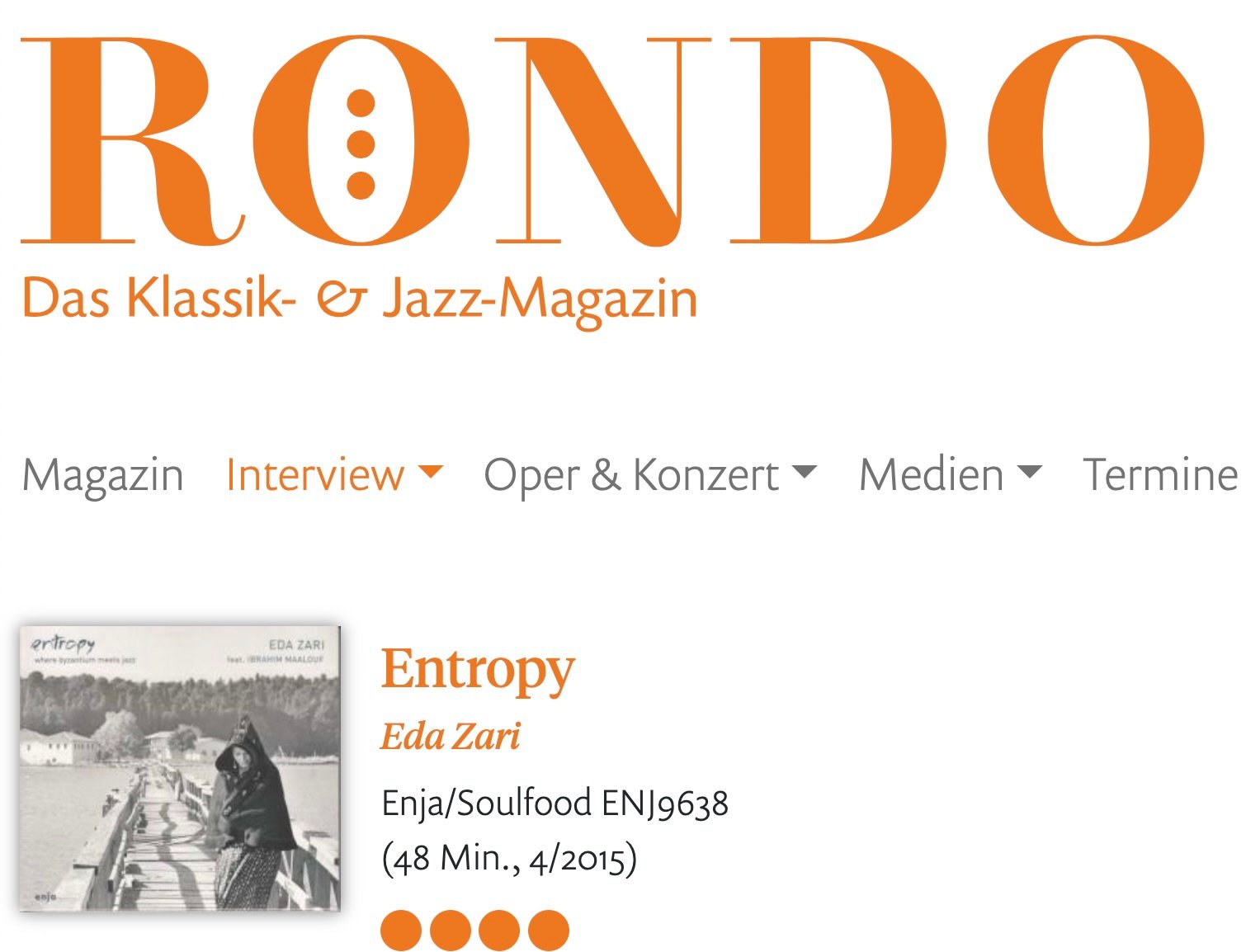
I would say Toka Incognita and Entropy, with their Byzantine troparia, demonstrate this.
A creator is often confronted with an abusive false dilemma:
Should one be an archaeologist of identity, buried in one’s roots, or a geologist searching for new layers?
That choice is false.
Roots are not a prison.
They are collective memory.
As Smetana might suggest through the river, the stream of tradition flows and creates new landscapes.
It absorbs the aesthetic demands of its era and preserves them in a new form.
The analogy also applies to jazz, which is hybrid by nature.
Jazz emerged from blues and from the rituals of enslaved people, but developed into a universal language of improvisation.
John Coltrane is a powerful example.
He did not abandon the blues.
He transformed it into a metaphysical argument about freedom and spirit.
Roots are grammatical structure.
He built new sentences, allowing the old voice to speak through a new form.
This is not conflict.
It is creative symbiosis.
When an artist understands both dimensions, that artist can create a work that is both unique and universal.
HEJZA: The voice is not merely a technical instrument. It is the most direct reflection of the inner world, a bridge between the spirit and the space surrounding us, an inner window through which a person moves toward the world and calls the world back inside. In this intimate and spiritual journey with your voice, what has been the most essential relationship you have built? Has this voice always been a loyal ally helping you express what is unspoken and unclear in the soul, or do you sometimes experience it as a difficult reflection, a challenge demanding confrontation and deep awareness? How do you understand the role of voice as a companion in your artistic and human journey?
EDA ZARI: Before I sing, my body becomes an entire instrument.
The breathing muscles, the diaphragm and the vocal folds prepare to release an inner wave.
It is a preparation, often unconscious, in which the physical body readies itself to become, to some degree, an abstract channel.
At the Cologne conservatory, my singing teacher Natalie U. Kock taught not only vocal technique and forms of canto but also the philosophical dimension of voice.
She referred to Plato.
He understood music and voice as means of educating the soul.
For him, the voice was a source that directly shaped human character, making a person more just or more corrupted.
In that sense, voice is an ethical and moral instrument.
For the same reason, I say that the voice is a microcosm of the soul.
For me it certainly serves as an ally through which to express the unspoken, transmit the challenges created by tradition, or make tradition itself into an intelligible melody.
If we observe signs and meanings, I would say the voices of artists such as Cesária Évora, Mercedes Sosa, Billie Holiday, Ella Fitzgerald, Montserrat Caballé, Amália Rodrigues, Renata Tebaldi, Mentor Xhemali or Myslym Lela are not simply emissions of sound.
They are “semiotic laboratories” where histories, identities and endless emotions intersect.
At a profound level these voices bear witness to a complex inheritance: a mosaic in which culture, pain and personal resistance melt together.
Another example is Rachmaninoff’s Vocalise, as interpreted with such genius by Anna Moffo.
Beyond being a musical work, Vocalise is a deep exploration of the role of voice in the absence of words.
The work challenges the premise of verbal communication and raises the voice to another level — silent sublimity.
Words, for me, often build a wall of meaning and place boundaries around emotion.
Vocalise, by contrast, is a “film made of sound”, in which narrative is created through the soft yet unyielding movement of the voice.
The absence of words is a genuine lesson.
It gives the voice an absolute freedom to become simply an instrument of feeling.
I emphasize this:
For me, the voice transforms “absence” into complete presence.
Moffo does not sing a story.
She constructs a space in which legato connects moments of sorrow and the fermata suspends time inside melancholy.
The voice becomes poetry without verse, narrative without characters — a direct reflection of the human condition.
But there are moments when the voice becomes a difficult reflection, a challenge that demands confrontation.
It appears as an alter ego — “another I”, a “second I” — exposing insecurities and forcing me to grow and learn from myself.
In this duality, the voice is both a close friend and a teacher with a switch in her hand.
The relationship with voice can be understood through two main dimensions:
the voice that sings — or sounds — and the voice that communicates through words.
Wittgenstein said that “the limits of my language mean the limits of my world.”
This implies that through words we construct and limit our reality.
A word can wound, not only because of its content, but through its colour, tone and intention.
A single word can ignite a fire of hatred or offer profound consolation.
When we see these two dimensions together, we realize that the voice is never merely a tool.
It is a deep reflection of existence.
Are we always aware of the power of our own voice, whether it sings or speaks?
Billie Holiday, for me, is testimony to alienation, a vocal document of pain and injustice.
Her voice was not technically perfect, but it was authentic to the bone.
In my view, she used her art as a kind of “counter-memory”, transforming the violent history of Black people in America into a universal language of compassion and dignity.
Her voice was a political act and, at the same time, a personal act saying:
“This is who I am. This is my history. And I will not be silent.”
With that aspiration, I want my own voice to keep searching and moving, to remain an “open text”, an ongoing opus in which every note and every word creates meaning.
At this point, together with two colleagues and friends, Elina Duni and Linda Rukaj, it seems to me that we occupy the same island.
What these creators do is build beyond the apparent simplicity of sound, constructing a complex architecture of feeling, sound, word and memory.
Is that not the essence of art?
To transform an inner condition into an intelligible form, even when it is profoundly personal?
HEJZA: Migration is not only movement through space, but a profound displacement of sensibility. Often those who leave — especially artists and creators — begin to seek a homeland not on the map but in feeling: in the language of the body, memory and art. In this double journey, physical and spiritual, has music become for you another kind of homeland, more stable than any geographic place? And if so, what language does this homeland living inside your voice speak? The language of memory, longing, resistance or transformation?
EDA ZARI: Migration...
Ah, migration is like pulling the scab from a wound and placing a new tattoo directly on the living flesh.
But this shows that migration is not disappearance.
It is transformation with inheritance.
You take the old initials — your identity and original homeland — and use them as the foundation for the new tattoo, your new identity.
Even if you believe you have erased the old traces by creating another image, the truth is that the essence of the past remains coded beneath the skin.
The new identity becomes a rebirth founded on memory rather than a total erasure.
A few days ago I was in Arles, in the south of France, where I visited the clinic in which Van Gogh was treated, today a cultural centre — an “Espace”.
I stood in the courtyard with its yellow walls and blue arches, a landscape that he himself painted, and it reminded me of his extraordinary irony and strength.
There I felt with particular force the weight of the question of migration, separation and displacement — and the need for spiritual and artistic rebirth.
That moment became an invitation to return to what is essential.
In Arles, Van Gogh did not merely work feverishly.
He arrived with a great dream: to create a colony of artists — a kind of spiritual and physical “Yellow House” for new art.
Despite his disturbed mental state, he had a clear vision and an intense desire to build an artistic centre in the South.
The Yellow House was point zero of that great dream.
This pushed me toward an analogy between him and myself: as an artist, as a woman and as a human being in a foreign country.
Migration as the search for an artistic “point zero”.
Just as Van Gogh left Paris for Arles in order to create a new environment for art — the Yellow House — I moved from Rruga e Kavajës, from Tirana, into a new living and artistic environment.
For me, arriving in a new country was a movement toward the point where I could shape the entire “film of my mind” and develop my artistic vision away from the restrictions and dictatorship of the previous environment.
Yet migration is not only a shift on the map.
It is an escape, a deep movement inside the soul, a search for a homeland that no war and no law can take away.
For me, music has not become “a kind of” second homeland.
It is the homeland.
It is that old, solid bed that I find wherever I go, on every stage and through every lonely night.
Everything else can collapse:
the structures of the outside world, human loyalty, particular places on the map.
But the voice — that is the one spiritual geography that remains intact.
It forms the immovable axis of my existence, the place where the spirit always finds its way toward wisdom, goodness, beauty and healing.
The homeland lives inside my voice, which speaks several languages at once, like a conversation with God late at night.
There is the language of memory.
It is the language of the smell of home that you never forget.
When I sing, I do not see only the stage.
I see old streets and faces I have lost.
Memory is not sentimentality.
It is the raw material from which I rebuild myself.
Then there is the language of longing — saudade.
Longing is the saddest melody and also the truest.
It is the voice of what you leave behind while knowing it will not return.
But do you know something?
Longing becomes resistance when you manage to transform wounds into art.
The most precious language, however, is transformation — metamorphosis.
That is even more important.
In my Tirana — Rruga e Kavajës, 21 Dhjetori — I was simply a little girl with dreams, my head full of “mind-films”.
But in the homeland of music I became who I am.
The language of my voice transforms the darkness of migration into a shimmering light I want to spread to everyone — and to myself.
That is the language of triumph:
the triumph won by a spirit when it had nothing but its voice.
And in the end, why would I need a geographic country when I have my voice?
It is my passport, my flag and the place where I always feel alive enough to give love — just as others may have found within themselves a homeland of thought, philosophy, film or business.
HEJZA: There is always an act of rebellion in art: against forgetting, against silence, against mediocrity. What has been your deepest rebellion in life and in art? And do those two rebellions ever happen at the same time?
EDA ZARI: I do not think what we rebel against matters as much as how that rebellion manifests itself as a message that serves society, the line of our lives and also our creative work.
For someone like me, immersed in music, culture and heritage, the deepest rebellion has never been charging at “the system” with a sword at my belt.
My rebellion has been against erasure, forgetting, the simplification of truth and the approval of what is easy.
It has been the desire to defend and raise again the profound value of heritage, art and music in places where others see only old fragments, silence or ruins.
That desire takes several forms.
Rebellion against intellectual mediocrity — a personal rebellion — is not an act of arrogance.
It is an obligation.
To create, think and inquire with complexity in an era enamoured of two-chord music, soundbites and easy repetition is an individual rebellion, a personal choice.
It is a refusal to accept that the world can be explained with two words, two tones and one form.
That is poverty.
Rebellion against forgetting — against amnesia — is not personal at all.
It is a demanding call directed at the dominant forces of our era.
I invite listeners, especially younger generations, to go deep: not only into music, but into the forgotten messages of the culture we have left behind.
At cultural, musicological and artistic conferences and at many international festivals, I have observed among French, British and American participants a need to be present with their tradition and their roots.
Not simply for the sake of cultural marketing.
It is an act of existential self-confirmation.
It is not merely concern for preserving tradition, but a way of constructing meaning in a fast, homogenizing world.
Ultimately, to be represented means consciously bringing yourself — your music and culture — to the table of global discussion and showing that your past has value for the future.
Entropy, for example, is my clear rebellion.
It refuses the idea that Byzantine music, with troparia translated by Fan Noli, is a dead relic.
On the contrary, it calls us to understand that this national treasure has not disappeared.
It remains present and coded within our spiritual and sonic language.
I need to return often to this heritage because there lies the weight and depth that fast culture lacks.
You ask whether rebellion or refusal in life and art happen simultaneously.
Yes.
They happen together — and they should.
Resistance is simultaneous because you cannot speak with depth in art if you have not lived with depth in rebellion.
My art becomes the voice of that which I refuse to allow to die.
And that rebellion, that essential voice, gives me presence and weight as a creator against the dissolving noise of a globalized culture.
That is the mission.
In the end, the greatest rebellion of a cultivated person is to continue asking difficult questions in a world that wants only immediate answers.
That is resistance worth making.
Someone may disagree, but complexity is the highest form of rebellion today.
HEJZA: Ultimately art no longer belongs to its creator. It becomes an entity moving freely among other souls, becoming echo, light and sensation in the world of others. When your voice reaches someone’s innermost feelings, when it brings tears of clarity, lights the flame of hope or transforms the silence of everyday life, how do you feel in that moment? Is that what it means truly to exist as an artist — to be a bridge between your inner world and a human infinity that transcends all form and time? Do you feel that in those moments art loses your ownership and becomes a free spirit living beyond every boundary, bringing light into the darkness of human experience?
EDA ZARI: When I feel that my voice has touched someone deeply, when it causes tears or awakens hope, I feel that the art has left my ownership.
At that moment I am no longer the creator.
I am only a witness to what is happening.
That is what it means truly to exist as an artist:
to be a bridge between your interior world and a human infinity.
In those moments art shows that it belongs to no one and to everyone.
When the voice strikes, breaks the silence and opens that hole — that tear of clarity in someone — then the work is done.
The song is theirs.
It is for them.
It is like breath, like a note held under tension and finally released.
It leaves and becomes an entity.
It becomes an echo inside the other person.
I am only the channel through which it was able to emerge.
When I see that it has touched the spirit, I feel only the absence it leaves behind.
And that is proof that something true has happened.
It has become pure art.
Why should the artist remain on stage after the final coda?
That is the reward.
What I feel is simple:
I have done my work.
Art is not about displaying oneself.
It is about stripping the soul bare and reminding the other person that they are not alone in this struggle.
At that moment every suffering, every battle, acquires meaning.
And that feeling...
that is worth more than every applause in the world.
My voice is my pact with life.
Arles, September 2025
Postscript
To transform this interview into a genuine bridge for readers, I would be delighted if readers were clearly directed toward my creative work through links to my YouTube channel, Eda Zari, my social networks, the digital distribution platforms for my music and my website, www.eda-zari.com.
There you can find my projects, albums, initiatives, articles, photographs and my blog with writing about culture and projects.
I am pleased to invite readers to follow my podcast Muzika Kultura dhe Kujtesa — Music, Culture and Memory — on Spotify and YouTube.
It would be wonderful for readers to be directed especially toward the episode on ten film-music soundtracks, which uniquely analyses Hollywood music alongside music by Albanian composers.
For those who love the tactile experience of music, I invite you to follow the journey of Palimpsest, the first and only Albanian album issued as a double vinyl LP, in ocean colour, 180 g, as a limited edition.
I would also like to inform readers about my engagement as a cultural advocate.
I have the honour of introducing the work of the KULT 360 Foundation, which we recently established.
Our work is dedicated to intangible cultural heritage.
We focus on Albanian artists and the diaspora, placing them in intercultural dialogue and advancing the right of every individual and community to be an interactive part of Albanian culture.
I often ask myself:
What is the real function of art in a society aspiring toward democracy?
Our work — that of my colleagues, my own work and the work of the communities with whom we collaborate — seeks to break what has become a quick dogma of modernity: the separation of art from social responsibility.
We seek to manifest an image of Albania in which culture functions as living evidence of democratic maturity.
That happens when art helps art, artists, people and, most importantly, forgotten communities.
Every society, after all, is measured by how it treats its margins.
That is a conscious demand of citizenship.
When we communicate the history of the country — its rivers, fields and mountains — through song, festivals, ballet, books and traditions, we are not simply practising cultural tourism.
We are showing our existential potential:
our capacity to celebrate life.
We take heritage, that old material, and dress it in our rhythm, giving it meaning and resonance in this chaotic and noisy world.
That is our practical answer to the question:
“How can we live, here and now, consciously and with dignity?”
And the answer is that we do so by making culture free, inclusive and an active force in favour of justice.
This interview was published in HEJZA magazine on 31 October 2025.
CONTINUE READING →