The Eda Zari Phenomenon: Beyond the ‘Unknown Land’, Toward the Muse! By Dr Përparim Kabo
Dr Përparim Kabo’s lyrical essay on Toka Incognita, reading Eda Zari’s music through myth, memory, Albanian oral culture, iso-polyphony, jazz, blues and the primordial idea of the Muse.
Is moving toward the unknown a journey, or something else — a metamorphosis that gives form to your spiritual double?
What compass do you need?
What is the polar star that guides you?
What song must accompany you?
What lies within the mystery you are seeking to encounter?
Anxiety, sadness, curiosity, forgotten feelings — or hope of rebirth?
Is it simply the land where people were born, lived, experienced love and eventually died?
Can it really be that simple?
Toka Incognita is an artistic surprise.
It is music that carries you far away, takes you into its own air and gives you breath, setting you in motion on a cosmogonic scale.
All four dimensions are there.
There is the sky; there is the human aura with all its anxieties, prayers and dream-bearing intimations; there are nightmares and joys.
Because we hear: “Fly, girl, fly — and the moon stands watching.”
The whole image feels like a modernist painting.
There is also the underworld as a cosmogonic dimension, appearing as submerged space: there at the lake, where Charon’s boat waits on the shore to carry you toward the world of spirits, and everything becomes a wave of foam — as in that ancient moment when, from the violent severing wrought by Cronus’ sickle upon his father Uranus, Aphrodite was born: mythical beauty and feminine love.
Human happiness was created — and at its foundation, happiness is feminine.
How unfortunate for those who have still not understood this.
They are the unlucky ones who perhaps have never been, and perhaps never will be able to go, to Toka Incognita.
The fourth dimension is the soul-song of Eda Zari, the Albanian singer who, through her art, has led us toward the Muse.
Zeus, the sun-god, possessed an abundance of erotic energy.
He tried to give this fire as warmth, as a lava of rapture, for above all he tested love in the realm of the temporary — among mortals.
That is how Hera — the only woman, so to speak, with official “papers” beside the supreme god — answered when the jealous women of Olympus asked:
“What does Zeus like when he betrays you with mortal women?”
“The temporary,” was her answer.
It is simple and complex at the same time.
Its complexity comes from the fact that we are all temporary, and so sin belongs with us too — not to humiliate us, but to tempt us toward truth.
Zeus knew whom to fertilize.
In a celestial orgasm, he impregnated Memory.
Reason became paired with that which must never be lost because it is an archive of feelings, experiences and chosen words: Mnemosyne, goddess of memory.
What was born from this union as inspiration — the Muses — were daughters.
They were feminine.
So from the beginning, from the genesis itself, the energy of transformation through creation, joy and the unknown, the final secret, irony and tragedy, elegy and sung dance, the sky and eloquence — all were feminine.
Through this feminine birth, happiness at its core becomes feminine.
The feminine Muse — woman as Muse.
From her arose the human test and the human challenge.
First among the daughters comes music — Euterpe — she who delighted everything that followed, for the daughters were not twins.
The fifth daughter was Terpsichore, lyrical poetry with dance, something so deeply present in Albanian anthropology from its imagined Pelasgian genesis onward.
Oral peoples such as ours have archived almost everything in epic or erotic song, and in dance — which is also an exhibition of dress and ritual, carrying all the joys and trappings of a spectacle that shines with a multiplicity of colours and emotional reliefs, from the simplest to the strangest, and that leads you with extraordinary openness toward the threshold of mystery.
One must dive deeply into folk song — pastoral or urban — as if into underground waters, to understand how profound something can be that, on the surface, seems so simple, naïve and direct.
The “Unknown Land” is not an untouched place waiting for a curious or adventurous traveller.
It is something more.
It is a surreal journey into the world of spirits.
A flight into those galaxies of the human inner universe where there exists one treasure that a person neither gives away, sells nor lends.
One can only give it.
It is love.
It is the most difficult journey.
It may knock you down, but you must rise.
It may exhaust you, but you must not stop.
It may lead you onto dangerous paths, but you must not be afraid.
It may confuse you with Circe’s drink; but you, human-being-on-the-road, whose mission is to return to Ithaca — to the heart — must continue.
You are alone and have no Mentor beside you.
There is only the self-offering love that suffers within you.
That soul-Muse does not want to die without giving birth.
Unborn loves are more tragic victims than Agamemnon’s Iphigenia, and lost battles — like a kiss that never happens — can be more tragic and painful than fallen Troy.
Our people did not possess freedom, because war was always so close that eventually it became a profession of life and death.
They did not possess wealth or glitter, but they possessed spirit and learned to sing of love even within the timidity of an almost provincial enclosure.
Toka Incognita sings to that spirituality, which does not dissolve in any of its motives or whims.
Its saving purpose is to help us leave behind that which frightens us, prevents expression, makes us ashamed.
This veil had to be torn away, because more than a black cloth or a membrane of belief, it had become an undeserved form of self-shaming.
The song lived inside the flesh.
It had to be sung outside the flesh as well by these modest people under a sky of inspiration that at times had been a closed horizon in an age of darkness.
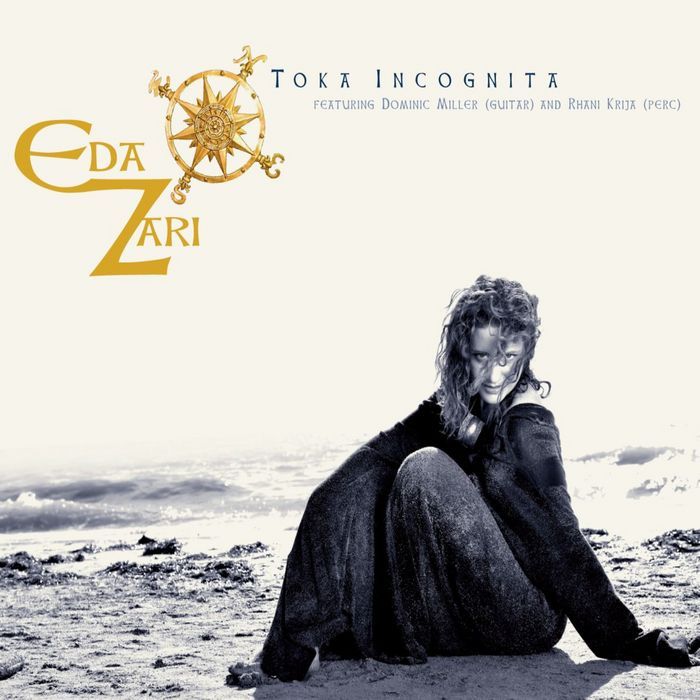
I listen and listen again to Eda Zari’s latest album, Toka Incognita.
Music — art that never reveals the final secret not because it hides it, but because the secret is infinite — led me, through this unresolved sign waiting to be deciphered, to an existential ground: to the place where our genesis first cried out.
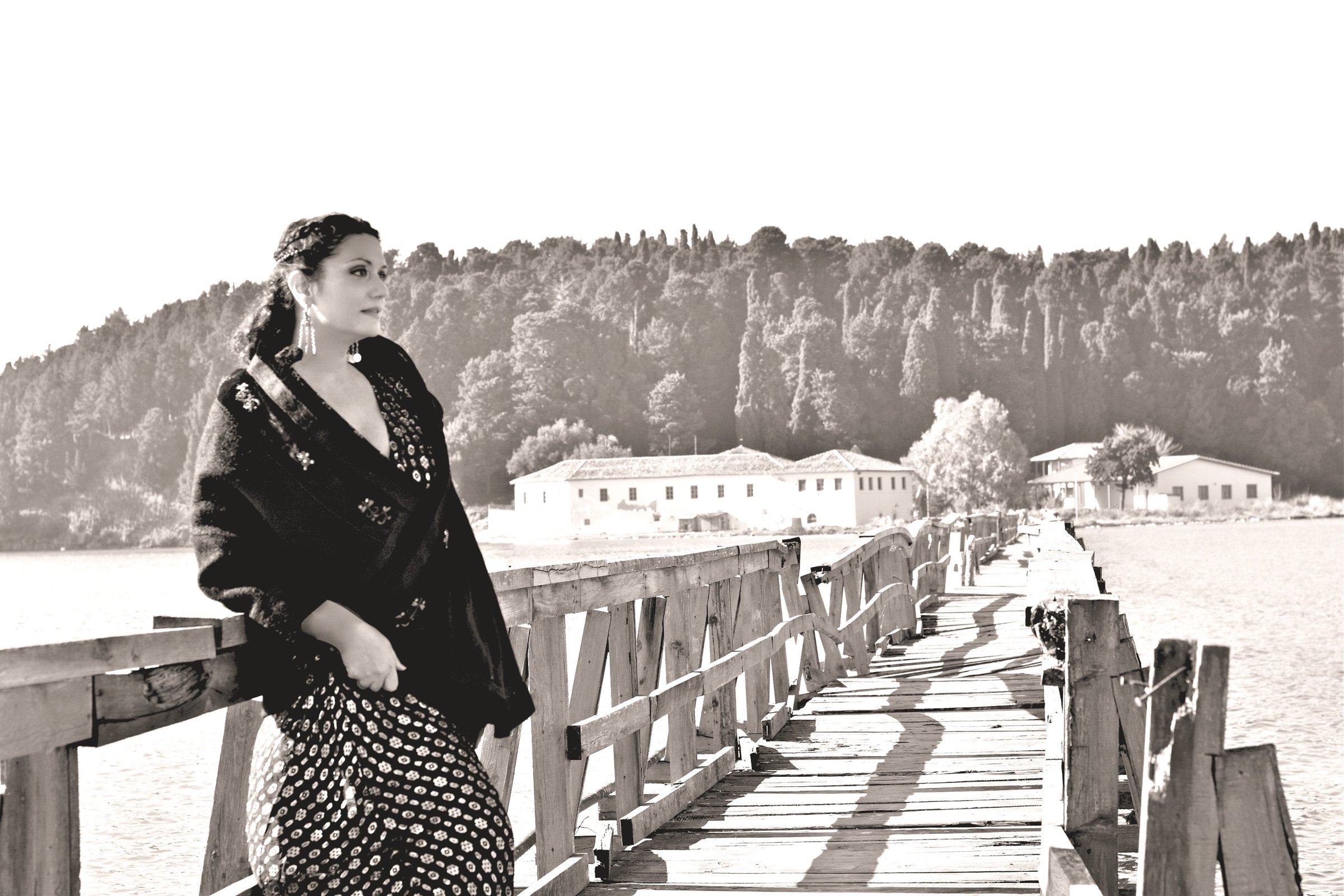
And the daughter of Dodona, Eda Zari, sings barefoot.
She communicates with the underworld and the sky in a spiritual geometry.
In the amphitheatre, people — by the grace of Proteus, god of metamorphosis — from the race of Achilles, son of Thetis, become the boys and girls of today, playing beneath existential sounds.
They acquire identity.
They are Albanian.
The “unknown” in the songs on this album, which also appears as the “hidden”, is the magic of a special journey made possible by art.
The “Zarian mission” is exceedingly delicate.
It is to find a new shell for the pearls of Albanian folk music — not simply a modern shell that can dazzle through the insincerity that seems attractive when one is intoxicated.
It is something beyond modernity.
With Albanian pearls in hand, Eda Zari invites other musical idioms — blues and jazz — on an almost apocalyptic journey.
She asks them to travel together back to the swaddling-cloth of origins, to the shelter where music was Muse, because it belongs to that people, that identity, that way of singing which even today can say, freely, “you’re with the Muse today” — an expression not used in the same way by other Balkan peoples.
Eda Zari’s voice, and everything that surrounds, accompanies and inspires it on such a journey, feels like a river of joy springing from the canyons of the south.
It has been released from underground by a chorus of beautiful girls bathing naked in those waters, because in that world there are no taboos.
Their grace remains in the river for all time.
The river then travels through forests, valleys and paths, absorbing during this mischievous wandering all the music offered by that inner journey.
Eventually it emerges into the broad plain, where all the “naïve heads” of sunflowers turn in love and silence toward the light arriving from this singing river.
The current pushes onward and reaches the open sea, where the horizon escapes into an almost mad freedom, moving toward the mirage.
The waters cross straits and open into an almost magical embrace with the oceans, where depth becomes the trial and being at the centre of the ocean becomes the test of fate.
There all continents, peoples and ethnicities meet.
The fair of spiritual rhythm creates a fusion between Albanian iso-polyphony and African rhythms from the Mediterranean shore, the meditative blues of the Pacific and jazz — music carrying the weight of pain while singing the song of destiny in sounds that move like blood of love through the capillaries.
The masters are present on the days of narration, and time no longer has arithmetic numbers.
These fusions emerge because the weight of responsibility exceeds art itself.
It is a “pilgrimage to discover the secret of the Muse”.
The shepherdess of this musical macro-soul is Eda Zari.
Then everything takes another direction.
Eda Zari guides them toward a temple as old as existence.
Come and taste an originating song — from the time when Muse and song were one and the same.
Come, because like the language of this people — this “living fossil” — its song too is primordial.
What unites us is the breadth of spirit, patience in the survival of pain.
What draws us together are feelings, the murmurs of the soul that become symbiotic in the deepest paths of the human body, and the capacity to feel profoundly in places not everyone can reach.
We will be able to see into those waters because the ocean has no walls.
This is the “First Primordial Secret” that the Eda Zari phenomenon has not merely discovered but generated — since that creative dawn when she kissed our iso-polyphony with jazz, a kiss sealed like a besa into a love from which there is no return.
As Honoré de Balzac said, the fate of love depends on the first kiss.
In Eda Zari’s art, that first kiss has happened.
This is not simply innovation of the sort that, through experimentation and technology, fills today’s market and captures our attention briefly because curiosity drives human beings toward more knowledge.
It is more than that.
Eda Zari has joined underground waters and brought the universe back to a time when it was a child and everything was magma of inspiration, not yet divided.
That was before the journey inspired by the destinies of peoples had begun, before unique cultures embroidered themselves with the threads of identity.
This discovery does not hand you its secret as a gift.
You must test yourself through challenges, needs, perceptive abilities and the rich nourishment of musical culture.
As a democratic art, her song enters the soul of every listener, because Eda Zari knows the path there and walks it like a joyful sleepwalker.
If you attempt to criticize her art, you must measure both the weakness and strength of your reason, culture and civility, because the task is not simple.
Before you stands a musical phenomenon, not merely a singer.
© 2012 Dr Përparim Kabo. All rights reserved.
CONTINUE READING →